
UNITED
STATES
SECURITIES
AND EXCHANGE COMMISSION
Washington,
D.C. 20549
FORM
10-K
ANNUAL
REPORT PURSUANT TO SECTION 13 OR 15(d) OF
THE
SECURITIES EXCHANGE ACT OF 1934
For
the fiscal year ended December 31, 2009
Commission
file number 0-24531
|
CoStar
Group, Inc.
|
|
(Exact
name of registrant as specified in its
charter)
|
|
Delaware
|
52-2091509
|
|
|
(State
or other jurisdiction of incorporation or organization)
|
(I.R.S.
Employer Identification No.)
|
|
2
Bethesda Metro Center, 10th Floor, Bethesda,
Maryland 20814
|
|
(Address
of principal executive offices) (zip code)
|
|
(301)
215-8300
|
|
Registrant’s
telephone number, including area
code
|
Securities
registered pursuant to Section 12(b) of the Act:
|
Title of Each Class
|
Name of Each Exchange on Which
Registered
|
|
Common
Stock, $.01 par value
|
NASDAQ
Global Select Market
|
Securities
registered pursuant to Section 12(g) of the Act:
None
Indicate
by check mark if the registrant is a well-known seasoned issuer, as defined in
Rule 405 of the Securities Act. Yes o No x
Indicate
by check mark if the registrant is not required to file reports pursuant to
Section 13 or Section 15(d) of the Exchange Act. Yes o No
x
Indicate
by check mark whether the registrant: (1) has filed all reports required to be
filed by Section 13 or 15(d) of the Securities Exchange Act of 1934 during the
preceding 12 months (or for such shorter period that the registrant was required
to file such reports), and (2) has been subject to such filing requirements of
the past 90 days. Yes x No
o
Indicate
by check mark whether the registrant has submitted electronically and posted on
its corporate Web site, if any, every Interactive Data File required to be
submitted and posted pursuant to Rule 405 of Regulation S-T (§232.405 of this
chapter) during the preceding 12 months (or for such shorter period that
registrant was required to submit and post such files.) Yes o No
o
Indicate
by check mark if disclosure of delinquent filers pursuant to Item 405 of
Regulation S-K is not contained herein, and will not be contained, to the best
of registrant’s knowledge, in definitive proxy or information statements
incorporated by reference in Part III of this Form 10-K or any amendment to this
Form 10-K. o
Indicate
by check mark whether the registrant is a large accelerated filer, an
accelerated filer, a non-accelerated filer, or a smaller reporting
company. See the definitions of “large accelerated filer,”
“accelerated filer” and “smaller reporting company” in Rule 12b-2 of the
Securities Exchange Act of 1934.
|
Large
accelerated filer o
|
Accelerated
filer x
|
|
Non-accelerated
filer o
|
Smaller
reporting company o
|
Indicate
by check mark whether the registrant is a shell company (as defined in Rule
12b-2 of the Exchange Act). Yes o No x
Based on
the closing price of the common stock on June 30, 2009 on the Nasdaq Stock
Market, Nasdaq Global Select Market, the aggregate market value of registrant’s
common stock held by non-affiliates of the registrant was approximately $641
million.
As of
February 19, 2010, there were 20,581,462 shares of the registrant’s common stock
outstanding.
DOCUMENTS
INCORPORATED BY REFERENCE
Portions
of the registrant’s definitive proxy statement, which is expected to be filed
with the Securities and Exchange Commission within 120 days after the end of the
registrant’s fiscal year ended December 31, 2009, are incorporated by reference
into Part III of this Report.
TABLE
OF CONTENTS
|
PART
I
|
||
|
Item
1.
|
3
|
|
|
Item
1A.
|
15
|
|
|
Item
1B.
|
21
|
|
|
Item
2.
|
21
|
|
|
Item
3.
|
22
|
|
|
Item
4.
|
22
|
|
|
PART
II
|
||
|
Item
5.
|
23
|
|
|
Item
6.
|
26
|
|
|
Item
7.
|
27
|
|
|
Item
7A.
|
41
|
|
|
Item
8.
|
42
|
|
|
Item
9.
|
42
|
|
|
Item
9A.
|
42
|
|
|
Item
9B.
|
43
|
|
|
PART
III
|
||
|
Item
10.
|
44
|
|
|
Item
11.
|
44
|
|
|
Item
12.
|
44
|
|
|
Item
13.
|
44
|
|
|
Item
14.
|
44
|
|
|
PART
IV
|
||
|
Item
15.
|
44
|
|
|
46
|
||
|
47
|
||
|
F-1
|
2
PART
I
|
Item
1.
|
(In this
report, the words “we,” “our,” “us,” “CoStar” or the “Company” refer to CoStar
Group, Inc. and its direct and indirect subsidiaries. This report also refers to
our websites, but information contained on those sites is not part of this
report).
CoStar
Group, Inc., a Delaware corporation, is the number one provider of information,
marketing and analytic services to the commercial real estate
industry in the United States (“U.S.”) and United Kingdom (“U.K.”) based on the
fact that we offer the most comprehensive commercial real estate database
available, have the largest research department in the industry, provide more
information, marketing and analytic services than any of our competitors and
believe we generate more revenues than any of our competitors. CoStar’s
integrated suite of services offers customers online access to the most
comprehensive database of commercial real estate information, which has been
researched and verified by our team of researchers, currently covering the U.S.,
as well as London and other parts of the U.K. and parts of France. Prior to
2007, CoStar operated within one segment. Due to the increased size, complexity
and funding requirements associated with our international expansion, in 2007 we
began to manage our business geographically in two operating segments, with our
primary areas of measurement and decision-making being the U.S. and
International, which includes the U.K. and France.
Since our
founding in 1987, CoStar’s strategy has been to provide commercial real estate
professionals with critical knowledge to explore and complete transactions, by
offering the most comprehensive, timely and standardized information on U.S.
commercial real estate. As a result of our January 2003 acquisition of Focus
Information Limited (now, CoStar U.K. Limited), June 2004 acquisition of
Scottish Property Network, December 2006 acquisition of Grecam S.A.S., February
2007 acquisition of Property Investment Exchange Limited, and July 2009
acquisition of Property and Portfolio Research, Inc. (“PPR”) and its wholly
owned U.K. subsidiary, Property and Portfolio Research Ltd. (“PPR UK”) we have
extended our offering of comprehensive commercial real estate information to
include London and other parts of the U.K. and parts of
France. Information about CoStar’s revenues from, and long-lived
assets located in, foreign countries is included in Notes 2 and 12 to our
consolidated financial statements. CoStar’s revenues, net income, assets and
liabilities, broken out by segment are set forth in Note 12 to our consolidated
financial statements. Information about risks attendant to our
foreign operations is included in “Item 7A. Quantitative and Qualitative
Disclosures about Market Risk.”
We
deliver our content to our U.S. customers primarily via an integrated suite of
online service offerings that includes information about space available for
lease, comparable sales information, tenant information, information about
properties for sale, internet marketing services, property information for
clients’ websites, information about industry professionals and their business
relationships, analytic information, data integration, and industry
news. We also provide market research and analysis for commercial
real estate investors and lenders via our PPR service offerings. We have created
and are continually improving a standardized information platform where the
commercial real estate industry and related businesses can continuously interact
and easily facilitate transactions due to the efficient exchange of accurate
information we have supplied.
We have a
number of assets that provide a unique foundation for our standardized platform,
including the most comprehensive proprietary database in the industry; the
largest research department in the industry; proprietary data collection,
information management and quality control systems; a large in-house product
development team; a broad suite of web-based information, marketing and analytic
services; a large team of analysts and economists and a large base of clients.
Our database has been developed and enhanced for more than 22 years by a
research department that makes thousands of daily database updates. In addition
to our internal efforts to grow the database, we have obtained and assimilated
over 51 proprietary databases.
We intend
to continue to grow our standardized platform of commercial real estate
information, marketing and analytic services. In 2004, we began
research for a 21-market U.S. expansion effort. By the end of the
first quarter of 2006, we had successfully launched service in each of those 21
markets. In addition, following our acquisition of National Research
Bureau in January 2005, we launched various research initiatives as part of our
expansion into real estate information for retail properties. We
launched the new retail component of our flagship product, CoStar Property
Professional, in May 2006. In July 2006, we announced our intention to commence
actively researching
3
commercial
properties in approximately 81 new Core Based Statistical Areas (“CBSAs”) across
the U.S. in an effort to expand the geographical coverage of our service
offerings, including our new retail service. In the fourth quarter of 2007, we
released our CoStar Property Professional service in the 81 new CBSAs across the
U.S. In 2008, we released CoStar Showcase, an internet marketing service that
provides commercial real estate professionals the opportunity to make their
listings accessible to all visitors to our public website,
www.CoStar.com.
During
the second half of 2009, as part of our strategy for providing subscribers with
tools for conducting primary research and analysis on commercial real estate, we
expanded subscribers’ capabilities to use our database of research-verified
commercial property information to conduct in-depth analysis and generate online
reports of trends in sales and leasing activity. Furthermore, in July
2009, we added analytic and market forecasting services to our platform of
research and marketing services with our acquisition of PPR and in October 2009
we acquired Resolve Technology, Inc., (“Resolve Technology”) adding business
intelligence and portfolio management software used by institutional real estate
investment companies.
We also
intend to continue to grow and expand the coverage of our service offerings
within our International segment. In December 2006, our U.K.
subsidiary, CoStar Limited, acquired Grecam S.A.S., a provider of commercial
property information and market-level surveys, studies and consulting services,
located in Paris, France. In February 2007, CoStar Limited also
acquired Property Investment Exchange Limited, a provider of commercial property
information and operator of an online investment property exchange located in
London, England. Our July 2009 acquisition of PPR and PPR UK also
expanded the market research capabilities of our U.K.
operations. CoStar intends to integrate its U.K. and French
operations more fully with its U.S. operations and eventually to introduce a
consistent international platform of service offerings. Further
information about CoStar’s acquisitions is included in Note 3 to our
consolidated financial statements.
We intend
to introduce a consistent worldwide platform of service
offerings. Following our acquisitions of PPR and Resolve Technology
in 2009, we began integrating their respective product and service offerings
with our own, including the services we have successfully integrated following
our prior acquisitions. In 2007, we introduced the “CoStar Group” as
the brand encompassing our worldwide operations. We believe that our
recent U.S. and International expansion and integration efforts have created a
platform for long-term growth.
Our
subscription-based information services, consisting primarily of CoStar Property
Professional, CoStar Tenant, CoStar COMPS Professional and FOCUS services,
currently generate more than 95% of our total revenues. Our contracts for our
subscription-based information services typically have a minimum term of one
year and renew automatically. Upon renewal, subscription contract rates may
increase in accordance with contract provisions or as a result of contract
renegotiations. To encourage clients to use our services regularly, we generally
charge a fixed monthly amount for our subscription-based services rather than
fees based on actual system usage. Contract rates are based on the number of
sites, number of users, organization size, the client’s business focus,
geography and the number of services to which a client subscribes. Our
subscription clients generally pay contract fees on a monthly basis, but in some
cases may pay us on a quarterly or annual basis.
Industry
Overview
The
market for commercial real estate information and analysis is vast
based on the variety, volume and value of transactions related to commercial
real estate. Each transaction has multiple participants and multiple information
requirements, and in order to facilitate transactions, industry participants
must have extensive, accurate and current information and analysis. Members of
the commercial real estate and related business community require daily access
to current data such as space availability, properties for sale, rental rates,
vacancy rates, tenant movements, sales comparables, supply, new construction,
absorption rates and other important market developments to carry out their
businesses effectively. Market research (including historical and forecast
conditions) and applied analytics have also become instrumental to the success
of commercial real estate industry participants operating in the current
economic environment. There is a strong need for an efficient marketplace, where
commercial real estate professionals can exchange information, evaluate
opportunities using standardized data and interpretive analyses, and interact
with each other on a continuous basis.
4
A large
number of parties involved in the commercial real estate and related business
community make use of the services we provide in order to obtain information
they need to conduct their businesses, including:
|
|
•
|
Sales
and leasing brokers
|
•
|
Government
agencies
|
|
|
•
|
Property
owners
|
•
|
Mortgage-backed
security issuers
|
|
|
•
|
Property
managers
|
•
|
Appraisers
|
|
|
•
|
Design
and construction professionals
|
•
|
Pension
fund managers
|
|
|
•
|
Real
estate developers
|
•
|
Reporters
|
|
|
•
|
Real
estate investment trust managers
|
•
|
Tenant
vendors
|
|
|
•
|
Investment
bankers
|
•
|
Building
services vendors
|
|
|
•
|
Commercial
bankers
|
•
|
Communications
providers
|
|
|
•
|
Mortgage
bankers
|
•
|
Insurance
companies’ managers
|
|
|
•
|
Mortgage
brokers
|
•
|
Institutional
advisors
|
|
|
•
|
Retailers
|
•
|
Investors
and asset managers
|
The
commercial real estate and related business community generally has operated in
an inefficient marketplace because of the fragmented approach to gathering and
exchanging information within the marketplace. Various organizations, including
hundreds of brokerage firms, directory publishers and local research companies,
collect data on specific markets and develop software to analyze the information
they have independently gathered. This highly fragmented methodology has
resulted in duplication of effort in the collection and analysis of information,
excessive internal cost and the creation of non-standardized data containing
varying degrees of accuracy and comprehensiveness, resulting in a formidable
information gap.
The
creation of a standardized information platform for commercial real estate
requires an infrastructure including a standardized database, accurate and
comprehensive research capabilities, experienced analysts, easy to use
technology and intensive participant interaction. By combining its extensive
database, over 975 researchers and outside contractors, experienced team of
analysts and economists, technological expertise and broad customer base, we
believe that we have created such a platform.
The U.S.
and global economies have changed adversely over the past year or more, and the
commercial real estate industry has been negatively impacted. The
commercial real estate market has seen a reduction in property sales and leasing
activity, lower absorption rates, climbing vacancy rates and decreases in rental
rates and sales prices. The full extent of the impact of our current
financial crisis is not yet clear. As our customers continue to look
for ways to reduce spending, we may continue to see reduced demand for our
information, marketing and analytic services. However, we believe
that even in a weakened economy there is a continuing need for accurate,
standardized commercial real estate information, marketing and analytic
services. We believe that access to continuously researched and
verified commercial real estate information becomes even more valuable in a down
market, as industry players assess where market conditions are heading, how
their businesses should adapt, determine what properties are worth, and try to
market their properties, among other things. Moreover, outsourcing
the labor-intensive task of conducting basic real estate research may result in
cost savings for our clients.
CoStar’s Comprehensive
Database
CoStar
has spent more than 22 years building and acquiring a database of commercial
real estate information, which includes information on leasing, sales,
comparable sales, tenants, and demand statistics, as well as digital
images.
As of
January 29, 2010, our database of real estate information covered the U.S., as
well as London, England and other parts of the U.K. and parts of France, and
contained:
|
|
•
|
More
than 1.4 million sale and lease
listings;
|
|
|
•
|
Approximately
3.7 million total properties;
|
|
|
•
|
Approximately
10.5 billion square feet of sale and lease
listings;
|
|
|
•
|
Approximately
7.2 million tenants;
|
|
|
•
|
Approximately
1.6 million sales transactions valued in the aggregate at approximately
$3.4 trillion; and
|
|
|
•
|
More
than 9.5 million digital attachments, including building photographs,
aerial photographs, plat maps and floor
plans.
|
5
This
highly complex database is comprised of hundreds of data fields, tracking such
categories as:
|
|
•
|
Location
|
•
|
Mortgage
and deed information
|
|
|
•
|
Site
and zoning information
|
•
|
For-sale
information
|
|
|
•
|
Building
characteristics
|
•
|
Income
and expense histories
|
|
|
•
|
Space
availability
|
•
|
Tenant
names
|
|
|
•
|
Tax
assessments
|
•
|
Lease
expirations
|
|
|
•
|
Ownership
|
•
|
Contact
information
|
|
|
•
|
Sales
and lease comparables
|
•
|
Historical
trends
|
|
|
•
|
Space
requirements
|
•
|
Demographic
information
|
|
|
•
|
Number
of retail stores
|
•
|
Retail
sales per square foot
|
CoStar
Research
We have
developed a sophisticated data collection organization utilizing a multi-faceted
research process. In 2009, our full time researchers and contractors drove
millions of miles, conducted hundreds of thousands of on-site building
inspections, and conducted millions of interviews of brokers, owners and
tenants.
Research Department. As of
January 29, 2010, we have approximately 975 commercial real estate research
professionals and outside contractors performing research. Our
research professionals undergo an extensive training program so that we can
maintain consistent research methods and processes throughout our research
department. Our researchers collect and analyze commercial real estate
information through millions of phone calls, e-mails, internet updates and faxes
each year, in addition to field inspections, public records review, news
monitoring and direct mail. Each researcher is responsible for maintaining the
accuracy and reliability of database information. As part of their update
process, researchers develop cooperative relationships with industry
professionals that allow them to gather useful information. Because of the
importance commercial real estate professionals place on our data and our
prominent position in the industry, many of these professionals routinely take
the initiative and proactively report available space and transactions to our
researchers.
CoStar
has an extensive field research effort that includes physical inspection of
properties in order to research new markets, find additional inventory,
photograph properties and verify existing information.
CoStar
utilizes 146 high-tech field research vehicles in 39 states and the U.K. Of
these vehicles, 99 are custom-designed energy efficient hybrid cars that are
equipped with computers, proprietary Global Positioning System tracking
software, high resolution digital cameras and handheld laser instruments to help
precisely measure buildings, geo-code them and position them on digital
maps. Some of our researchers also use custom-designed trucks with
the same equipment as well as pneumatic masts that extend up to an elevation of
twenty-five feet to allow for unobstructed building photographs from “birds-eye”
views. Each CoStar vehicle uses wireless technology to track and
transmit field data. A typical site inspection consists of photographing the
building, measuring the building, geo-coding the building, capturing “For Sale”
or “For Lease” sign information, counting parking spaces, assessing property
condition and construction, and gathering tenant information. Certain
researchers canvass properties, interviewing tenants suite by suite. In
addition, many of our field researchers are photographers who take photographs
of commercial real estate properties to add to CoStar’s database of digital
images.
Data and Image Providers. We
license a small portion of our data and images from public record providers and
third party data sources. Licensing agreements with these entities provide for
our use of a variety of commercial real estate information, including property
ownership, tenant information, demographic information, maps and aerial
photographs, all of which enhance various CoStar services. These license
agreements generally grant us a non-exclusive license to use the data and images
in the creation and supplementation of our information, marketing and analytic
services and include what we believe are standard terms, such as a contract term
ranging from one to five years, automatic renewal of the contract and fixed
periodic license fees or a combination of fixed periodic license fees plus
additional fees based upon our usage.
6
Management and Quality Control
Systems. Our research processes include automated and non-automated
controls to ensure the integrity of the data collection process. A large number
of automated data quality tests check for potential errors, including occupancy
date conflicts, available square footage greater than building area, typical
floor space greater than land area and expired leases. We also monitor changes
to critical fields of information to ensure all information is kept in
compliance with our standard definitions and methodology. Our non-automated
quality control procedures include:
|
·
|
calling
our information sources on recently updated properties to re-verify
information;
|
|
·
|
performing
periodic research audits and field checks to determine if we correctly
canvassed buildings;
|
|
·
|
providing
training and retraining to our research professionals to ensure accurate
data compilation; and
|
|
·
|
compiling
measurable performance metrics for research teams and managers for
feedback on data quality.
|
Finally,
one of the most important and effective quality control measures we rely on is
feedback provided by the commercial real estate professionals using our data
every day.
Proprietary
Technology
As of
January 29, 2010, CoStar had a staff of 122 product development, database and
network professionals. CoStar’s information technology professionals
focus on developing new services for our customers and delivering research
automation tools that improve the quality of our data and increase the
efficiency of our research analysts.
Our
information technology team is responsible for developing and maintaining CoStar
products, including CoStar Property Professional, CoStar COMPS, CoStar Tenant,
CoStar Showcase, CoStar Commercial MLS, CoStar Connect, FOCUS, SPN,
Shopproperty, PPR products and services, Resolve Portfolio Maximizer and
Request. In 2007, to better support our retail customers, we added
significant features to CoStar Property Professional including tenant proximity
and demographic search capability, mapping layers, detailed retail tenant
information and demographics. In 2008, CoStar released CoStar
Showcase, an internet marketing service that provides commercial real estate
professionals the opportunity to make their listings accessible to all visitors
to our public website, www.CoStar.com.
Our
information technology team is responsible for developing the infrastructure
necessary to support CoStar’s business processes, our comprehensive database of
commercial real estate information, marketing and analytic services and our
extensive image library. The team implements technologies and systems that
introduce efficient workflows and controls that increase the production capacity
of our research teams and improve the quality of our data. Over the
years, the team has developed data collection and quality control mechanisms
that we believe are unique to the commercial real estate industry. The team
continues to develop and modify our enterprise information management system
that integrates CoStar sales, research, field research, customer support and
accounting information. We use this system to maintain our commercial
real estate research information, manage contacts with the commercial real
estate community, provide research workflow automation and conduct daily
automated quality assurance checks. In addition, our information technology team
has also developed fraud-detection technology to detect and prevent unauthorized
access to our services.
Our
information technology professionals also maintain the servers and network
components necessary to support CoStar services and research
systems. Our encrypted virtual private network provides remote
researchers and salespeople secure access to CoStar applications and network
resources. CoStar maintains a comprehensive data protection policy that provides
for use of encrypted data fields and off-site storage of all system backups,
among other protective measures. CoStar’s services are continually
monitored in an effort to ensure our customers fast and reliable
access.
Services
Our suite
of information, marketing and analytic services is branded and marketed to our
customers. Our services are derived from a database of building-specific
information and offer customers specialized tools for accessing, analyzing and
using our information. Over time, we expect to enhance our existing information,
marketing and analytic services and develop additional services that make use of
our comprehensive database to meet the needs of our existing customers as well
as potential new categories of customers.
7
Our
various information, marketing and analytic services are described in detail in
the following paragraphs as of January 29, 2010:
CoStar Property
Professional® CoStar
Property Professional, or “CoStar Property,” is the Company’s flagship service.
It provides subscribers a comprehensive inventory of office, industrial, retail
and multifamily properties and land in markets throughout the U.S., including
for-lease and for-sale listings, historical data, building photographs, maps and
floor plans. Commercial real estate professionals use CoStar Property to
identify available space for lease, evaluate leasing and sale opportunities,
value assets and position properties in the marketplace. Our clients also use
CoStar Property to analyze market conditions by calculating current vacancy
rates, absorption rates or average rental rates, and forecasting future trends
based on user selected variables. CoStar Property provides subscribers with
powerful map-based search capabilities as well as a user controlled, password
protected extranet (or electronic “file cabinet”) where brokers may share space
surveys and transaction-related documents online, in real time, with team
members. When used together with CoStar Connect, CoStar Property enables
subscribers to share space surveys and transaction-related documents with their
clients, accessed through their corporate website. CoStar Property, along with
all of CoStar’s other core information, marketing and analytic services, is
delivered solely via the internet.
CoStar COMPS
Professional® CoStar
COMPS Professional, or “COMPS Professional,” provides comprehensive
coverage of comparable sales information in the U.S. commercial real estate
industry. It is the industry’s most comprehensive database of comparable sales
transactions and is designed for professionals who need to research property
comparables, identify market trends, expedite the appraisal process and support
property valuations. COMPS Professional offers subscribers numerous fields of
property information, access to support documents (e.g., deeds of trust) for new
comparables, demographics and the ability to view for-sale properties alongside
sold properties in three formats – plotted on a map, aerial image or in a
table.
CoStar Tenant® CoStar Tenant is a
detailed online business-to-business prospecting and analytical tool providing
commercial real estate professionals with the most comprehensive commercial real
estate-related U.S. tenant information available. CoStar Tenant profiles tenants
occupying space in commercial buildings across the U.S. and provides updates on
lease expirations - one of the service’s key features - as well as occupancy
levels, growth rates and numerous other facts. Delivering this information via
the internet allows users to target prospective clients quickly through a
searchable database that identifies only those tenants meeting certain
criteria.
CoStar Showcase® CoStar
Showcase offers commercial real estate professionals a simple way to get their
for-sale and for-lease listings in front of a broad internet audience who search
on Google, Yahoo, Bing, Showcase.com and Costar.com to find commercial
properties. When customers sign up for CoStar Showcase, their listings
become accessible to visitors to Showcase.com and Costar.com, who can search
those listings for free. To drive traffic to CoStar Showcase subscriber
listings, CoStar invests in Google, Yahoo and Bing keyword based pay-per-click
advertising to capture the high volume traffic of users actively searching for
commercial properties on those search engines. As part of their CoStar
Showcase subscription, subscribers also receive customized websites for each of
their brokers that displays their bio, photo, contact information and updated
listings that they can use to promote their services. CoStar Showcase can be
purchased as a firm-wide annual subscription by firms who want all of their
brokers to be able to access the service, or it can be purchased by individual
brokers on a month-to-month basis. When individual brokers sign up
for CoStar Showcase, they also receive access to CoStar Commercial
MLS.
CoStar Property Express® CoStar Property Express
provides access, via an annual subscription, to a “light” or scaled down version
of CoStar Property. Commercial real estate professionals use CoStar Property
Express to look up and search for-lease and for-sale listings in CoStar’s
comprehensive national database. CoStar Property Express provides base building
information, photos, floor plans, maps and a limited number of
reports.
CoStar Listings Express® CoStar
Listings Express provides access via an annual subscription to a listings only
version of CoStar Property Express. Commercial real estate
professionals use CoStar Listings Express to look up and search for lease and
for sale listings in CoStar’s comprehensive national database. CoStar
Listings Express provides base building information, photos, floor plans, maps
and a limited number of reports on only properties that are either for lease or
for sale. CoStar Listings Express does not provide information on
fully leased properties, as found in CoStar Property Professional and CoStar
Property Express.
8
CoStar COMPS Express® CoStar
COMPS Express provides users with immediate, subscription free access with
payment by credit card to the CoStar COMPS Professional system on a
report-by-report basis. Subscribers also use this on-demand service to research
comparable sales information outside of their subscription markets.
CoStar Connect® CoStar Connect allows
commercial real estate firms to license CoStar’s technology and information to
market their U.S. property listings on their corporate websites. Customers
enhance the quality and depth of their listing information through access to
CoStar’s database of content and digital images. The service automatically
updates via the CoStar Property database and manages customers’ online property
information, providing comprehensive listings coverage and significantly
reducing the expense of building and maintaining their websites’ content and
functionality.
CoStar Commercial MLS® CoStar Commercial MLS
is the industry’s most comprehensive collection of researched for sale
listings. CoStar Commercial MLS draws upon CoStar’s large database of
digital images and includes office, industrial, multifamily and retail
properties, as well as shopping centers and raw land. CoStar
Commercial MLS represents an efficient means for sellers to market their
properties to a large audience and for buyers to easily identify target
properties.
CoStar Advertising® CoStar Advertising
offers property owners a highly targeted and cost effective way to market a
space for lease or a property for sale directly to the individuals looking for
that type of space through interactive advertising. Our advertising model is
based on varying levels of exposure, enabling the advertiser to target as
narrowly or broadly as its budget permits. With the CoStar Advertising program,
when the advertiser’s listings appear in a results set, they receive priority
positioning and are enhanced to stand out. The advertiser can also purchase
exposure in additional submarkets, or the entire market area so that this ad
will appear even when this listing would not be returned in a results
set.
CoStar Professional
Directory® CoStar
Professional Directory, a service available exclusively to CoStar Property
Professional subscribers, provides detailed contact information for
approximately 1.3 million commercial real estate professionals, including
specific information about an individual’s current and prior activities such as
completed transactions, current landlord representation assignments, sublet
listings, major tenants and owners represented and local and national
affiliations. Commercial real estate brokers can input their
biographical information and credentials and upload their photo to create
personal profiles. Subscribers use CoStar Professional Directory to
network with their peers, identify and evaluate potential business partners, and
maintain accurate mailing lists of other industry professionals for their direct
mail marketing efforts.
CoStar Market
Report™ The CoStar Market Report provides in-depth
current and historical analytical information covering office, industrial and
retail properties across the U.S. Published quarterly, each market
report includes details such as absorption rates, vacancy rates, rental rates,
average sales prices, capitalization rates, existing inventory and current
construction activity. This data is presented using standard definitions and
calculations developed by CoStar, and offers real estate professionals critical
and unbiased information necessary to make intelligent commercial real estate
decisions. CoStar Market Reports are available to CoStar Property Professional
subscribers at no additional charge.
Metropolis™ The
Metropolis service is a single interface that combines commercial real estate
data from multiple information providers into a comprehensive resource. The
Metropolis service allows a user to input a property address and then view
detailed information on that property from multiple information providers,
including CoStar services. This technology offers commercial real estate
professionals a simple and convenient solution for integrating a wealth of third
party information and proprietary data, and is currently available for the
Southern California markets.
PPR® Our
subsidiary PPR, and its U.K. subsidiary, PPR UK, offer products and services
designed to meet the research needs of commercial real estate investors and
lenders. PPR covers metropolitan areas throughout the United States, the U.K.,
Europe, and Asia, with offerings including historical and forecast market data
and analysis by market and property type, and services including access to PPR’s
analysts, economists, and strategists to develop and deliver custom research
solutions.
9
Resolve Portfolio
Maximizer® Resolve Portfolio
Maximizer is an industry leading real estate portfolio management software
solution. Resolve Portfolio Maximizer allows users to model partnership
structures, calculate waterfall distributions and fees, model and analyze debt
obligations, and create multiple “what if” scenarios for alternative investment
decisions.
Request™ Request
is the first business intelligence software solution built specifically for
managing commercial real estate investments. Request helps users eliminate some
of the difficulties of consolidating real estate investment data from disparate
sources and facilitates standardization of information presentation and
reporting across an organization. Request also provides a platform for users to
develop business intelligence and reporting capabilities.
FOCUS™ CoStar’s
U.K. subsidiary, CoStar U.K. Limited, offers several services; its primary
service is FOCUS. FOCUS is a digital online service offering information on the
U.K. commercial real estate market. This service seamlessly links data on
individual properties and companies across the U.K., including comparable sales,
available space, requirements, tenants, lease deals, planning information,
socio-economics and demographics, credit ratings, photos and maps.
SPN™ SPN
provides users online access to a comprehensive database of information for
properties located in Scotland, including available space, comparable sales and
lease deals.
Propex™ Propex
gives users access to the commercial property investment market. It is used by
U.K. investment agencies and professional investors and is a secure online
exchange through which investment deals may be introduced. It is a primary
channel for the distribution of live transaction data and property research data
in the U.K. investment market. Propex also provides private investors
with a gateway into the commercial property investment market. It is a
free-access listing website, which provides details of commercial property
investments. It is used by U.K. agencies to sell investments suitable for the
private investor.
Shopproperty.co.uk™ Shopproperty
is a listing database of available retail units across the U.K. on a free-access
website. Shopproperty.co.uk is the only specialist listing website
with fully licensed Goad street-trader plans.
Grecam™ Our
French subsidiary, Grecam S.A.S., provides commercial real estate information
throughout the Paris region through its Observatoire Immobilier D’ Entreprise
(“OIE”) service offering. The OIE service provides commercial
property availability and transaction information to its subscribers through
both an online service and market reports.
Clients
We draw
clients from across the commercial real estate and related business community.
Commercial real estate brokers have traditionally formed the largest portion of
CoStar clients, however, we also provide services to owners, landlords,
financial institutions, retailers, vendors, appraisers, investment banks,
governmental agencies, and other parties involved in commercial real estate. The
following chart lists U.S. and U.K. clients that are well known or have the
highest annual subscription fees in each of the various categories, each as of
January 29, 2010.
10
|
Brokers
|
Lenders,
Investment Bankers
|
Institutional Advisors, Asset
Managers
|
||
|
CB
Richard Ellis
|
Deutsche
Bank
|
BlackRock
|
||
|
CB
Richard Ellis — U.K.
|
Wells
Fargo
|
Prudential
|
||
|
Colliers
|
JP
Morgan Chase Bank
|
Prudential
— U.K.
|
||
|
Colliers
Conrad Ritblat Erdman — U.K.
|
Key
Bank
|
Metropolitan
Life
|
||
|
Cushman
& Wakefield
|
TD
Bank
|
ING
Clarion Partners
|
||
|
Cushman
& Wakefield — U.K.
|
Citibank
|
Duke
Realty Corporation
|
||
|
Weichert
Commercial Brokerage
|
AEGON
USA Realty Advisors, Inc.
|
USAA
Real Estate Company
|
||
|
Jones
Lang LaSalle
|
Capmark
Financial Group, Inc.
|
NorthMarq
Capital
|
||
|
Jones
Lang LaSalle — U.K.
|
East
West Bank
|
AEW
Capital Management LP
|
||
|
Grubb
& Ellis
|
Q10
Bonneville Mortgage Company
|
Progressive
Casualty Insurance Co.
|
||
|
Gerald
Eve — U.K.
|
||||
|
Drivers
Jonas — U.K.
|
||||
|
Lambert
Smith Hampton — U.K.
|
||||
|
Charles
Dunn Company, Inc.
|
Owners,
Developers
|
Appraisers,
Accountants
|
||
|
Marcus
& Millichap
|
Hines
|
Integra
|
||
|
Mohr
Partners
|
LNR
Property Corp
|
Deloitte
|
||
|
Newmark
& Company Real Estate
|
Shorenstein
Company, LLC
|
Marvin
F. Poer
|
||
|
CRESA
Partners
|
Tishman
Speyer
|
KPMG
|
||
|
Studley
|
Manulife
Financial
|
GE
Capital
|
||
|
Coldwell
Banker Commercial NRT
|
Industrial
Developments International (IDI)
|
PGP
Valuation
|
||
|
UGL
Equis
|
Land
Securities — U.K.
|
Thomson
Reuters
|
||
|
FirstService
Williams
|
||||
|
Cassidy
Turley BRE Commercial
|
||||
|
Binswanger
|
||||
|
Re/Max
|
||||
|
Carter
|
Retailers
|
Government
Agencies
|
||
|
USI
Real Estate Brokerage Services
|
Nationwide
Insurance
|
U.S.
General Services Administration
|
||
|
DAUM
Commercial Real Estate Services
|
In-N-Out
Burger
|
County
of Los Angeles
|
||
|
HFF
|
Merle
Norman Cosmetics, Inc.
|
Internal
Revenue Service
|
||
|
U.S.
Equities Realty
|
Massage
Envy
|
City
of Chicago
|
||
|
Sperry
Van Ness
|
7-Eleven
|
Cook
County Assessor’s Office
|
||
|
DTZ
— U.K.
|
Dollar
General Corporation
|
U.S.
Department of Housing and
|
||
|
Savillis
Commercial — U.K.
|
Walgreens
|
Urban
Development
|
||
|
NB
Real Estate — U.K.
|
Town
Fair Tire
|
Corporation
of London — U.K.
|
||
|
GVA
Grimley — U.K.
|
Rent-A-Center
|
Federal
Reserve Bank of New York
|
||
|
Vail
Williams — U.K.
|
Spencer
Gifts LLC
|
Federal
Deposit Insurance Corporation
|
||
|
REITs
|
Property Managers
|
Vendors
|
||
|
Simon
Property Group, Inc.
|
Transwestern
Commercial Services
|
Turner
Construction Company
|
||
|
Brandywine
Realty Trust
|
Lincoln
Property Company
|
Kastle
Systems
|
||
|
Brookfield
Properties
|
PM
Realty Group
|
Comcast
Corporation
|
||
|
Boston
Properties
|
Navisys
Group
|
ADT
Security
|
||
|
Liberty
Property Trust
|
Osprey
Management Company
|
Cox
Communications, Inc.
|
||
|
Kimco
Realty Corporation
|
Leggat
McCall Properties
|
DirectTV
|
||
|
Vornado
Realty Trust
|
Asset
Plus Corporation
|
Verizon
Communications, Inc.
|
||
11
For the
years ended December 31, 2007, 2008 and 2009, no single client accounted for
more than 5% of our revenues.
Sales
and Marketing
As of
January 29, 2010, we had 276 sales, marketing and customer support employees,
with the majority of our direct sales force located in field sales offices. Our
sales teams are primarily located in 25 field sales offices throughout the U.S.
and in London, England; Manchester, England; Glasgow, Scotland and Paris,
France. Our inside sales team is located in our Bethesda, Maryland
office. This team prospects for new clients and performs service demonstrations
exclusively by telephone and over the internet to support the direct sales
force.
Our local
offices typically serve as the platform for our in-market sales, customer
support and field research operations for their respective regions. The sales
force is responsible for selling to new prospects, training new and existing
clients, providing ongoing customer support, renewing existing client contracts
and identifying cross-selling opportunities. In addition, the sales force has
primary front line responsibility for customer care.
Our sales
strategy is to aggressively attract new clients, while providing ongoing
incentives for existing clients to subscribe to additional services. We actively
manage client accounts in order to retain clients by providing frequent service
demonstrations as well as company-client contact and
communication. We place a premium on training new and existing client
personnel on the use of our services so as to promote maximum client utilization
and satisfaction with our services. Our strategy also involves entering into
multi-year, multi-market license agreements with our larger
clients.
We seek
to make our services essential to our clients’ businesses. To encourage clients
to use our services regularly, we generally charge a fixed monthly amount for
our subscription-based services rather than fees based on actual system usage.
Contract rates are generally based on the number of sites, number of users,
organization size, the client’s business focus, geography and the number of
services to which a client subscribes. Our subscription clients generally pay
contract fees on a monthly basis, but in some cases may pay us on a quarterly or
annual basis. In addition, through CoStar COMPS Express, clients can
access our database of commercial real estate information without a subscription
on a pay per use basis.
Our
customer service and support staff is charged with ensuring high client
satisfaction by providing ongoing customer support.
Our
primary marketing methods include: service demonstrations; face to face
networking; web-based marketing; direct marketing; communication via our
corporate website and news services; participation in trade show and industry
events; print advertising in trade magazines and other business publications;
client referrals; and CoStar Advisor™, the Company’s newsletter, which is
distributed to our clients and prospects. Web-based marketing and direct
marketing are the most cost-effective means for us to find prospective clients.
Our web-based marketing efforts include paid advertising with major search
engines and commercial real estate news sites and our direct marketing efforts
include direct mail, email and telemarketing, and make extensive use of our
unique, proprietary database. Once we have identified a prospective client, our
most effective sales method is a service demonstration. We use various forms of
advertising to build brand identity and reinforce the value and benefits of our
services. We also sponsor and attend local association activities and events,
and attend and/or exhibit at industry trade shows and conferences to reinforce
our relationships with our core user groups, including industry-leading events
for commercial brokers and retail and financial services
institutions.
In May
2008, we released CoStar Showcase®, an
internet marketing service that provides commercial real estate professionals
the opportunity to make their listings available to all visitors to our public
websites, www.CoStar.com and Showcase.com, and allows each visitor to search
those property listings for free. CoStar Showcase draws additional traffic to
our website through searches on Google, Yahoo, and Bing. Commercial real estate
listings are derived from our database and are researched
and verified by CoStar researchers. CoStar Showcase subscribers need
only designate their listings for inclusion in the free property search tool. In
addition, CoStar Showcase customers who have not subscribed for our other
services, serve as leads for additional cross-selling
opportunities.
12
Competition
The
market for information, marketing and analytic services generally is competitive
and rapidly changing. In the commercial real estate industry, the principal
competitive factors for commercial real estate information, marketing and
analytic services and providers are:
|
|
•
|
quality
and depth of the underlying
databases;
|
|
|
•
|
ease
of use, flexibility, and functionality of the
software;
|
|
|
•
|
timeliness
of the data;
|
|
|
•
|
breadth
of geographic coverage and services
offered;
|
|
|
•
|
client
service and support;
|
|
|
•
|
perception
that the service offered is the industry
standard;
|
|
|
•
|
price;
|
|
|
•
|
effectiveness
of marketing and sales efforts;
|
|
|
•
|
proprietary
nature of methodologies, databases and technical
resources;
|
|
|
•
|
vendor
reputation;
|
|
|
•
|
brand
loyalty among customers; and
|
|
|
•
|
capital
resources.
|
We
compete directly and indirectly for customers with the following categories of
companies:
|
|
•
|
online
services or websites targeted to commercial real estate brokers, buyers
and sellers of commercial real estate properties, insurance companies,
mortgage brokers and lenders, such as LoopNet, Inc., Cityfeet.com, Inc.,
Reed Business Information Limited, officespace.com, MrOfficeSpace.com,
TenantWise, Inc., WorkplaceIQ and RealPoint
LLC;
|
|
|
•
|
publishers
and distributors of information, marketing and analytic services,
including regional providers and national print publications, such as
Black’s Guide, CBRE Economic Advisors, Marshall & Swift, Yale Robbins,
Inc., Reis, Inc., Real Capital Analytics, Inc. and The Smith Guide,
Inc.;
|
|
|
•
|
locally
controlled real estate boards, exchanges or associations sponsoring
property listing services and the companies with whom they partner, such
as Xceligent, Catalyst, the National Association of Realtors, CCIM
Institute, Society of Industrial and Office Realtors (SIOR) the Commercial
Association of Realtors Data Services and the Association of Industrial
Realtors (AIR);
|
|
|
•
|
in-house
research departments operated by commercial real estate brokers;
and
|
|
|
|
|
•
|
public
record providers.
|
As the
commercial real estate information, marketing and analytic services marketplace
develops, additional competitors (including companies which could have greater
access to data, financial, product development, technical, analytic or marketing
resources than we do) may enter the market and competition may intensify. For
example, the National Association of Realtors and Bloomberg L.P. have moved into
the commercial real estate information business and intend to compete with us in
the commercial real estate information space. Similarly, a company
like Google, which has a far-reaching web presence and substantial data
aggregation capabilities, could easily enter the commercial real estate
marketing arena, something Google has already done with residential real estate.
While we believe that we have successfully differentiated ourselves from
existing competitors, competition could materially harm our
business.
13
Proprietary
Rights
To
protect our proprietary rights in our methodologies, database, software,
trademarks and other intellectual property, we depend upon a combination
of:
|
|
•
|
trade
secret, copyright, trademark, database protection and other
laws;
|
|
|
•
|
nondisclosure,
noncompetition and other contractual provisions with employees and
consultants;
|
|
|
•
|
license
agreements with customers;
|
|
|
•
|
patent
protection; and
|
|
|
•
|
technical
measures.
|
We seek
to protect our software’s source code, our database and our photography as trade
secrets and under copyright law. Although copyright registration is not a
prerequisite for copyright protection, we have filed for copyright registration
for many of our databases, photographs, software and other materials. Under
current U.S. copyright law, the arrangement and selection of data may be
protected, but the actual data itself may not be. In addition, with respect to
our U.K. databases, certain database protection laws provide additional
protections of these databases. We license our services under license agreements
that grant our clients non-exclusive, non-transferable licenses. These
agreements restrict the disclosure and use of our information and prohibit the
unauthorized reproduction or transfer of the information, marketing and analytic
services we license.
We also
attempt to protect the secrecy of our proprietary database, our trade secrets
and our proprietary information through confidentiality and noncompetition
agreements with our employees and consultants. Our services also include
technical measures designed to discourage and detect unauthorized copying of our
intellectual property. We have established an internal antipiracy team that uses
fraud-detection technology to continually monitor our services to detect and
prevent unauthorized access, and we actively prosecute individuals and firms
that engage in this unlawful activity.
We have
filed trademark applications to register trademarks for a variety of names for
CoStar services and other marks, and have obtained registered trademarks for a
variety of our marks, including “CoStar,” “COMPS,” “CoStar Property,” “CoStar
Tenant,” “CoStar Showcase” and “CoStar Group.” Depending upon the jurisdiction,
trademarks are generally valid as long as they are in use and/or their
registrations are properly maintained and they have not been found to become
generic. We consider our trademarks in the aggregate to constitute a
valuable asset. In addition, we have filed several patent
applications covering certain of our methodologies and software and currently
have one patent in the U.K. which expires in 2021 covering, among other things,
certain of our field research methodologies, and six patents in the U.S. which
expire in 2020, 2021, 2022, 2023 (2 patents) and 2025, covering, among other
things, critical elements of CoStar’s proprietary field research technology and
mapping tools. We regard the rights under our patents as valuable to
our business but do not believe that our business is materially dependent on any
single patent.
Employees
As of
January 29, 2010, we employed 1,438 employees. None of our employees are
represented by a labor union. We have experienced no work stoppages. We believe
that our employee relations are excellent.
Available
Information
Our
investor relations internet website is http://www.costar.com/investors.aspx. The
reports we file with or furnish to the Securities and Exchange Commission,
including our annual report, quarterly reports and current reports, are
available free of charge on our internet website as soon as reasonably
practicable after we electronically file such material with, or furnish it to,
the Securities and Exchange Commission. You may review and copy any of the
information we file with the Securities and Exchange Commission at the
Commission's Public Reference Room at 100 F Street, NE, Washington, DC 20549.
You may obtain information regarding the operation of the Public Reference Room
by calling the SEC at 1-800-SEC-0330. The Securities and Exchange
Commission maintains an internet site that contains reports, proxy and
information statements, and other information regarding issuers that file
electronically with the Commission at http://www.sec.gov.
14
|
Item
1A.
|
Cautionary
Statement Concerning Forward-Looking Statements
We have
made forward-looking statements in this Report and make forward-looking
statements in our press releases and conference calls that are subject to risks
and uncertainties. Forward-looking statements include information that is not
purely historic fact and include, without limitation, statements concerning our
financial outlook for 2010 and beyond, our possible or assumed future results of
operations generally, and other statements and information regarding assumptions
about our revenues, EBITDA, fully diluted net income, taxable income, cash flow
from operating activities, available cash, operating costs, amortization
expense, intangible asset recovery, net income per share, diluted net income per
share, weighted-average outstanding shares, capital and other expenditures,
effective tax rate, equity compensation charges, future taxable income, purchase
amortization, financing plans, geographic expansion, acquisitions, contract
renewal rate, capital structure, contractual obligations, legal proceedings and
claims, our database, database growth, services and facilities, employee
relations, future economic performance, our ability to liquidate or realize our
long-term investments, management’s plans, goals and objectives for future
operations, and growth and markets for our stock. Sections of this Report which
contain forward-looking statements include “Business,” “Risk Factors,”
“Properties,” “Legal Proceedings,” “Management’s Discussion and Analysis of
Financial Condition and Results of Operations,” “Quantitative and Qualitative
Disclosures About Market Risk,” “Controls and Procedures” and the Financial
Statements and related Notes.
Our
forward-looking statements are also identified by words such as “believes,”
“expects,” “thinks,” “anticipates,” “intends,” “estimates” or similar
expressions. You should understand that these forward-looking statements are
estimates reflecting our judgment, beliefs and expectations, not guarantees of
future performance. They are subject to a number of assumptions, risks and
uncertainties that could cause actual results to differ materially from those
expressed or implied in the forward-looking statements. The following important
factors, in addition to those discussed or referred to under the heading “Risk
Factors,” and other unforeseen events or circumstances, could affect our future
results and could cause those results or other outcomes to differ materially
from those expressed or implied in our forward-looking statements: general
economic conditions; commercial real estate market conditions; changes or
consolidations within the commercial real estate industry; customer retention;
our ability to attract new clients; our ability to sell additional services to
existing clients; competition; foreign currency fluctuations; our ability to
identify, acquire and integrate acquisition candidates; our ability to obtain
any required financing on favorable terms; global credit market conditions
affecting investments; our ability to integrate our U.S. and international
product offerings; our ability to continue to expand successfully; our ability
to effectively penetrate the market for retail real estate information and gain
acceptance in that market; our ability to control costs; litigation; changes in
accounting policies or practices; release of new and upgraded services by us or
our competitors; data quality; development of our sales force; employee
retention; technical problems with our services; managerial execution; changes
in relationships with real estate brokers and other strategic partners; legal
and regulatory issues; and successful adoption of and training on our
services.
Accordingly,
you should not place undue reliance on forward-looking statements, which speak
only as of, and are based on information available to us on, the date of this
Report. All subsequent written and oral forward-looking statements attributable
to us or any person acting on our behalf are expressly qualified in their
entirety by the cautionary statements contained or referred to in this section.
We do not undertake any obligation to update any such statements or release
publicly any revisions to these forward-looking statements to reflect events or
circumstances after the date of this Report or to reflect the occurrence of
unanticipated events.
Risk
Factors
A continuing decline or
consolidation in the commercial real estate industry may decrease customer
demand for our services. A continuing decline in the commercial real
estate industry’s leasing activity, rental rates and absorption rates or a
sustained downturn in the commercial real estate market’s for sale activity may
continue to hamper our ability to generate revenues and may lead to more
cancellations by our current or future customers, either of which could cause
our revenues to decline and reduce our profitability. A depressed commercial
real estate market has a negative impact on our core customer base, which could
decrease demand for our information, marketing and analytic services. Also,
companies in this industry are consolidating, often in order to reduce expenses.
Consolidation, or other cost-cutting measures by our customers, may lead to more
cancellations of our information, marketing and analytic services by our
customers, reduce the number of our existing clients, reduce the size of our
target market or increase our clients’ bargaining power, all of which could
cause our revenues to decline and reduce our profitability.
15
Negative general economic conditions
could increase our expenses and reduce our revenues. Our business and the
commercial real estate industry are particularly affected by negative trends in
the general economy. The success of our business depends on a number of factors
relating to general global, national, regional and local economic conditions,
including perceived and actual economic conditions, recessions, inflation,
deflation, exchange rates, interest rates, taxation policies, availability of
credit, employment levels, and wage and salary levels. Negative general economic
conditions could continue to adversely affect our business by reducing our
revenues and profitability. Further, continuing bank failures and
freezing of the credit markets generally, other adverse national and global
economic events, as well as any significant terrorist attack, are likely to have
a further dampening effect on the economy in general, which could negatively
affect our financial performance and our stock price. Market disruptions may
also contribute to extreme price and volume fluctuations in the stock market
that may affect our stock price for reasons unrelated to our operating
performance. In addition, a significant increase in inflation could
increase our expenses more rapidly than expected, the effect of which may not be
offset by corresponding increases in revenue. Conversely, deflation resulting in
a decline of prices could reduce our revenues. In the current economic
environment, it is difficult to predict whether we will experience significant
inflation or deflation in the near future. A significant increase in either
could have an adverse effect on our results of operations. As a result of the
negative economic conditions that have persisted for more than a year, we have
seen increased customer cancellations, reductions of services and failures to
timely pay amounts due to us. If we continue to experience greater
cancellations and more reductions of services and failures to timely pay and we
do not acquire new clients or sell new services to our existing clients, our
revenues may decline and our financial position would be adversely
affected.
Our revenues and financial position
will be adversely affected if we are not able to attract and retain
clients. Our success and revenues depend on attracting and retaining
subscribers to our information, marketing and analytic services. Our
subscription-based information, marketing and analytic services generate the
largest portion of our revenues. However, we may be unable to attract new
clients, and our existing clients may decide not to add, not to renew or to
cancel subscription services. In addition, in order to increase our revenue, we
must continue to attract new customers, continue to keep our cancellation rate
low and continue to sell new services to our existing customers. We may not be
able to continue to grow our customer base, keep the cancellation rate for
customers and services low or sell new services to existing customers as a
result of several factors, including without limitation: economic pressures, a
decision that customers have no need for our services; a decision to use
alternative services; customers’ and potential customers’ pricing and budgetary
constraints; consolidation in the real estate and/or financial services
industries; data quality; technical problems; or competitive pressures. If
clients decide to cancel services or not to renew their subscription agreements,
and we do not sell new services to our existing clients or attract new clients,
then our renewal rate, and revenues may decline.
If we are unable to hire qualified
persons for, or retain and continue to develop, our sales force, or if our sales
force is unproductive, our revenues could be adversely affected. In order
to support revenues and future revenue growth, we need to continue to develop,
train and retain our sales force. Our ability to build and develop a strong
sales force may be affected by a number of factors, including: our ability to
attract, integrate and motivate sales personnel; our ability to effectively
train our sales force; the ability of our sales force to sell an increased
number of services; our ability to manage effectively an outbound telesales
group; the length of time it takes new sales personnel to become productive; the
competition we face from other companies in hiring and retaining sales
personnel; and our ability to effectively manage a multi-location sales
organization. If we are unable to hire qualified sales personnel and develop and
retain the members of our sales force, including sales force management, or if
our sales force is unproductive, our revenues or growth rate could decline and
our expenses could increase.
If we are unable to increase our
revenues or our operating costs are higher than expected, our profitability may
continue to decline and our operating results may fluctuate
significantly. We may not be able to accurately forecast our revenues or
future revenue growth rate. Many of our expenses, particularly
personnel costs and occupancy costs, are relatively fixed. As a result, we may
not be able to adjust spending quickly enough to offset any unexpected increase
in expenses or revenue shortfall. We may experience higher than expected
operating costs, including increased personnel costs, occupancy costs, selling
and marketing costs, investments in geographic
16
expansion,
acquisition costs, communications costs, travel costs, software development
costs, professional fees and other costs. If operating costs exceed our
expectations and cannot be adjusted accordingly, our profitability may be
reduced and our results of operations and financial position will be adversely
affected. In 2009, we were unable to sustain our historic revenue
growth rates, and in fact, our annual revenues declined in 2009 compared to
2008. We may not be able to return to our historic revenue growth rates and our
revenues may continue to decline. Our ability to increase our
revenues and operating profit will depend on increased demand for our
services. Our sales are affected by, among other things, general
economic and commercial real estate conditions. Reduced demand,
whether due to changes in customer preference, a further weakening of the U.S.
or global economy, competition or other reasons, may result in decreased revenue
and growth, adversely affecting our operating results.
Competition could render our
services uncompetitive. The market for information systems and services
in general is highly competitive and rapidly changing. Competition in
this market may increase further as a result of current recessionary economic
conditions, as customer bases and customer spending decrease and service
providers are competing for fewer customer resources. Our existing
competitors, or future competitors, may have greater name recognition, larger
customer bases, better technology or data, lower prices, easier access to data,
greater user traffic or greater financial, technical or marketing resources than
we have. Our competitors may be able to undertake more effective marketing
campaigns, obtain more data, adopt more aggressive pricing policies, make more
attractive offers to potential employees, subscribers, distribution partners and
content providers or may be able to respond more quickly to new or emerging
technologies or changes in user requirements. If we are unable to retain
customers or obtain new customers, our revenues could
decline. Increased competition could result in lower revenues and
higher expenses, which would reduce our profitability.
Litigation or government
investigations in which we become involved may significantly increase our
expenses and adversely affect our stock price. Currently and from time to
time, we are a party to various lawsuits. Any lawsuits, threatened lawsuits or
government investigations in which we are involved could cost us a significant
amount of time and money to defend, could distract management’s attention away
from operating our business, could result in negative publicity, and could
adversely affect our stock price. In addition, if any claims are determined
against us or if a settlement requires us to pay a large monetary amount or take
other action that materially restricts or impedes our operations, our
profitability could be significantly reduced and our financial position could be
adversely affected. We cannot make assurances that we will have any or
sufficient insurance to cover any litigation claims.
Fluctuating foreign currencies may
negatively impact our business, results of operations and financial
position. Due to our acquisitions of CoStar U.K. Limited (formerly FOCUS
Information Limited), SPN, Grecam S.A.S., Propex, and Property and Portfolio
Research Ltd. a portion of our business is denominated in the British Pound and
Euro and as a result, fluctuations in foreign currencies may have an impact on
our business, results of operations and financial position. Foreign
currency exchange rates have fluctuated and may continue to
fluctuate. Significant foreign currency exchange rate fluctuations
may negatively impact our international revenue, which in turn affects our
consolidated revenue. Currencies may be affected by internal factors,
general economic conditions and external developments in other countries, all of
which can have an adverse impact on a country’s currency. Currently, we are not
party to any hedging transactions intended to reduce our exposure to exchange
rate fluctuations. We may seek to enter into hedging transactions in the future,
but we may be unable to enter into these transactions successfully, on
acceptable terms or at all. We cannot predict whether we will incur foreign
exchange losses in the future. Further, significant foreign exchange
fluctuations resulting in a decline in the British Pound or Euro may decrease
the value of our foreign assets, as well as decrease our revenues and earnings
from our foreign subsidiaries, which would reduce our profitability and
adversely affect our financial position.
We may be subject to legal liability
for collecting, displaying or distributing information. Because the
content in our database is collected from various sources and distributed to
others, we may be subject to claims for breach of contract, defamation,
negligence, unfair competition or copyright or trademark infringement or claims
based on other theories. We could also be subject to claims based upon the
content that is accessible from our website through links to other websites or
information on our website supplied by third parties. Even if these claims do
not result in liability to us, we could incur significant costs in investigating
and defending against any claims. Our potential liability for information
distributed by us to others could require us to implement measures to reduce our
exposure to such liability, which may require us to expend substantial resources
and limit the attractiveness of our information, marketing and analytic services
to users.
17
An impairment in carrying value of
goodwill could negatively impact our consolidated results of operations and net
worth. Goodwill and identifiable intangible assets not subject to
amortization are tested annually by each reporting unit on October 1st of
each year for impairment and are tested for impairment more frequently based
upon the existence of one or more indicators. We consider our
operating segments, U.S. and International, as our reporting units under
Financial Accounting Standards Board (“FASB”) authoritative guidance for
consideration of potential impairment of goodwill. We assess the impairment of
long-lived assets, identifiable intangibles and goodwill whenever events or
changes in circumstances indicate that the carrying value may not be
recoverable. The existence of one or more of the following indicators could
cause us to test for impairment prior to the annual assessment.
|
|
•
|
Significant
underperformance relative to historical or projected future operating
results;
|
|
|
•
|
Significant
changes in the manner of our use of acquired assets or the strategy for
our overall business;
|
|
|
•
|
Significant
negative industry or economic trends;
or
|
|
|
•
|
Significant
decline in our market capitalization relative to net book value for a
sustained period.
|
These
types of events or indicators and the resulting impairment analysis could result
in goodwill impairment charges in the future, which would reduce our
profitability. Impairment charges could negatively affect our financial results
in the periods of such charges, which may reduce our profitability. As of
December 31, 2009, we had $80.3 million of goodwill, $55.2 million in our U.S.
segment and $25.1 million in our International segment.
Our stock price may be negatively
affected by fluctuations in our financial results. Our operating results,
revenues and expenses may fluctuate as a result of changes in general economic
conditions and also for many other reasons, many of which are outside of our
control, such as: cancellations or non-renewals of our services; competition;
our ability to control expenses; loss of clients or revenues; technical problems
with our services; changes or consolidation in the real estate industry; our
investments in geographic expansion and to increase coverage in existing
markets; interest rate fluctuations; the timing and success of new service
introductions and enhancements; successful execution of our expansion plans;
data quality; the development of our sales force; managerial execution; employee
retention; foreign currency and exchange rate fluctuations; inflation;
successful adoption of and training on our services; litigation; acquisitions of
other companies or assets; sales, brand enhancement and marketing promotional
activities; client support activities; changes in client budgets; or our
investments in other corporate resources. In addition, changes in accounting
policies or practices may affect our level of net income. Fluctuations in our
financial results, revenues and expenses may cause the market price of our
common stock to decline.
Market volatility may have an
adverse effect on our stock price. The trading price of our common stock
has fluctuated widely in the past, and we expect that it will continue to
fluctuate in the future. The price could fluctuate widely based on numerous
factors, including: economic factors; quarter-to-quarter variations in our
operating results; changes in analysts’ estimates of our earnings; announcements
by us or our competitors of technological innovations or new services; general
conditions in the commercial real estate industry; developments or disputes
concerning copyrights or proprietary rights or other legal proceedings; and
regulatory developments. In addition, in recent years, the stock market in
general, and the shares of internet-related and other technology companies in
particular, have experienced extreme price fluctuations. This volatility has had
a substantial effect on the market prices of securities issued by many companies
for reasons unrelated to the operating performance of the specific companies and
may have the same effect on the market price of our common stock.
Negative conditions in the global
credit markets may affect the liquidity of a portion of our long-term
investments. Currently, our long-term investments include
mostly AAA rated auction rate securities (“ARS”), which are primarily student
loan securities supported by guarantees from the Federal Family Education Loan
Program (“FFELP”) of the U.S. Department of Education. Continuing negative
conditions in the global credit markets have prevented some investors from
liquidating their holdings of auction rate securities because the amount of
securities submitted for sale has exceeded the amount of purchase orders for
such securities. As of December 31, 2009, we held $32.8 million par value of
ARS, all of which failed to settle at auctions. When an auction fails for ARS in
which we have invested, we may be unable to liquidate some or all of these
securities at par. In the event we need or desire to immediately access these
funds, we will not be able to do so until a future auction on these investments
is successful, a buyer is found outside the auction process or an alternative
action is determined. If a buyer is found but is unwilling to purchase the
investments at par, we may incur a loss, which would reduce our profitability
and adversely affect our financial position.
18
Our ARS
investments are not currently trading and therefore do not currently have a
readily determinable market value. Accordingly, the estimated fair
value of the ARS no longer approximates par value. We have used a
discounted cash flow model to determine the estimated fair value of our
investment in ARS as of December 31, 2009. The assumptions used in
preparing the discounted cash flow model include estimates for interest rates,
credit spreads, timing and amount of cash flows, liquidity risk premiums,
expected holding periods and default risk of the ARS. Based on this
assessment of fair value, as of December 31, 2009, we determined there was a
decline in the fair value of our ARS investments of approximately $3.0
million. The decline was deemed to be a temporary impairment and
recorded as an unrealized loss in accumulated other comprehensive loss in
stockholders’ equity. If the issuers of these ARS are unable to
successfully close future auctions and their credit ratings deteriorate, we may
be required to record additional unrealized losses in accumulated other
comprehensive loss or an other-than-temporary impairment charge to earnings on
these investments, which would reduce our profitability and adversely affect our
financial position.
International operations expose us
to additional business risks, which may reduce our profitability. Our
international operations and expansion subject us to additional business risks,
including: currency exchange rate fluctuations; adapting to the differing
business practices and laws in foreign countries; difficulties in managing
foreign operations; limited protection for intellectual property rights in some
countries; difficulty in collecting accounts receivable and longer collection
periods; costs of enforcing contractual obligations; impact of recessions in
economies outside the U.S.; and potentially adverse tax consequences. In
addition, international expansion imposes additional burdens on our executive
and administrative personnel, systems development, research and sales
departments, and general managerial resources. If we are not able to manage our
international operations successfully, we may incur higher expenses and our
profitability may be reduced. Finally, the investment required for additional
international expansion could exceed the profit generated from such expansion,
which would reduce our profitability and adversely affect our financial
position.
Our expansion into the commercial
real estate analytics sector may not be successful or may not result in
increased revenues, which may negatively impact our business, results of
operations and financial position. Expanding into the
commercial real estate market research and forecasting arena imposes additional
burdens on our research, systems development, sales, marketing and general
management resources. During 2010, we expect to continue to expand
our presence in the commercial real estate analytics sector. If we
are unable to manage this expansion effectively or if our costs for this effort
exceed our expectations, our financial position could be adversely
affected. In addition, if we incur additional costs to expand our
analytics services and we are not successful in marketing or selling these
expanded services, our expansion may have a material adverse effect on our
financial position by increasing our expenses without increasing our revenues,
adversely affecting our profitability.
If we are unable to enforce or
defend our ownership and use of intellectual property, our business, competitive
position and operating results could be harmed. The success of our
business depends in large part on the intellectual property involved in our
methodologies, database, services and software. We rely on a combination of
trade secret, patent, copyright and other laws, nondisclosure and noncompetition
provisions, license agreements and other contractual provisions and technical
measures to protect our intellectual property rights. However, current law may
not provide for adequate protection of our databases and the actual data. In
addition, legal standards relating to the validity, enforceability and scope of
protection of proprietary rights in internet related businesses are uncertain
and evolving, and we cannot assure you of the future viability or value of any
of our proprietary rights. Our business could be significantly harmed if we are
not able to protect our content and our other intellectual property. The same
would be true if a court found that our services infringe other persons’
intellectual property rights. Any intellectual property lawsuits or threatened
lawsuits in which we are involved, either as a plaintiff or as a defendant,
could cost us a significant amount of time and money and distract management’s
attention from operating our business. In addition, if we do not prevail on any
intellectual property claims, this could result in a change to our methodology
or information, marketing and analytic services and could reduce our
profitability.
19
Our current or future geographic
expansion plans may not result in increased revenues, which may negatively
impact our business, results of operations and financial position.
Expanding into new markets and investing resources towards increasing the depth
of our coverage within existing markets imposes additional burdens on our
research, systems development, sales, marketing and general managerial
resources. During 2010, we plan to continue to increase the depth of
our coverage in the U.S. and U.K. If we are unable to manage our
expansion efforts effectively, if our expansion efforts take longer than planned
or if our costs for these efforts exceed our expectations, our financial
position could be adversely affected. In addition, if we incur significant costs
to improve data quality within existing markets, or are not successful in
marketing and selling our services in these markets or in new markets, our
expansion may have a material adverse effect on our financial position by
increasing our expenses without increasing our revenues, adversely affecting our
profitability.
We may not be able to successfully
introduce new or upgraded information, marketing and analytic services, which
could decrease our revenues and our profitability. Our future business
and financial success will depend on our ability to continue to introduce new
and upgraded services into the marketplace. To be successful, we must adapt to
rapid technological changes by continually enhancing our information, marketing
and analytic services. Developing new services and upgrades to services imposes
heavy burdens on our systems department, management and researchers. This
process is costly, and we cannot assure you that we will be able to successfully
develop and enhance our services. In addition, successfully launching and
selling a new service puts pressure on our sales and marketing resources. If we
are unable to develop new or upgraded services, then our customers may choose a
competitive service over ours and our revenues may decline and our profitability
may be reduced. In addition, if we incur significant costs in developing new or
upgraded services, are not successful in marketing and selling these new
services or upgrades, or our customers fail to accept these new services, it
could have a material adverse effect on our results of operations by decreasing
our revenues and reducing our profitability.
Our continuing expansion into the
retail real estate sector may not be completed successfully or may not result in
increased revenues, which may negatively impact our business, results of
operations and financial position. Expanding into the retail real estate
sector imposed and continues to impose additional burdens on our research,
systems development, sales, marketing and general managerial resources. During
the next year, we expect to continue to expand the number of retail properties
contained within our database. If we are unable to manage this expansion
effectively, if this expansion effort takes longer than planned or if our costs
for this effort exceed our expectations, our financial position could be
adversely affected. In addition, if we incur significant costs to expand our
retail sector services and we are not successful in marketing and selling these
expanded services, or customers fail to accept these new services, our expansion
may have a material adverse effect on our financial position by increasing our
expenses without increasing our revenues, adversely affecting our
profitability.
Technical problems that affect
either our customers’ ability to access our services, or the software, internal
applications and systems underlying our services, could lead to reduced demand
for our information, marketing and analytic services, lower revenues and
increased costs. Our business increasingly depends upon the satisfactory
performance, reliability and availability of our website, the internet and our
service providers. Problems with our website, the internet or the services
provided by our local exchange carriers or internet service providers could
result in slower connections for our customers or interfere with our customers’
access to our information, marketing and analytic services. If we experience
technical problems in distributing our services, we could experience reduced
demand for our information, marketing and analytic services. In addition, the
software, internal applications and systems underlying our services are complex
and may not be efficient or error-free. Our careful development and testing may
not be sufficient to ensure that we will not encounter technical problems when
we attempt to enhance our software, internal applications and systems. Any
inefficiencies, errors or technical problems with our software, internal
applications and systems could reduce the quality of our services or interfere
with our customers’ access to our information, marketing and analytic services,
which could reduce the demand for our services, lower our revenues and increase
our costs.
If we are not able to obtain and
maintain accurate, comprehensive or reliable data, we could experience reduced
demand for our information, marketing and analytic services. Our success
depends on our clients’ confidence in the comprehensiveness, accuracy and
reliability of the data and analysis we provide. The task of establishing and
maintaining accurate and reliable data and analysis is challenging.
If our data, including the data we obtain from third parties, or analysis is not
current, accurate, comprehensive or reliable, we could experience reduced demand
for our services or legal claims by our customers, which could result in lower
revenues and higher expenses. Our U.S. researchers use integrated internal
research processes to update our database. Any inefficiencies,
errors, or technical problems with this application could reduce the quality of
our data, which could result in reduced demand for our services, lower revenues
and higher costs.
20
If we are not able to successfully
identify, finance and/or integrate acquisitions, our business operations and
financial position could be adversely affected. We have expanded our
markets and services in part through acquisitions of complementary businesses,
services, databases and technologies, and expect to continue to do so in the
future. Our strategy to acquire complementary companies or assets depends on our
ability to identify, and the availability of, suitable acquisition candidates.
In addition, acquisitions involve numerous risks, including managing the
integration of personnel and products; including those of PPR and Resolve
Technology; managing geographically remote operations, such as SPN in Scotland,
Grecam S.A.S. in France, CoStar U.K. Limited, Propex and Property and Portfolio
Research Ltd. in the U.K.; the diversion of management’s attention from other
business concerns; the inherent risks in entering markets and sectors in which
we have either limited or no direct experience; and the potential loss of key
employees or clients of the acquired companies. We may not successfully
integrate any acquired businesses or assets and may not achieve anticipated
benefits of any acquisition. Acquisitions could result in dilutive issuances of
equity securities, the incurrence of debt, one-time write-offs of goodwill and
substantial amortization expenses of other intangible
assets. Obtaining credit in the current economic environment may be
difficult and cost prohibitive. We may be unable to obtain financing
on favorable terms, or at all, if necessary to finance future acquisitions
making it impossible or more costly to acquire complementary
businesses. If we are able to obtain financing, the terms may be
onerous and restrict our operations.
Temporary or permanent outages of
our computers, software or telecommunications equipment could lead to reduced
demand for our information, marketing and analytic services, lower revenues and
increased costs. Our operations depend on our ability to protect our
database, computers and software, telecommunications equipment and facilities
against damage from potential dangers such as fire, power loss, security
breaches, computer viruses and telecommunications failures. Any temporary or
permanent loss of one or more of these systems or facilities from an accident,
equipment malfunction or some other cause could harm our business. If we
experience a failure that prevents us from delivering our information, marketing
and analytic services to clients, we could experience reduced demand for our
information, marketing and analytic services, lower revenues and increased
costs.
Changes in accounting and reporting
policies or practices may affect our financial results or presentation of
results, which may affect our stock price. Changes in accounting and
reporting policies or practices could reduce our net income, which reductions
may be independent of changes in our operations. These reductions in reported
net income could cause our stock price to decline. For example, in
2006, we adopted authoritative guidance for stock compensation, which required
us to expense the value of granted stock options.
Our business depends on retaining
and attracting highly capable management and operating personnel. Our
success depends in large part on our ability to retain and attract management
and operating personnel, including our President and Chief Executive Officer,
Andrew Florance, and our other officers and key employees. Our business requires
highly skilled technical, sales, management, web development, marketing and
research personnel, who are in high demand and are often subject to competing
offers. To retain and attract key personnel, we use various measures, including
employment agreements, awards under a stock incentive plan and incentive bonuses
for key executive officers. These measures may not be enough to retain and
attract the personnel we need or to offset the impact on our business of the
loss of the services of Mr. Florance or other key officers or
employees.
|
Item
1B.
|
None.
|
Item
2.
|
Our
corporate headquarters currently is located in Bethesda, Maryland, where we
occupy approximately 60,000 square feet of office space. This facility is used
primarily by our U.S. segment. Our main lease for our Bethesda, Maryland
headquarters expires on October 15, 2010.
In
February 2010, we purchased a 169,429 square-foot LEED Gold certified office
building located at 1331 L Street, NW in downtown Washington, D.C. together with
the tenancy in the underlying ground lease for the property. This facility will
be used primarily by our U.S. segment. We intend to begin relocating our
Bethesda-based employees and infrastructure to our new building starting in the
second quarter of 2010. We currently expect to complete our relocation by
October 2010 and allow the lease for our Bethesda property to
expire.
21
Our
principal facility in the U.K. is located in London, England, where we occupy
approximately 11,000 square feet of office space. Our lease for this
facility has a maximum term ending October 20, 2018, with early termination at
our option on October 18, 2013, with advance notice. This facility is used
primarily by our International segment.
In
addition to our Bethesda, Maryland, Washington, D.C. and London, England
facilities, our research operations are principally run out of leased spaces in
San Diego, California; Columbia, Maryland; White Marsh, Maryland; Glasgow,
Scotland; and Paris, France. Additionally, we lease office space in a variety of
other metropolitan areas, which generally house our field sales offices. These
locations include, without limitation, the following: New York; Los Angeles;
Chicago; San Francisco; Boston; Manchester, England; Orange County, California;
Philadelphia; Houston; Atlanta; Phoenix; Detroit; Pittsburgh; Iselin, New
Jersey; Fort Lauderdale; Denver; Dallas; Kansas City; Cleveland; Cincinnati;
Indianapolis; Austin; Salt Lake City; Seattle; and St. Louis.
We
believe these facilities are suitable and appropriately support our business
needs.
|
Item
3.
|
Currently,
and from time to time, we are involved in litigation incidental to the conduct
of our business. We are not a party to any lawsuit or proceeding that, in the
opinion of our management based on consultations with legal counsel, is likely
to have a material adverse effect on our financial position or results of
operations.
We did
not submit any matters to a vote of our security holders during the quarter
ended December 31, 2009.
22
PART
II
Price Range of Common Stock.
Our common stock is traded on the Nasdaq
Global Select Market under the symbol “CSGP.” The following table sets forth,
for the periods indicated, the high and low daily closing prices per share of
our common stock, as reported by the Nasdaq Global Select
Market.
|
High
|
Low
|
|||||||
|
Year
Ended December 31, 2008
|
||||||||
|
First
Quarter
|
$ | 45.31 | $ | 36.55 | ||||
|
Second
Quarter
|
$ | 51.36 | $ | 44.39 | ||||
|
Third
Quarter
|
$ | 56.70 | $ | 43.57 | ||||
|
Fourth
Quarter
|
$ | 45.20 | $ | 27.00 | ||||
|
Year
Ended December 31, 2009
|
||||||||
|
First
Quarter
|
$ | 35.93 | $ | 24.23 | ||||
|
Second
Quarter
|
$ | 40.09 | $ | 31.10 | ||||
|
Third
Quarter
|
$ | 41.57 | $ | 33.97 | ||||
|
Fourth
Quarter
|
$ | 44.43 | $ | 38.35 | ||||
As of
February 1, 2010, there were 359 holders of record of our common
stock.
Dividend Policy. We have
never declared or paid any dividends on our common stock. Any future
determination to pay dividends will be at the discretion of our Board of
Directors, subject to applicable limitations under Delaware law, and will be
dependent upon our results of operations, financial position and other factors
deemed relevant by our Board of Directors. We do not anticipate paying any
dividends on our common stock during the foreseeable future, but intend to
retain any earnings for future growth of our business.
Recent Issues of Unregistered
Securities. On July 17, 2009, we acquired all of the issued and
outstanding capital stock of PPR from DMG Information, Inc., a Delaware
corporation (“DMGI”), the sole stockholder of PPR, in exchange for an aggregate
of 572,999 shares of CoStar common stock, which had a value of approximately
$20.9 million as of that date. On July 17, 2009, we issued 433,667
shares of common stock as initial consideration, and on September 28, 2009, we
issued the remaining 139,332 shares of common stock as deferred purchase price
after taking into account post-closing adjustments. We issued the
shares of common stock in reliance upon the exemption from registration under
Section 4(2) of the Securities Act of 1933 as issuances not involving a public
offering based upon the fact that, among other things, PPR had only one
stockholder and there was no general solicitation.
On
October 19, 2009, we issued 25,886 shares of common stock to an individual as
the stock portion of the consideration in exchange for all of the issued and
outstanding capital stock of Resolve Technology. The stock portion of
the purchase price was approximately $1.1 million, and the shares are subject to
a three-year lockup period. We issued the shares of common stock in
reliance upon the exemption from registration under Section 4(2) of the
Securities Act of 1933 as issuances not involving a public offering based upon
the fact that, among other things, Resolve Technology had only one stockholder
and there was no general solicitation.
23
Issuer Purchases of Equity
Securities. The following table is a summary of
our repurchases of common stock during each of the three months in the quarter
ended December 31, 2009:
ISSUER
PURCHASES OF EQUITY SECURITIES
|
Month,
2009
|
Total
Number of Shares Purchased
|
Average
Price Paid per Share
|
Total
Number of Shares Purchased as Part of Publicly Announced Plans or
Programs
|
Maximum
Number of Shares that May Yet Be Purchased Under the Plans or
Programs
|
||||||||||||
|
October
1 through 31
|
¾ | ¾ | ¾ | ¾ | ||||||||||||
|
November
1 through 30
|
¾ | ¾ | ¾ | ¾ | ||||||||||||
|
December
1 through 31
|
4,070 | (1) | $ | 41.96 | ¾ | ¾ | ||||||||||
|
Total
|
4,070 | $ | 41.96 | ¾ | ¾ | |||||||||||
(1) The
number of shares purchased consists of shares of common stock tendered by
employees to the Company to satisfy the employees’ tax withholding obligations
arising as a result of vesting of restricted stock grants under the Company’s
1998 Stock Incentive Plan, as amended, and the Company’s 2007 Stock Incentive
Plan, as amended, which shares were purchased by the Company based on their fair
market value on the vesting date. None of these share purchases were
part of a publicly announced program to purchase common stock of the
Company.
Stock
Price Performance Graph
The stock
performance graph below shows how an initial investment of $100 in our common
stock would have compared to:
|
·
|
An
equal investment in the Standards & Poor's Stock 500 (“S&P
500”) Index.
|
|
·
|
An
equal investment in the S&P 500 Application Software
Index.
|
The
comparison covers the period beginning December 31, 2004, and ending on December
31, 2009, and assumes the reinvestment of any dividends. You should note that
this performance is historical and is not necessarily indicative of future price
performance.
24
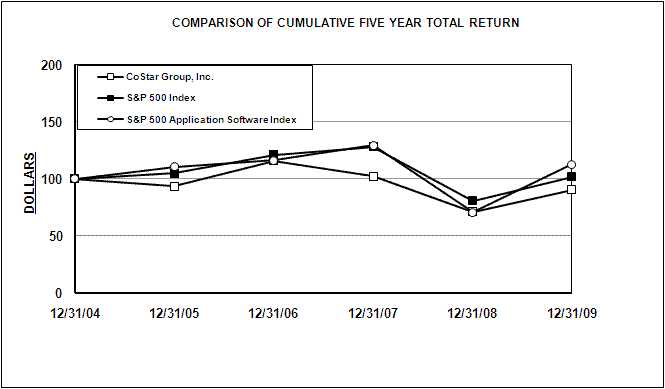
|
Company
/ Index
|
12/31/04
|
12/31/05
|
12/31/06
|
12/31/07
|
12/31/08
|
12/31/09
|
||||||||||||||||||
|
CoStar
Group, Inc.
|
100 | 93.48 | 115.98 | 102.32 | 71.33 | 90.45 | ||||||||||||||||||
|
S&P
500 Index
|
100 | 104.91 | 121.48 | 128.16 | 80.74 | 102.11 | ||||||||||||||||||
|
S&P
500 Application Software Index
|
100 | 110.69 | 116.59 | 129.51 | 70.79 | 113.14 | ||||||||||||||||||
25
Selected
Consolidated Financial and Operating Data
(in
thousands, except per share data and other operating data)
The
following table provides selected consolidated financial and other operating
data for the five years ended December 31, 2009. The consolidated statement of
operations data shown below for each of the three years ended December 31, 2007,
2008, and 2009 and the consolidated balance sheet data as of December 31, 2008
and 2009 are derived from audited consolidated financial statements that are
included in this report. The consolidated statement of operations data for each
of the years ended December 31, 2005 and 2006 and the consolidated balance sheet
data as of December 31, 2005, 2006, and 2007 shown below are derived from
audited consolidated financial statements for those years that are not included
in this report.
|
Year
Ended December 31,
|
||||||||||||||||||||
|
Consolidated
Statement of Operations Data:
|
2005
|
2006
|
2007
|
2008
|
2009
|
|||||||||||||||
|
Revenues
|
$ | 134,338 | $ | 158,889 | $ | 192,805 | $ | 212,428 | $ | 209,659 | ||||||||||
|
Cost
of revenues
|
44,286 | 56,136 | 76,704 | 73,408 | 73,714 | |||||||||||||||
|
Gross
margin
|
90,052 | 102,753 | 116,101 | 139,020 | 135,945 | |||||||||||||||
|
Operating
expenses
|
82,710 | 88,672 | 98,249 | 99,232 | 104,110 | |||||||||||||||
|
Income
from operations
|
7,342 | 14,081 | 17,852 | 39,788 | 31,835 | |||||||||||||||
|
Interest
and other income, net
|
3,455 | 6,845 | 8,045 | 4,914 | 1,253 | |||||||||||||||
|
Income
before income taxes
|
10,797 | 20,926 | 25,897 | 44,702 | 33,088 | |||||||||||||||
|
Income
tax expense , net
|
4,340 | 8,516 | 9,946 | 20,079 | 14,395 | |||||||||||||||
|
Net
income
|
$ | 6,457 | $ | 12,410 | $ | 15,951 | $ | 24,623 | $ | 18,693 | ||||||||||
|
Net
income per share -
basic
|
$ | 0.35 | $ | 0.66 | $ | 0.84 | $ | 1.27 | $ | 0.95 | ||||||||||
|
Net
income per share -
diluted
|
$ | 0.34 | $ | 0.65 | $ | 0.82 | $ | 1.26 | $ | 0.94 | ||||||||||
|
Weighted
average shares outstanding -
basic
|
18,453 | 18,751 | 19,044 | 19,372 | 19,780 | |||||||||||||||
|
Weighted
average shares outstanding -
diluted
|
19,007 | 19,165 | 19,404 | 19,550 | 19,925 | |||||||||||||||
|
As
of December 31,
|
||||||||||||||||||||
|
Consolidated
Balance Sheet Data:
|
2005
|
2006
|
2007
|
2008
|
2009
|
|||||||||||||||
|
Cash,
cash equivalents, short-term and long-term investments
|
$ | 134,185 | $ | 158,148 | $ | 187,426 | $ | 224,590 | $ | 255,698 | ||||||||||
|
Working
capital
|
124,501 | 154,606 | 167,441 | 183,347 | 203,660 | |||||||||||||||
|
Total
assets
|
248,059 | 275,437 | 321,843 | 334,384 | 404,579 | |||||||||||||||
|
Total
liabilities
|
23,263 | 25,327 | 40,038 | 30,963 | 45,573 | |||||||||||||||
|
Stockholders’
equity
|
224,796 | 250,110 | 281,805 | 303,421 | 359,006 | |||||||||||||||
|
As
of December 31,
|
||||||||||||||||||||
|
Other
Operating Data
|
2005
|
2006
|
2007
|
2008
|
2009
|
|||||||||||||||
|
Number
of subscription client sites
|
11,464 | 13,257 | 14,467 | 15,920 | 16,020 | |||||||||||||||
|
Millions
of properties in database
|
1.8 | 2.1 | 2.7 | 3.2 | 3.6 | |||||||||||||||
26
The
following Management’s Discussion and Analysis of Financial Condition and
Results of Operations contains “forward-looking statements,” including
statements about our beliefs and expectations. There are many risks and
uncertainties that could cause actual results to differ materially from those
discussed in the forward-looking statements. Potential factors that could cause
actual results to differ materially from those discussed in any forward-looking
statements include, but are not limited to, those stated above in Item 1A. under
the headings “Risk Factors ¾ Cautionary
Statement Concerning Forward-Looking Statements” and “¾Risk Factors,” as
well as those described from time to time in our filings with the Securities and
Exchange Commission.
All
forward-looking statements are based on information available to us on the date
of this filing and we assume no obligation to update such statements. The
following discussion should be read in conjunction with our Annual Reports on
Form 10-K, Quarterly Reports on Form 10-Q, Current Reports on Form 8-K and other
filings with the Securities and Exchange Commission and the consolidated
financial statements and related notes in this Annual Report on Form
10-K.
Overview
CoStar
Group, Inc. (“CoStar”) is the number one provider of information, marketing and
analytic services to the commercial real estate industry in the U.S. and the
U.K. based on the fact that we offer the most comprehensive commercial real
estate database available, have the largest research department in the industry,
provide more information, marketing and analytic services than any of our
competitors and believe we generate more revenues than any of our competitors.
We have created a standardized information, marketing and analytic platform
where members of the commercial real estate and related business community can
continuously interact and facilitate transactions by efficiently exchanging
accurate and standardized commercial real estate information. Our integrated
suite of online service offerings includes information about space available for
lease, comparable sales information, tenant information, information about
properties for sale, internet marketing services, information for clients'
websites, information about industry professionals and their business
relationships, data integration, and industry news. We also provide market
research and analysis for commercial real estate investors and lenders via our
PPR service offerings. Our service offerings span all commercial property types,
including office, industrial, retail, land, mixed-use, hospitality and
multifamily.
Since
1994, we have expanded the geographical coverage of our existing information and
marketing services and developed new information, marketing and analytic
services. In addition to internal growth, this expansion included the
acquisitions of Chicago ReSource, Inc. in Chicago in 1996 and New Market
Systems, Inc. in San Francisco in 1997. In August 1998, we expanded into
the Houston region through the acquisition of Houston-based real estate
information provider C Data Services, Inc. In January 1999, we expanded further
into the Midwest and Florida by acquiring LeaseTrend, Inc. and into Atlanta and
Dallas/Fort Worth by acquiring Jamison Research, Inc. In February 2000, we
acquired COMPS.COM, Inc., a San Diego-based provider of commercial real
estate information. In November 2000, we acquired First Image Technologies,
Inc., a California-based provider of commercial real estate
software. In September 2002, we expanded further into Portland,
Oregon through the acquisition of certain assets of Napier Realty Advisors
(doing business as REAL-NET). In January 2003, we established a base in the U.K.
with our acquisition of London-based FOCUS Information Limited. In May 2004, we
expanded into Tennessee through the acquisition of Peer Market Research, Inc.,
and in September 2004, we extended our coverage of the U.K. through the
acquisition of Scottish Property Network. In September 2004, we strengthened our
position in Denver, Colorado through the acquisition of substantially all of the
assets of RealComp, Inc., a local comparable sales information
provider.
In
January 2005, we acquired National Research Bureau, a Connecticut-based provider
of U.S. shopping center information. In December 2006, our U.K. subsidiary,
CoStar Limited, acquired Grecam S.A.S. (“Grecam”), a provider of commercial
property information and market-level surveys, studies and consulting services
located in Paris, France. In February 2007, CoStar Limited also acquired
Property Investment Exchange Limited (“Propex”), a provider of commercial
property information and operator of an electronic platform that facilitates the
exchange of investment property located in London, England. In April 2008, we
acquired the assets of First CLS, Inc. (doing business as the Dorey Companies
and DoreyPRO), an Atlanta-based provider of local commercial real estate
information. Most recently, in July 2009, we acquired Massachusetts-based
Property and Portfolio Research, Inc. (“PPR”), a provider of real
27
estate
analysis, market forecasts and credit risk analytics to the commercial real
estate industry, and its wholly owned U.K. subsidiary Property and Portfolio
Research Ltd., and in October 2009, we acquired Massachusetts-based Resolve
Technology, Inc. (“Resolve Technology”), a provider of business intelligence and
portfolio management software serving the institutional real estate investment
industry. The First CLS, Inc., PPR and Resolve Technology acquisitions are
discussed later in this section under the heading “Recent
Acquisitions.”
In 2004,
we began our expansion into 21 new metropolitan markets throughout the U.S. and
began expanding the geographical coverage of many of our existing U.S. and U.K.
markets. We completed our expansion into the 21 new markets in the first quarter
of 2006. In early 2005, in conjunction with the acquisition of National Research
Bureau, we launched a major effort to expand our coverage of retail real estate
information. The retail component of our flagship product, CoStar Property
Professional, was unveiled in May 2006 at the International Council of Shopping
Centers’ convention in Las Vegas.
During
the second half of 2006, in order to expand the geographical coverage of our
service offerings, we began actively researching commercial properties in 81 new
Core Based Statistical Areas (“CBSAs”) in the U.S., we increased our U.S. field
research fleet by adding 89 vehicles and we hired researchers to staff these
vehicles. We released our CoStar Property Professional service in the 81 new
CBSAs across the U.S. in the fourth quarter of 2007. Throughout our recent
expansion efforts, we have remained focused on ensuring that CoStar continues to
provide the quality of information our customers expect. As such, in 2009 we
expanded our research operations, and we plan to continue to grow our research
operations slightly in 2010, in order to continue to meet customer
expectations.
During
the second half of 2009, as a part of our strategy to provide subscribers with
tools for conducting primary research and analysis on commercial real estate, we
expanded subscribers’ capabilities to use CoStar’s database of research-verified
commercial property information to conduct in-depth analysis and generate
reports on trends in sales and leasing activity online. Further, in July 2009,
we acquired PPR and its wholly owned subsidiary, providers of real estate
investment analysis and market forecasting services.
In
connection with our acquisitions of Propex, Grecam and PPR’s wholly owned
subsidiary Property and Portfolio Research Ltd., we intend to expand the
coverage of our service offerings within the U.K. and to integrate our
international operations more fully with those in the U.S. We have gained
operational efficiencies as a result of consolidating a majority of our U.K.
research operations in one location in Glasgow and combining the majority of our
remaining U.K. operations in one central location in London.
We intend
to eventually introduce a consistent international platform of service
offerings. In 2007, we introduced the “CoStar Group” as the brand encompassing
our international operations. We believe that our recent U.S. and international
expansion and integration efforts have created a platform for long-term
growth.
We expect
to continue to develop and distribute new services, expand existing services
within our current platform, consider strategic acquisitions and expand and
develop our sales and marketing organization. For instance, in May 2008, we
released CoStar Showcase®, an
internet marketing service that provides commercial real estate professionals
the opportunity to make their listings accessible to all visitors to our public
website, www.CoStar.com. More recently, in July 2009, we expanded subscribers’
analytic capabilities to use our online database to conduct in-depth analysis
and generate reports on sales and leasing activity through our acquisition of
PPR and in October 2009, we acquired Resolve Technology, which enabled us to
provide our customers with additional tools for analyzing commercial real estate
markets. Any future expansion could reduce our profitability and increase our
capital expenditures. Therefore, while we expect current service offerings to
remain profitable, driving overall earnings throughout 2010 and providing
substantial cash flow for our business, it is possible that any new investments
could cause us to generate losses and negative cash flow from operations in the
future.
Current
general economic conditions in the U.S. and the world are negatively affecting
business operations for our clients and are resulting in more business
consolidations and, in certain circumstances, failures. As a result of these
economic conditions, we continue to see customer cancellations, reductions of
services and failures to pay amounts due to us, although at a slower pace than
in previous quarters. If cancellations, reductions of services and
failures to pay continue at the current rate or increase, and we are unable to
offset the resulting decrease in revenue by increasing sales to new or existing
customers, our revenues may decline or grow at reduced
rates. Additionally,
28
current
economic conditions may cause customers to reduce expenses, and customers may be
forced to purchase fewer services from us or cancel all services. We
compete against many other commercial real estate information, marketing and
analytic service providers for business. If customers choose to
cancel our services for cost-cutting or other reasons, our revenue could
decline. The extent and duration of any future continued weakening of
the economy is unknown. The extent and duration of any benefits
resulting from any of the governmental or private sector initiatives designed to
strengthen the economy are currently unknown and there can be no assurance that
those initiatives will be successful in the future. Because of these
uncertainties, we may not be able to accurately forecast our revenue or
earnings. However, we continue to believe that the Company is
positioned to generate continued, sustained earnings in 2010.
Our
financial reporting currency is the U.S. dollar. Changes in exchange rates
can significantly affect our reported results and consolidated
trends. We believe that our increasing diversification beyond the
U.S. economy through our international businesses benefits our stockholders over
the long term. We also believe it is important to evaluate our operating results
before and after the effect of currency changes, as it may provide a more
accurate comparison of our results of operations over historical periods.
Currency volatility may continue, which may impact (either positively or
negatively) our reported financial results and consolidated trends and
comparisons.
We
currently issue stock options and/or restricted stock to our officers, directors
and employees, and as a result we record additional compensation expense in our
consolidated statements of operations. We plan to continue the use of
stock-based compensation for our officers, directors and employees, which may
include, among other things, restricted stock or stock option grants that
typically will require us to record additional compensation expense in our
consolidated statements of operations and reduce our net income.
Our
subscription-based information services, consisting primarily of CoStar Property
Professional, CoStar Tenant, CoStar COMPS Professional, and FOCUS services
currently generate more than 95% of our total revenues. CoStar Property
Professional, CoStar Tenant, and CoStar COMPS Professional are generally sold as
a suite of similar services and comprise our primary service offering in our
U.S. operating segment. FOCUS is our primary service offering in our
International operating segment. The majority of our contracts for our
subscription-based information services typically have a minimum term of one
year and renew automatically. Upon renewal, many of the subscription contract
rates may change in accordance with contract provisions or as a result of
contract renegotiations. To encourage clients to use our services regularly, we
generally charge a fixed monthly amount for our subscription-based information
services rather than fees based on actual system usage. Contract rates are
generally based on the number of sites, number of users, organization size, the
client’s business focus, geography and the number of services to which a client
subscribes. Our subscription clients generally pay contract fees on a monthly
basis, but in some cases may pay us on a quarterly or annual basis. We recognize
this revenue on a straight-line basis over the life of the contract. Annual and
quarterly advance payments result in deferred revenue, substantially reducing
the working capital requirements generated by accounts receivable.
For the
twelve months ended December 31, 2009 and 2008, our contract renewal rate was
approximately 85% and 89%, respectively. As discussed above, our trailing
twelve-month contract renewal rate may continue to decline if continuing
negative economic conditions lead to greater business failures and/or
consolidations, further reductions in customer spending or decreases in the
customer base.
Application
of Critical Accounting Policies and Estimates
The
preparation of financial statements and related disclosures in conformity with
generally accepted accounting principles (“GAAP”) in the United States of
America requires management to make estimates and assumptions that affect the
reported amounts of assets and liabilities, the disclosure of contingent assets
and liabilities at the date of the financial statements and revenues and
expenses during the period reported. The following accounting policies involve a
“critical accounting estimate” because they are particularly dependent on
estimates and assumptions made by management about matters that are highly
uncertain at the time the accounting estimates are made. In addition, while we
have used our best estimates based on facts and circumstances available to us at
the time, different estimates reasonably could have been used in the current
period. Changes in the accounting estimates we use are reasonably likely to
occur from period to period, which may have a material impact on the
presentation of our financial condition and results of operations. We review
these estimates and assumptions periodically and reflect the effects of
revisions in the period that they are determined to be necessary.
29
Valuation of Long-Lived and Intangible Assets and Goodwill
We assess
the impairment of long-lived assets, identifiable intangibles and goodwill
whenever events or changes in circumstances indicate that the carrying value may
not be recoverable. Judgments made by management relate to the expected useful
lives of long-lived assets and our ability to realize any undiscounted cash
flows of the carrying amounts of such assets. The accuracy of these
judgments may be adversely affected by several factors, including the factors
listed below:
|
|
•
|
Significant
underperformance relative to historical or projected future operating
results;
|
|
|
•
|
Significant
changes in the manner of our use of the acquired assets or the strategy
for our overall business;
|
|
|
•
|
Significant
negative industry or economic trends;
or
|
|
|
•
|
Significant
decline in our market capitalization relative to net book value for a
sustained period.
|
When we
determine that the carrying value of long-lived and identifiable intangible
assets may not be recovered based upon the existence of one or more of the above
indicators, we test for impairment.
Goodwill
and identifiable intangible assets not subject to amortization are tested
annually by each reporting unit on October 1 of each year for impairment and are
tested for impairment more frequently based upon the existence of one or more of
the above indicators. We consider our operating segments, U.S. and
International, as our reporting units under FASB authoritative guidance for
consideration of potential impairment of goodwill.
The
goodwill impairment test is a two-step process. The first step is to
determine the fair value of each reporting unit. We estimate the fair value of
each reporting unit based on a projected discounted cash flow model that
includes significant assumptions and estimates including our future financial
performance and a weighted average cost of capital. The fair value of each
reporting unit is compared to the carrying amount of the reporting unit. If the
carrying value of the reporting unit exceeds the fair value, then the second
step of the process is performed to measure the impairment loss. We
measure impairment loss based on a projected discounted cash flow method using a
discount rate determined by our management to be commensurate with the risk in
our current business model. A 50% decrease in the fair value of our
International reporting unit as of December 31, 2009 would have no impact on the
carrying value of our goodwill.
Accounting
for Income Taxes
As part
of the process of preparing our consolidated financial statements, we are
required to estimate our income taxes in each of the jurisdictions in which we
operate. This process requires us to estimate our actual current tax exposure
and assess the temporary differences resulting from differing treatment of
items, such as deferred revenue or deductibility of certain intangible assets,
for tax and accounting purposes. These differences result in deferred tax assets
and liabilities, which are included within our consolidated balance sheets. We
must then also assess the likelihood that our deferred tax assets will be
recovered from future taxable income, and, to the extent we believe that it is
more-likely-than not that some portion or all of our deferred tax assets will
not be realized, we must establish a valuation allowance. To the
extent we establish a valuation allowance or change the allowance in a period,
we must reflect the corresponding increase or decrease within the tax provision
in the statements of operations.
Non-GAAP
Financial Measures
We
prepare and publicly release quarterly unaudited financial statements prepared
in accordance with GAAP. We also disclose and discuss certain non-GAAP financial
measures in our public releases. Currently, the non-GAAP financial measure that
we disclose is EBITDA, which is our net income (loss) before interest, income
taxes, depreciation and amortization. We disclose EBITDA on a consolidated and
an operating segment basis in our earnings releases, investor conference calls
and filings with the Securities and Exchange Commission. The non-GAAP financial
measures that we use may not be comparable to similarly titled measures reported
by other companies. Also, in the future, we may disclose different non-GAAP
financial measures in order to help our investors more meaningfully evaluate and
compare our future results of operations to our previously reported results of
operations.
30
We view
EBITDA as an operating performance measure and as such we believe that the GAAP
financial measure most directly comparable to it is net income (loss). In
calculating EBITDA, we exclude from net income (loss) the financial items that
we believe should be separately identified to provide additional analysis of the
financial components of the day-to-day operation of our business. We have
outlined below the type and scope of these exclusions and the material
limitations on the use of this non-GAAP financial measure as a result of these
exclusions. EBITDA is not a measurement of financial performance under GAAP and
should not be considered as a measure of liquidity, as an alternative to net
income (loss) or as an indicator of any other measure of performance derived in
accordance with GAAP. Investors and potential investors in our securities should
not rely on EBITDA as a substitute for any GAAP financial measure, including net
income (loss). In addition, we urge investors and potential investors in our
securities to carefully review the reconciliation of EBITDA to net income (loss)
set forth below, in our earnings releases and in other filings with the
Securities and Exchange Commission and to carefully review the GAAP financial
information included as part of our Quarterly Reports on Form 10-Q and our
Annual Reports on Form 10-K that are filed with the Securities and Exchange
Commission, as well as our quarterly earnings releases, and compare the GAAP
financial information with our EBITDA.
EBITDA is
used by management to internally measure our operating and management
performance and by investors as a supplemental financial measure to evaluate the
performance of our business that, when viewed with our GAAP results and the
accompanying reconciliation, we believe provides additional information that is
useful to gain an understanding of the factors and trends affecting our
business. We have spent more than 22 years building our database of
commercial real estate information and expanding our markets and services
partially through acquisitions of complementary businesses. Due to the expansion
of our information, marketing and analytic services, which included
acquisitions, our net income (loss) has included significant charges for
purchase amortization, depreciation and other amortization. EBITDA excludes
these charges and provides meaningful information about the operating
performance of our business, apart from charges for purchase amortization,
depreciation and other amortization. We believe the disclosure of EBITDA helps
investors meaningfully evaluate and compare our performance from quarter to
quarter and from year to year. We also believe EBITDA is a measure of our
ongoing operating performance because the isolation of non-cash charges, such as
amortization and depreciation, and non-operating items, such as interest and
income taxes, provides additional information about our cost structure, and,
over time, helps track our operating progress. In addition, investors,
securities analysts and others have regularly relied on EBITDA to provide a
financial measure by which to compare our operating performance against that of
other companies in our industry.
Set forth
below are descriptions of the financial items that have been excluded from our
net income (loss) to calculate EBITDA and the material limitations associated
with using this non-GAAP financial measure as compared to net income
(loss):
|
|
·
|
Purchase
amortization in cost of revenues may be useful for investors to consider
because it represents the use of our acquired database technology, which
is one of the sources of information for our database of commercial real
estate information. We do not believe these charges necessarily reflect
the current and ongoing cash charges related to our operating cost
structure.
|
|
|
·
|
Purchase
amortization in operating expenses may be useful for investors to consider
because it represents the estimated attrition of our acquired customer
base and the diminishing value of any acquired trade names. We do not
believe these charges necessarily reflect the current and ongoing cash
charges related to our operating cost
structure.
|
|
|
·
|
Depreciation
and other amortization may be useful for investors to consider because
they generally represent the wear and tear on our property and equipment
used in our operations. We do not believe these charges necessarily
reflect the current and ongoing cash charges related to our operating cost
structure.
|
|
|
·
|
The
amount of net interest income we generate may be useful for investors to
consider and may result in current cash inflows or outflows. However, we
do not consider the amount of net interest income to be a representative
component of the day-to-day operating performance of our
business.
|
31
|
|
·
|
Income
tax expense (benefit) may be useful for investors to consider because
it generally represents the taxes which may be payable for the period and
the change in deferred income taxes during the period and may reduce the
amount of funds otherwise available for use in our
business. However, we do not consider the amount of income tax
expense (benefit) to be a representative component of the day-to-day
operating performance of our
business.
|
Management
compensates for the above-described limitations of using non-GAAP measures by
using a non-GAAP measure only to supplement our GAAP results and to provide
additional information that is useful to gain an understanding of the factors
and trends affecting our business.
The
following table shows our EBITDA reconciled to our net income and our cash flows
from operating, investing and financing activities for the indicated periods (in
thousands):
|
Year
Ended December 31,
|
||||||||||||
|
2007
|
2008
|
2009
|
||||||||||
|
Net
income
|
$ | 15,951 | $ | 24,623 | $ | 18,693 | ||||||
|
Purchase
amortization in cost of revenues
|
2,170 | 2,284 | 2,389 | |||||||||
|
Purchase
amortization in operating expenses
|
5,063 | 4,880 | 3,412 | |||||||||
|
Depreciation
and other amortization
|
8,914 | 9,637 | 8,875 | |||||||||
|
Interest
income, net
|
(8,045 | ) | (4,914 | ) | (1,253 | ) | ||||||
|
Income
tax expense, net
|
9,946 | 20,079 | 14,395 | |||||||||
|
EBITDA
|
$ | 33,999 | $ | 56,589 | $ | 46,511 | ||||||
|
Cash
flows provided by (used in)
|
||||||||||||
|
Operating
activities
|
$ | 51,732 | $ | 40,908 | $ | 39,569 | ||||||
|
Investing
activities
|
$ | (40,331 | ) | $ | 52,430 | $ | 3,408 | |||||
|
Financing
activities
|
$ | 8,161 | $ | 11,475 | $ | 2,172 | ||||||
Consolidated
Results of Operations
The
following table provides our selected consolidated results of operations for the
indicated periods (in thousands of dollars and as a percentage of total
revenue):
|
Year
Ended December 31,
|
||||||||||||||||||||||||
|
2007
|
2008
|
2009
|
||||||||||||||||||||||
|
Revenues
|
$ | 192,805 | 100.0 | % | $ | 212,428 | 100.0 | % | $ | 209,659 | 100.0 | % | ||||||||||||
|
Cost
of
revenues
|
76,704 | 39.8 | 73,408 | 34.6 | 73,714 | 35.2 | ||||||||||||||||||
|
Gross
margin
|
116,101 | 60.2 | 139,020 | 65.4 | 135,945 | 64.8 | ||||||||||||||||||
|
Operating
expenses:
|
||||||||||||||||||||||||
|
Selling
and
marketing
|
51,777 | 26.9 | 41,705 | 19.6 | 42,508 | 20.3 | ||||||||||||||||||
|
Software
development
|
12,453 | 6.5 | 12,759 | 6.0 | 13,942 | 6.6 | ||||||||||||||||||
|
General
and
administrative
|
36,569 | 19.0 | 39,888 | 18.8 | 44,248 | 21.1 | ||||||||||||||||||
|
Gain
on lease settlement,
net
|
(7,613 | ) | (3.9 | ) | ¾ | 0.0 | ¾ | 0.0 | ||||||||||||||||
|
Purchase
amortization
|
5,063 | 2.6 | 4,880 | 2.3 | 3,412 | 1.6 | ||||||||||||||||||
|
Total
operating
expenses
|
98,249 | 51.0 | 99,232 | 46.7 | 104,110 | 49.7 | ||||||||||||||||||
|
Income
from
operations
|
17,852 | 9.3 | 39,788 | 18.7 | 31,835 | 15.2 | ||||||||||||||||||
|
Interest
and other income,
net
|
8,045 | 4.2 | 4,914 | 2.3 | 1,253 | 0.6 | ||||||||||||||||||
|
Income
before income
taxes
|
25,897 | 13.4 | 44,702 | 21.0 | 33,088 | 15.8 | ||||||||||||||||||
|
Income
tax expense,
net
|
9,946 | 5.2 | 20,079 | 9.5 | 14,395 | 6.9 | ||||||||||||||||||
|
Net
income
|
$ | 15,951 | 8.3 | % | $ | 24,623 | 11.6 | % | $ | 18,693 | 8.9 | % | ||||||||||||
32
Comparison
of Year Ended December 31, 2009 and Year Ended December 31, 2008
Revenues. Revenues decreased
to $209.7 million in 2009, from $212.4 million in 2008. Revenues from customers
in our International operations decreased $4.3 million primarily due to foreign
currency fluctuations. The decrease in International revenues was partially
offset by an increase in U.S. revenues of approximately $1.5
million. The increase in U.S. revenues is primarily due to additional
revenue of approximately $8.5 million from our July 2009 acquisition of PPR
partially offset by decreased sales resulting from a difficult commercial real
estate and economic environment. Our subscription-based information services
consist primarily of CoStar Property Professional, CoStar Tenant, CoStar COMPS
Professional, FOCUS services and Propex services. As of December 31, 2009, our
subscription-based information services represented more than 95% of our total
revenues.
Gross Margin. Gross margin
decreased to $135.9 million in 2009, from $139.0 million in 2008. The gross
margin percentage decreased to 64.8% in 2009, from 65.4% in 2008. The decrease
in the amount and percentage of gross margin was principally due to a $2.8
million decrease in revenue in 2009.
Selling and Marketing
Expenses. Selling and marketing expenses increased to $42.5 million in
2009, from $41.7 million in 2008, and increased as a percentage of revenues to
20.3% in 2009, from 19.6% in 2008. The increase in the amount and percentage of
selling and marketing expenses was primarily due to additional selling and
marketing expenses of approximately $1.7 million incurred by PPR and included as
a result of our July 2009 acquisition of PPR. The increase was offset
by an approximately $900,000 decrease due to foreign currency
fluctuations.
Software Development
Expenses. Software development expenses increased to $13.9 million in
2009, from $12.8 million in 2008, and increased as a percentage of revenues to
6.6% in 2009, from 6.0% in 2008. The increase in the
amount and percentage of software development expenses was due to additional
software development expenses of approximately $600,000 incurred by PPR and
included as a result of our July 2009 acquisition of PPR as well as additional
development expenses of approximately $400,000 incurred by Resolve Technology,
and included as a result of our October 2009 acquisition of Resolve
Technology.
General and Administrative
Expenses. General and administrative expenses increased to $44.2 million
in 2009, from $39.9 million in 2008, and increased as a percentage of revenues
to 21.1% in 2009, from 18.8% in 2008. The increase in the amount and percentage
of general and administrative expenses was principally a result of an increase
of acquisition and deal related costs of approximately $700,000, an increase in
legal fees of $2.0 million and additional general and administrative expenses of
approximately $1.1 million incurred by PPR and included as a result of our July
2009 acquisition of PPR.
Purchase Amortization.
Purchase amortization decreased to $3.4 million in 2009, from $4.9 million in
2008, and decreased as a percentage of revenues to 1.6% in 2009, from 2.3% in
2008. The decrease in purchase amortization expense is due to the
completion of amortization for certain identifiable intangible assets in
2009.
Interest and Other Income, Net.
Interest and other income, net decreased to $1.3 million in 2009, from
$4.9 million in 2008. Interest and other income, net decreased due to lower
average interest rates in 2009 compared to 2008.
Income Tax Expense, Net.
Income tax expense, net decreased to $14.4 million in 2009, from $20.1
million in 2008. This decrease was due to lower income before income taxes as a
result of our decreased profitability.
Comparison
of Business Segment Results for Year Ended December 31, 2009 and Year Ended
December 31, 2008
We manage
our business geographically in two operating segments, with our primary areas of
measurement and decision-making being the U.S. and International, which includes
the U.K. and France. Management relies on an internal management reporting
process that provides segment revenue and EBITDA, which is our net income before
interest, income taxes, depreciation and amortization. Management believes that
segment EBITDA is an appropriate measure for evaluating the operational
performance of our segments. EBITDA is used by management to internally measure
our operating and management performance and to evaluate the performance of our
business. However, this measure should be considered in addition to, not as a
substitute for or superior to, income from operations or other measures of
financial performance prepared in accordance with GAAP.
33
Segment Revenues. CoStar Property
Professional, CoStar Tenant, and CoStar COMPS Professional are generally sold as
a suite of similar services and comprise our primary service offering in our
U.S. operating segment. U.S. revenues increased to $191.6 million from $190.1
million for the years ended December 31, 2009 and 2008, respectively. This
increase in U.S. revenue is due to additional revenues of approximately $8.5
million included as a result of our July 2009 acquisition of PPR, partially
offset by a decrease of approximately $7.0 million in U.S. revenues due to
decreased sales resulting from a difficult commercial real estate and economic
environment. FOCUS is our primary service offering in our International
operating segment. International revenues decreased approximately
$4.3 million primarily due to foreign currency fluctuations, partially offset by
intersegment revenues of approximately $900,000 attributable to services
performed by Property and Portfolio Research Ltd. for
PPR. Intersegment revenues are eliminated from total
revenues.
Segment EBITDA. U.S. EBITDA
decreased to $47.7 million from $58.8 million for the years ended December 31,
2009 and 2008, respectively. The decrease in U.S. EBITDA was due primarily to
additional costs incurred by PPR, which we acquired in July of 2009 and
increased legal fees. International EBITDA decreased to a loss of $1.2 million
for the year ended December 31, 2009 from a $2.2 million loss for the year ended
December 31, 2008. This decreased loss is primarily due to a lower corporate
allocation in 2009 as compared to 2008. International EBITDA includes a
corporate allocation of approximately $500,000 and $1.1 million for the years
ended December 31, 2009 and 2008, respectively. The corporate allocation
represents costs incurred for U.S. employees involved in international
management and expansion activities.
Comparison
of Year Ended December 31, 2008 and Year Ended December 31, 2007
Revenues. Revenues grew to
$212.4 million in 2008, from $192.8 million in 2007. This increase in revenue
was due to further penetration of our subscription-based information and
marketing services, and successful cross-selling of our services to our
customers in existing markets, combined with continued high renewal rates. Our
subscription-based information services consist primarily of CoStar Property
Professional, CoStar Tenant, CoStar COMPS Professional, FOCUS services and
Propex services. As of December 31, 2008, our subscription-based information and
marketing services represented more than 90% of our total revenues.
Gross Margin. Gross margin
increased to $139.0 million in 2008, from $116.1 million in 2007. The gross
margin percentage increased to 65.4% in 2008, from 60.2% in 2007. The increase
in the gross margin resulted principally from revenue growth from our
subscription-based information and marketing services and a decrease in cost of
revenues. Cost of revenues decreased to $73.4 million for the year ended
December 31, 2008, from $76.7 million for the year ended December 31, 2007
principally due to expansion costs that were incurred in 2007 that were not
incurred in 2008.
Selling and Marketing
Expenses. Selling and marketing expenses decreased to $41.7 million in
2008, from $51.8 million in 2007, and decreased as a percentage of revenues to
19.6% in 2008, from 26.9% in 2007. The decrease was principally due to a
reduction in personnel costs of approximately $5.4 million primarily due to the
fact that the sales force sold services with a smaller average price point in
2008, which resulted in lower average contract values compared to 2007.
Additionally, there was a decrease in marketing initiatives of approximately
$2.3 million in 2008.
Software Development
Expenses. Software development expenses slightly increased to $12.8
million in 2008, from $12.5 million in 2007, and slightly decreased as a
percentage of revenues to 6.0% in 2008, from 6.5% in 2007. The
decrease in the percentage was primarily due to increased revenues in
2008.
General and Administrative
Expenses. General and administrative expenses increased to $39.9 million
in 2008, from $36.6 million in 2007, and decreased slightly as a percentage of
revenues to 18.8% in 2008, from 19.0% in 2007. The increase in the amount of
general and administrative expenses was principally a result of an increase of
approximately $2.5 million in legal fees and an increase of $1.6 million in bad
debt expense.
34
Gain on Lease Settlement, Net.
On September 14, 2007, CoStar U.K Limited, a wholly owned U.K. subsidiary
of CoStar, entered into an agreement with Trafigura Limited to assign to
Trafigura our leasehold interest in our office space located in London. The
lease assignment was effective on December 19, 2007. As a result, CoStar U.K.
Limited was paid $7.6 million, net of expenses, for the assignment of the lease.
There were no gains on lease settlements in 2008.
Purchase Amortization.
Purchase amortization slightly decreased to $4.9 million in 2008, from $5.1
million in 2007, and slightly decreased as a percentage of revenues to 2.3% in
2008, from 2.6% in 2007.
Interest and Other Income, Net.
Interest and other income, net decreased to $4.9 million in 2008, from
$8.0 million in 2007. Although, cash and cash equivalents, short-term and
long-term investments were higher in 2008 than in 2007, our interest and other
income decreased due to lower average interest rates in 2008 compared to
2007.
Income Tax Expense, Net.
Income tax expense, net increased to $20.1 million in 2008, from $9.9
million in 2007. This increase was primarily due to higher income before income
taxes for 2008 due to our growth and profitability, in addition to a higher
effective tax rate in 2008. The effective tax rate was lower in 2007
due to the gain on lease settlement in the U.K. that was completed in December
2007. The lease settlement resulted in income in the U.K., which
reduced the overall effective tax rate.
Comparison
of Business Segment Results for Year Ended December 31, 2008 and Year Ended
December 31, 2007
Due to
the increased size, complexity and funding requirements associated with our
international expansion, in 2007 we began to manage our business geographically
in two operating segments, with our primary areas of measurement and
decision-making being the U.S. and International, which includes the U.K. and
France. Management relies on an internal management reporting process that
provides segment revenue and EBITDA, which is our net income before interest,
income taxes, depreciation and amortization. Management believes that segment
EBITDA is an appropriate measure for evaluating the operational performance of
our segments. EBITDA is used by management to internally measure our operating
and management performance and to evaluate the performance of our business.
However, this measure should be considered in addition to, not as a substitute
for or superior to, income from operations or other measures of financial
performance prepared in accordance with GAAP.
Segment Revenues. CoStar Property
Professional, CoStar Tenant, and CoStar COMPS Professional are generally sold as
a suite of similar services and comprise our primary service offering in our
U.S. operating segment. U.S. revenues increased to $190.1 million from $170.3
million for the years ended December 31, 2008 and 2007, respectively. This
increase in U.S. revenue is due to further penetration of our U.S.
subscription-based information and marketing services and the successful
cross-selling of our service to our customers, combined with a continued high
renewal rate. FOCUS is our primary service offering in our International
operating segment. International revenues slightly decreased to $22.4
million from $22.5 million for the years ended December 31, 2008 and 2007,
respectively. This decrease is due to foreign currency
fluctuations. In their functional currency, International revenues
increased 7.2% for the year ended December 31, 2008 compared to the year ended
December 31, 2007.
Segment EBITDA. U.S. EBITDA
increased to $58.8 million from $32.9 million for the years ended December 31,
2008 and 2007, respectively. The increase in U.S. EBITDA was due to increased
revenues, and lower sales and marketing personnel costs, partially offset by an
increase in legal fees and bad debt expense. International EBITDA decreased to a
loss of $2.2 million from $1.1 million earnings for the years ended December 31,
2008 and 2007, respectively. This decrease is primarily due to gain on lease
settlement of $7.6 million in 2007 that did not occur in 2008. International
EBITDA also includes a corporate allocation of approximately $1.1 million and
$2.6 million for the years ended December 31, 2008 and 2007, respectively. The
corporate allocation represents costs incurred for U.S. employees involved in
international management and expansion activities.
35
Consolidated
Quarterly Results of Operations
The
following tables summarize our consolidated results of operations on a quarterly
basis for the indicated periods (in thousands, except per share amounts, and as
a percentage of total revenues):
| 2008 | 2009 | |||||||||||||||||||||||||||||||
| Mar. 31 | Jun. 30 | Sep. 30 | Dec. 31 | Mar. 31 | Jun. 30 | Sep. 30 | Dec. 31 | |||||||||||||||||||||||||
|
Revenues
|
$ | 52,264 | $ | 53,478 | $ | 53,757 | $ | 52,929 | $ | 51,370 | $ | 50,064 | $ | 53,590 | $ | 54,635 | ||||||||||||||||
|
Cost
of revenues
|
19,721 | 18,341 | 17,613 | 17,733 | 16,894 | 16,744 | 19,149 | 20,927 | ||||||||||||||||||||||||
|
Gross
margin
|
32,543 | 35,137 | 36,144 | 35,196 | 34,476 | 33,320 | 34,441 | 33,708 | ||||||||||||||||||||||||
|
Operating
expenses
|
25,313 | 26,627 | 24,864 | 22,428 | 23,735 | 25,129 | 27,490 | 27,756 | ||||||||||||||||||||||||
|
Income
from operations
|
7,230 | 8,510 | 11,280 | 12,768 | 10,741 | 8,191 | 6,951 | 5,952 | ||||||||||||||||||||||||
|
Interest
and other income, net
|
1,938 | 1,243 | 951 | 782 | 442 | 322 | 263 | 226 | ||||||||||||||||||||||||
|
Income
before income taxes
|
9,168 | 9,753 | 12,231 | 13,550 | 11,183 | 8,513 | 7,214 | 6,178 | ||||||||||||||||||||||||
|
Income
tax expense, net
|
4,126 | 4,318 | 5,586 | 6,049 | 5,077 | 3,897 | 2,889 | 2,532 | ||||||||||||||||||||||||
|
Net
income
|
$ | 5,042 | $ | 5,435 | $ | 6,645 | $ | 7,501 | $ | 6,106 | $ | 4,616 | $ | 4,325 | $ | 3,646 | ||||||||||||||||
|
Net
income per share -
basic
|
$ | 0.26 | $ | 0.28 | $ | 0.34 | $ | 0.39 | $ | 0.31 | $ | 0.24 | $ | 0.22 | $ | 0.18 | ||||||||||||||||
|
Net
income per share -
diluted
|
$ | 0.26 | $ | 0.28 | $ | 0.34 | $ | 0.38 | $ | 0.31 | $ | 0.24 | $ | 0.22 | $ | 0.18 | ||||||||||||||||
|
2008
|
2009
|
|||||||||||||||||||||||||||||||
|
Mar.
31
|
Jun.
30
|
Sep.
30
|
Dec.
31
|
Mar.
31
|
Jun.
30
|
Sep.
30
|
Dec.
31
|
|||||||||||||||||||||||||
|
Revenues
|
100.0 | % | 100.0 | % | 100.0 | % | 100.0 | % | 100.0 | % | 100.0 | % | 100.0 | % | 100.0 | % | ||||||||||||||||
|
Cost
of revenues
|
37.7 | 34.3 | 32.8 | 33.5 | 32.9 | 33.4 | 35.7 | 38.3 | ||||||||||||||||||||||||
|
Gross
margin
|
62.3 | 65.7 | 67.2 | 66.5 | 67.1 | 66.6 | 64.3 | 61.7 | ||||||||||||||||||||||||
|
Operating
expenses
|
48.5 | 49.8 | 46.2 | 42.4 | 46.2 | 50.2 | 51.3 | 50.8 | ||||||||||||||||||||||||
|
Income
from operations
|
13.8 | 15.9 | 21.0 | 24.1 | 20.9 | 16.4 | 13.0 | 10.9 | ||||||||||||||||||||||||
|
Interest
and other income, net
|
3.7 | 2.3 | 1.8 | 1.5 | 0.9 | 0.6 | 0.5 | 0.4 | ||||||||||||||||||||||||
|
Income
before income taxes
|
17.5 | 18.2 | 22.8 | 25.6 | 21.8 | 17.0 | 13.5 | 11.3 | ||||||||||||||||||||||||
|
Income
tax expense, net
|
7.9 | 8.0 | 10.4 | 11.4 | 9.9 | 7.8 | 5.4 | 4.6 | ||||||||||||||||||||||||
|
Net
income
|
9.6 | % | 10.2 | % | 12.4 | % | 14.2 | % | 11.9 | % | 9.2 | % | 8.1 | % | 6.7 | % | ||||||||||||||||
Recent
Acquisitions
First CLS, Inc. On April 1,
2008, we acquired certain assets of First CLS, Inc. (doing business as the Dorey
Companies and DoreyPRO), an Atlanta-based provider of local commercial real
estate information for $3.0 million in initial cash consideration and deferred
consideration of $1.7 million paid during the third quarter of
2009.
PPR. On July 17, 2009, we
acquired all of the issued and outstanding equity securities of PPR, and its
wholly owned subsidiary Property and Portfolio Research Ltd., providers of real
estate analysis, market forecasts and credit risk analytics to the commercial
real estate industry. We acquired PPR from DMG Information, Inc. (“DMGI”) in
exchange for 572,999 shares of CoStar common stock, which had an aggregate value
of approximately $20.9 million as of the closing date. On July 17, 2009, 433,667
shares of our common stock were issued to DMGI, and the remaining 139,332 shares
were issued to DMGI on September 28, 2009 after taking into account post-closing
purchase price adjustments.
Resolve Technology. On
October 19, 2009, we acquired all of the outstanding capital stock of Resolve
Technology, a Delaware corporation, for approximately $4.5 million, consisting
of approximately $3.4 million in cash and 25,886 shares, or approximately $1.1
million, of CoStar restricted common stock, which shares are subject to a
three-year lockup. The purchase price is subject to certain
post-closing adjustments. Additionally, the seller may be entitled to
receive (i) a potential deferred cash payout two years after closing based on
the incremental growth of Resolve Technology’s revenue, and (ii) other potential
deferred cash payouts for successful completion of operational and sales
milestones during the period from closing through June 30, 2013, which period
may be subject to extension to a date no later than December 31,
2014.
36
Accounting Treatment. These
acquisitions were accounted for using purchase accounting. The purchase price
for the First CLS, Inc. acquisition was primarily allocated to acquired customer
base and goodwill. For each of the PPR and Resolve Technology acquisitions, the
purchase price was allocated to various working capital accounts, developed
technology, customer base, trademarks, non-competition agreements and
goodwill. The acquired customer base for the acquisitions, which
consists of one distinct intangible asset for each acquisition and is composed
of acquired customer contracts and the related customer relationships, is being
amortized on a 125% declining balance method over ten years. The identified
intangibles will be amortized over their estimated useful
lives. Goodwill for these acquisitions will not be amortized, but is
subject to annual impairment tests. The results of operations of
First CLS, Inc., PPR, and Resolve Technology have been consolidated with those
of the Company since the respective dates of the acquisitions and are not
considered material to our consolidated financial statements. Accordingly, pro
forma financial information has not been presented for any of the
acquisitions.
Liquidity
and Capital Resources
Our
principal sources of liquidity are cash, cash equivalents and short-term
investments. Total cash, cash equivalents and short-term investments were $226.0
million at December 31, 2009 compared to $195.3 million at December 31, 2008.
The increase in cash, cash equivalents and short-term investments for the year
ended December 31, 2009 was primarily due to net cash from operating activities
of approximately $39.6 million, net cash provided from financing activities of
approximately $2.2 million, partially offset by purchases of property and
equipment and other assets of approximately $10.5 million, and net cash paid for
acquisitions of approximately $3.2 million.
Net cash
provided by operating activities for the year ended December 31, 2009 was $39.6
million compared to $40.9 million for the year ended December 31, 2008. The $1.3
million decrease in net cash provided by operating activities is primarily due
to a decrease of approximately $5.5 million from net income plus non-cash items,
a decrease of approximately $4.7 million due to changes in prepaid expenses and
deposits, and decreased cash receipts for deferred revenue of $1.1 million,
partially offset by decreased payments for accounts payable and other
liabilities of approximately $5.7 million and $4.3 million in increased cash
receipts on receivables.
Net cash
provided by investing activities was $3.4 million for the year ended December
31, 2009, compared to net cash provided by investing activities of $52.4 million
for the year ended December 31, 2008. This $49.0 million decrease in net cash
provided by investing activities was primarily due to the decision in 2008 to
invest in money market funds and U.S. treasuries instead of short-term
investment instruments, which resulted in a net sale of investments of
approximately $59.1 million for the year ended December 31, 2008 compared to
sales of investments of approximately $17.2 million for the year ended December
31, 2009.
Net cash
provided by financing activities was $2.2 million for the year ended December
31, 2009 compared to $11.5 million for the year ended
December 31, 2008. The change is due to decreased proceeds from
exercise of stock options.
Contractual Obligations. The
following table summarizes our principal contractual obligations at December 31,
2009 and the effect such obligations are expected to have on our liquidity and
cash flows in future periods (in thousands):
|
Total
|
2010
|
2011-2012 | 2013-2014 |
2015
and
thereafter
|
||||||||||||||||
|
Operating
leases
|
$ | 26,225 | $ | 10,530 | $ | 11,751 | $ | 3,061 | $ | 883 | ||||||||||
|
Purchase
obligations(1)
|
7,036 | 2,927 | 2,746 | 763 | 600 | |||||||||||||||
|
Total
contractual principal cash obligations
|
$ | 33,261 | $ | 13,457 | $ | 14,497 | $ | 3,824 | $ | 1,483 | ||||||||||
|
|
(1)Amounts
do not include (i) contracts with initial terms of twelve months or less,
or (ii) multi-year contracts that may be terminated by a third party or
us. Amounts do not include unrecognized tax benefits of $1.9
million due to uncertainty regarding the timing of future cash
payments.
|
37
In
February 2010, we purchased a 169,429 square-foot LEED Gold certified office
building located at 1331 L Street, NW in downtown Washington, D.C. for a
purchase price of $41.25 million in cash.
During
2009, we incurred capital expenditures of approximately $10.5 million. We expect
to make capital expenditures in 2010 of approximately $20.0 million to $25.0
million.
To date,
we have grown in part by acquiring other companies and we may continue to make
acquisitions. Our acquisitions may vary in size and could be material
to our current operations. We may use cash, stock, debt or other means of
funding to make these acquisitions. We paid $3.0 million in initial
cash consideration in April 2008 and $1.7 million in deferred consideration in
August 2009 for the online commercial real estate information assets of First
CLS, Inc., an Atlanta-based provider of local commercial real estate
information. In the third quarter of 2009, we issued 572,999 shares of common
stock to DMGI, Inc. for all of the issued and outstanding capital stock of PPR
and its wholly owned subsidiary. In October 2009, we acquired Resolve
Technology for approximately $3.4 million ($2.9 million was paid upon
acquisition and $450,000 was deferred until February 2010) in cash and 25,886
shares of CoStar common stock. Additionally, the seller may be
entitled to receive (i) a potential deferred cash payout two years after closing
based on the incremental growth of Resolve Technology’s revenue, and (ii) other
potential deferred cash payouts for successful completion of additional
operational and sales milestones during the period from closing through June 30,
2013, which period may be subject to extension to a date no later than December
31, 2014.
Based on
current plans, we believe that our available cash combined with positive cash
flow provided by operating activities should be sufficient to fund our
operations for at least the next 12 months.
As of
December 31, 2009, we had $32.8 million par value of long-term investments in
student loan auction rate securities (“ARS”), which failed to settle at
auctions. The majority of these investments are of high credit quality
with AAA credit ratings and are primarily securities supported by
guarantees from the Federal Family Education Loan Program (“FFELP”) of the
U.S. Department of Education. While we continue to earn interest on
these investments, the investments are not liquid in the short
term. In the event we need to immediately access these funds, we may
have to sell these securities at an amount below par value. Based on
our ability to access our cash, cash equivalents and other short-term
investments and our expected operating cash flows, we do not
anticipate having to sell these investments below par value in order to operate
our business in the foreseeable future.
On
December 23, 2008, the Company initiated a Financial Industry Regulatory
Authority (“FINRA”) arbitration against Credit Suisse First Boston (“CSFB”)
related to CSFB’s purchase of ARS for the Company’s account. Our
complaint asserts breach of contract, fraud, breach of fiduciary duty and other
causes of action. An arbitration hearing was originally scheduled to begin
during the week beginning December 7, 2009, but was rescheduled at the request
of CSFB and is now set to begin on March 8, 2010. We expect to receive a
ruling on its claim during the second quarter of 2010. Since the outcome
of this legal proceeding is uncertain at this time, we cannot estimate the
amount of gain or loss, if any, that could result from the resolution of this
matter.
Recent
Accounting Pronouncements
In
February 2007, the FASB issued authoritative guidance on the fair value option
for financial assets and financial liabilities, which permits entities to choose
to measure many financial instruments and certain other items at fair value that
are not currently required to be measured at fair value. This guidance is
effective for fiscal years beginning on or after December 31, 2007. We adopted
this guidance on January 1, 2008 and have not elected to apply the fair value
option to any of our financial instruments. The adoption of this
guidance did not have a material impact on our results of operations or
financial position.
In
December 2007, the FASB issued authoritative guidance on business
combinations, which changes the accounting for any business combination we enter
into with an acquisition date after December 31, 2008. Under this guidance, an
acquiring entity is required to recognize all the assets acquired and
liabilities assumed in a transaction at the acquisition date fair value with
limited exceptions. This guidance changes the accounting treatment and
disclosure for certain specific items in a business combination. We
adopted this guidance on January 1, 2009 and have recorded assets acquired and
liabilities assumed at fair value.
38
In
December 2007, the FASB issued authoritative guidance on non-controlling
interest, which establishes new accounting and reporting standards for the
non-controlling interest in a subsidiary and for the deconsolidation of a
subsidiary. This guidance is effective for fiscal years beginning on or after
December 15, 2008. We adopted this guidance on January 1, 2009. The
adoption of this guidance did not have a material impact on our results of
operations or financial position.
In April
2008, the FASB issued authoritative guidance on existing intangibles or expected
future cash flows from those intangibles, which is effective for all fiscal
years and interim periods beginning after December 15, 2008. Early adoption of
this guidance is not permitted. This guidance requires additional footnote
disclosures about the impact of our ability or intent to renew or extend
agreements related to existing intangibles or expected future cash flows from
those intangibles, how we account for costs incurred to renew or extend such
agreements, the time until the next renewal or extension period by asset class,
and the amount of renewal or extension costs capitalized, if any. For any
intangibles acquired after December 31, 2008, this guidance requires that we
consider our experience regarding renewal and extensions of similar arrangements
in determining the useful life of such intangibles. If we do not have experience
with similar arrangements, this guidance requires that we use the assumptions of
a market participant putting the intangible to its highest and best use in
determining the useful life. We adopted this guidance on January 1, 2009. The
adoption of this guidance did not have a material impact on our results of
operations or financial position.
In June
2008, the FASB issued authoritative guidance related to determining whether
instruments granted in share-based payment transactions are participating
securities. This guidance clarifies that unvested share-based payment
awards with a right to receive non-forfeitable dividends are participating
securities. This guidance is effective for all annual and interim periods
beginning after December 15, 2008. Adoption of this standard will require the
two-class method of calculating basic earnings per share to the extent that
unvested share-based payments have the right to receive non-forfeitable
dividends. We adopted this guidance on January 1, 2009. The adoption
of this guidance did not have a material impact on our results of operations or
financial position.
In April
2009, the FASB issued authoritative guidance related to the initial recognition,
measurement and subsequent accounting for assets and liabilities arising from
pre-acquisition contingencies in a business combination. It requires that such
assets acquired or liabilities assumed be initially recognized at fair value at
the acquisition date if fair value can be determined during the measurement
period. When fair value cannot be determined, companies should typically account
for the acquired contingencies using existing guidance. This guidance requires
that companies expense acquisition and deal-related costs that were previously
allowed to be capitalized. This guidance also requires that a
systematic and rational basis for subsequently measuring and accounting for the
assets or liabilities be developed depending on their nature. This guidance was
effective for contingent assets or liabilities arising from business
combinations with an acquisition date on or after January 1,
2009. The adoption of this guidance changes the accounting
treatment and disclosure for certain specific items in a business combination
with an acquisition date subsequent to December 31, 2008. We adopted
this guidance on January 1, 2009, and expensed acquisition and deal-related
costs associated primarily with the acquisitions of PPR and Resolve
Technology.
In April
2009, the FASB issued authoritative guidance for determining whether a market is
active or inactive, and whether a transaction is distressed. This guidance is
applicable to all assets and liabilities (financial and non-financial) and will
require enhanced disclosures. We adopted this guidance for our interim period
ending June 30, 2009. The adoption of this guidance did not have a material
impact on our results of operations or financial position, but did require
additional disclosures in our financial statements.
In April
2009, the FASB issued authoritative guidance requiring disclosures in interim
reporting periods concerning the fair value of financial instruments that were
previously only required in the annual financial statements. We adopted the
provisions of this guidance for our interim period ending June 30, 2009. The
adoption of this guidance did not have a material impact on our results of
operations or financial position, but did require additional disclosures in our
financial statements.
In April
2009, the FASB issued authoritative guidance that redefines what constitutes an
other-than-temporary impairment, defines credit and non-credit components of an
other-than-temporary impairment, prescribes their financial statement treatment,
and requires enhanced disclosures relating to such impairments. We adopted this
guidance for our interim period ending June 30, 2009. The adoption of this
guidance did not have a material impact on our results of operations or
financial position, but did require additional disclosures in our financial
statements.
39
In May
2009, the FASB issued authoritative guidance which establishes general standards
of accounting for and disclosure of events that occur after the balance sheet
date but before financial statements are issued. This guidance was effective for
all interim and annual reporting periods ending after June 15, 2009. This
guidance has not and is not expected to result in significant changes in the
subsequent events that we report, either through recognition or disclosure, in
our financial statements.
In June
2009, the FASB issued authoritative guidance to amend the manner in which
entities evaluate whether consolidation is required for variable interest
entities (VIE). Previously, variable interest holders were required
to determine whether they had a controlling financial interest in a VIE based on
a quantitative analysis of the expected gains and/or losses of the
entity. The new guidance requires an enterprise with a variable
interest in a VIE to qualitatively assess whether it has a controlling financial
interest in the entity, and if so, whether it is the primary
beneficiary. This guidance also requires that companies continually
evaluate VIEs for consolidation, rather than assessing whether consolidation is
required based upon the occurrence of triggering events. This
guidance enhances disclosures to provide financial statement users with greater
transparency about transfers of financial assets and a transferor’s continuing
involvement with transferred financial assets. This guidance will be effective
for the first annual reporting period beginning after November 15, 2009. This
guidance is not expected to materially impact our results of operations,
financial position or related disclosures.
In June
2009, the FASB issued authoritative guidance which replaced the previous
hierarchy of U.S. GAAP and establishes the FASB Codification as the single
source of authoritative U.S. GAAP recognized by the FASB to be applied by
nongovernmental entities. This guidance is effective for financial statements
issued for interim and annual periods ending after September 15, 2009. This
guidance did not materially impact our results of operations or financial
position, but did require changes to our disclosures in our financial
statements.
In July
2009, the FASB issued authoritative guidance to improve the consistency with
which companies apply fair value measurements guidance to
liabilities. This guidance is effective for interim and annual
periods beginning after September 30, 2009. This guidance is not
expected to materially impact our results of operations, financial position or
related disclosures.
In
October 2009, the FASB issued authoritative guidance that amends existing
guidance for identifying separate deliverables in a revenue-generating
transaction where multiple deliverables exist, and provides guidance for
measuring and allocating revenue to one or more units of
accounting. In addition, the FASB issued authoritative guidance on
arrangements that include software elements. Under this guidance,
tangible products containing software components and non-software components
that are essential to the functionality of the tangible product will no longer
be within the scope of the software revenue recognition guidance. This guidance
is effective using the prospective application or the retrospective application
for revenue arrangements entered into or materially modified in fiscal years
beginning on or after June 15, 2010 with earlier application permitted. We are
currently assessing the impacts adoption of this guidance may have on our
financial statements.
In
January 2010, the FASB issued authoritative guidance that amends the disclosure
requirements related to recurring and nonrecurring fair value measurements. This
guidance requires new disclosures on the transfers of assets and liabilities
between Level 1 (assets and liabilities measured using observable inputs such as
quoted prices in active markets) and Level 2 (assets and liabilities measured
using inputs other than quoted prices in active markets that are either directly
or indirectly observable) of the fair value measurement hierarchy, including the
amount and reason of the transfers. Additionally, this guidance requires a roll
forward of activities on purchases, sales, issuance, and settlements of the
assets and liabilities measured using significant unobservable inputs (Level 3
fair value measurements). This guidance is effective for interim and annual
reporting periods beginning after December 15, 2009, with the exception of the
additional disclosure for Level 3 assets and liabilities, which is effective for
fiscal years beginning after December 15, 2010, and for interim periods within
those fiscal years. This guidance is not expected to materially impact our
results of operations or financial position, but will require changes to our
disclosures in our interim and annual financial statements.
40
We
provide information, marketing and analytic services to the commercial real
estate and related business community in the U.S., U.K. and France. Our
functional currency for our operations in the U.K. and France is the local
currency. As such, fluctuations in the British Pound and Euro may have an impact
on our business, results of operations and financial position. For the year
ended December 31, 2009, revenue denominated in foreign currencies was
approximately 9.1% of total revenue. For the year ended December 31,
2009, our revenue would have decreased by approximately $1.9 million if the U.S.
dollar exchange rate used strengthened by 10%. In addition, we have
assets and liabilities denominated in foreign currencies. A 10%
strengthening of the U.S. dollar exchange rate against all currencies with which
we have exposure at December 31, 2009 would have resulted in an increase of
approximately $210,000 in the carrying amount of net assets. For the year ended
December 31, 2009, our revenue would have increased by approximately $1.9
million if the U.S. dollar exchange rate used weakened by 10%. In addition, we
have assets and liabilities denominated in foreign currencies. A 10%
weakening of the U.S. dollar exchange rate against all currencies with which we
have exposure at December 31, 2009 would have resulted in a decrease of
approximately $210,000 in the carrying amount of net assets. We currently do not
use financial instruments to hedge our exposure to exchange rate fluctuations
with respect to our foreign subsidiaries. We may seek to enter hedging
transactions in the future to reduce our exposure to exchange rate fluctuations,
but we may be unable to enter into hedging transactions successfully, on
acceptable terms or at all. As of December 31, 2009, accumulated
other comprehensive loss included a loss from foreign currency translation
adjustments of approximately $4.9 million.
We do not
have material exposure to market risks associated with changes in interest rates
related to cash equivalent securities held as of December 31,
2009. As of December 31, 2009, we had $226.0 million of cash, cash
equivalents and short-term investments. If there is an increase
or decrease in interest rates, there will be a corresponding increase or
decrease in the amount of interest earned on our cash, cash equivalents
and short-term investments. Based on our ability to access our
cash, cash equivalents and short-term investments, and our expected
operating cash flows, we do not believe that increases or decreases in interest
rates will impact our ability to operate our business in the foreseeable
future.
Included
within our long-term investments are investments in mostly AAA rated student
loan ARS. These securities are primarily securities supported by
guarantees from the FFELP of the U.S. Department of Education. As of
December 31, 2009, auctions for $32.8 million of our investments in auction rate
securities failed. As a result, we may not be able to sell these
investments at par value until a future auction on these investments is
successful. In the event we need to immediately liquidate these investments, we
may have to locate a buyer outside the auction process, who may be unwilling to
purchase the investments at par, resulting in a loss. Based on an
assessment of fair value of these investments in ARS as of December 31, 2009, we
determined that there was a decline in the fair value of our ARS investments of
approximately $3.0 million, which was deemed to be a temporary impairment and
recorded as an unrealized loss in accumulated other comprehensive loss in
stockholders’ equity. If the issuers are unable to successfully close
future auctions and their credit ratings deteriorate, we may be required to
adjust the carrying value of these investments as a temporary impairment and
recognize a greater unrealized loss in accumulated other comprehensive loss or
as an other-than-temporary impairment charge to earnings. Based on our ability
to access our cash, cash equivalents and short-term investments, and our
expected operating cash flows, we do not anticipate having to sell these
securities below par value in order to operate our business in the foreseeable
future. See Note 2 to the consolidated financial statements for
further discussion.
We have
approximately $103.7 million in intangible assets as of December 31, 2009. As of
December 31, 2009, we believe our intangible assets will be recoverable,
however, changes in the economy, the business in which we operate and our own
relative performance could change the assumptions used to evaluate intangible
asset recoverability. In the event that we determine that an asset has been
impaired, we would recognize an impairment charge equal to the amount by which
the carrying amount of the assets exceeds the fair value of the asset. We
continue to monitor these assumptions and their effect on the estimated
recoverability of our intangible assets.
41
Financial
Statements meeting the requirements of Regulation S-X are set forth beginning at
page F-1. Supplementary data is set forth in “Management’s Discussion and
Analysis of Financial Condition and Results of Operations” under the caption
“Consolidated Results of Operations.”
None.
|
Item
9A.
|
We
maintain disclosure controls and procedures that are designed to ensure that
information required to be disclosed in our reports filed or submitted under the
Exchange Act is recorded, processed, summarized and reported, within the time
periods specified in the Securities and Exchange Commission’s rules and forms,
and that such information is accumulated and communicated to our management,
including our Chief Executive Officer and Chief Financial Officer, as
appropriate, to allow for timely decisions regarding required disclosure. In
designing and evaluating the disclosure controls and procedures, management
recognized that any controls and procedures, no matter how well designed and
operated, can provide only reasonable assurance of achieving the desired control
objectives, and management is required to apply its judgment in evaluating the
cost-benefit relationship of possible controls and procedures.
As of
December 31, 2009, we carried out an evaluation, under the supervision and with
the participation of our management, including our Chief Executive Officer and
our Chief Financial Officer, of the effectiveness of the design and operation of
our disclosure controls and procedures. Based on the foregoing, our Chief
Executive Officer and Chief Financial Officer concluded that our disclosure
controls and procedures were effective and were operating at the reasonable
assurance level.
Management’s
Report on Internal Control over Financial Reporting
Management
of CoStar is responsible for establishing and maintaining adequate internal
control over financial reporting and for the assessment of the effectiveness of
internal control over financial reporting. As defined by the Securities and
Exchange Commission, internal control over financial reporting is a process
designed by, or supervised by, the Company’s principal executive and principal
financial officers, to provide reasonable assurance regarding the reliability of
financial reporting and the preparation of financial statements in accordance
with generally accepted accounting principles.
The
Company’s internal control over financial reporting is supported by written
policies and procedures, that (1) pertain to the maintenance of records that, in
reasonable detail, accurately and fairly reflect the transactions and
dispositions of the Company’s assets; (2) provide reasonable assurance that
transactions are recorded as necessary to permit preparation of financial
statements in accordance with generally accepted accounting principles, and that
receipts and expenditures of the Company are being made only in accordance with
authorizations of the Company’s management and directors; and (3) provide
reasonable assurance regarding prevention or timely detection of unauthorized
acquisition, use or disposition of the Company’s assets that could have a
material effect on the financial statements.
Because
of its inherent limitations, internal control over financial reporting may not
prevent or detect misstatements. Projections of any evaluation of
effectiveness to future periods are subject to the risk that controls may become
inadequate because of changes in conditions, or that the degree of compliance
with the policies or procedures may deteriorate.
In
connection with the preparation of the Company's annual financial statements,
management of the Company has undertaken an assessment of the effectiveness of
the Company’s internal control over financial reporting as of December 31, 2009
based on criteria established in Internal Control – Integrated Framework issued
by the Committee of Sponsoring Organizations of the Treadway Commission (“the
COSO Framework”). Management's assessment included an evaluation of
the design of the Company's internal control over financial reporting and
testing of the operational effectiveness of the Company's internal control over
financial reporting.
42
Based on
this assessment, management did not identify any material weakness in the
Company's internal control, and management has concluded that the Company's
internal control over financial reporting was effective as of December 31,
2009.
Ernst
& Young, LLP, the independent registered public accounting firm that audited
the Company's financial statements included in this report, has issued an
attestation report on the effectiveness of internal control over financial
reporting, a copy of which is included in this Annual Report on Form
10-K.
There
have been no changes in our internal control over financial reporting during our
most recent fiscal quarter that have materially affected, or are reasonably
likely to materially affect, our internal control over financial
reporting.
|
Item
9B.
|
None.
43
PART
III
The
information required by this Item is incorporated by reference to our Proxy
Statement for our 2010 annual meeting of stockholders.
|
Item
11.
|
The information required by this Item
is incorporated by reference to our Proxy Statement for our 2010 annual meeting
of stockholders.
|
Item
12.
|
The
information required by this Item is incorporated by reference to our Proxy
Statement for our 2010 annual meeting of stockholders.
The
information required by this Item is incorporated by reference to our Proxy
Statement for our 2010 annual meeting of stockholders.
The
information required by this Item is incorporated by reference to our Proxy
Statement for our 2010 annual meeting of stockholders.
PART
IV
(a)(1)
The following financial statements are filed as a part of this report: CoStar
Group, Inc. Consolidated Financial Statements.
(a)(2)
Financial statement schedules:
Schedule
II – Valuation and Qualifying Accounts
Years
Ended December 31, 2009, 2008, and 2007 (in thousands):
|
Allowance
for doubtful accounts and billing adjustments (1)
|
Balance
at Beginning
of
Year
|
Charged
to Expense
|
Write-offs,
Net of Recoveries
|
Balance
at End
of
Year
|
||||||||||||
|
Year
ended December 31, 2009
|
$ | 3,213 | $ | 4,172 | $ | 4,522 | $ | 2,863 | ||||||||
|
Year
ended December 31, 2008
|
$ | 2,959 | $ | 4,042 | $ | 3,788 | $ | 3,213 | ||||||||
|
Year
ended December 31, 2007
|
$ | 1,966 | $ | 2,464 | $ | 1,471 | $ | 2,959 | ||||||||
|
(1)
|
Additions
to the allowance for doubtful accounts are charged to bad debt expense.
Additions to the allowance for billing adjustments are charged against
revenues.
|
44
Additional
financial statement schedules are omitted because they are not applicable or not
required or because the required information is incorporated herein by reference
or included in the financial statements or related notes included elsewhere in
this report.
(a)(3)
The documents required to be filed as exhibits to this Report under Item 601 of
Regulation S-K are listed in the Exhibit Index included elsewhere in this
report, which list is incorporated herein by reference.
45
Pursuant
to the requirements of Section 13 of the Securities Act of 1934, as amended, the
Registrant has duly caused this report to be signed on its behalf by the
undersigned, thereunto duly authorized, in the City of Bethesda, State of
Maryland, on the 25th day
of February 2010.
|
COSTAR
GROUP, INC.
|
||
|
By:
|
/s/
Andrew C. Florance
|
|
|
Andrew
C. Florance
|
||
|
President
and Chief Executive Officer
|
||
KNOW ALL
PERSONS BY THESE PRESENTS, that each individual whose signature appears below
constitutes and appoints Andrew C. Florance and Brian J. Radecki, and each of
them individually, as their true and lawful attorneys-in-fact and agents, with
full power of substitution, for him and in his name, place and stead, in any and
all capacities, to sign any and all amendments to this report, and to file the
same, with all exhibits thereto and to all documents in connection therewith,
with the Securities and Exchange Commission, granting unto said
attorneys-in-fact and agents, and each of them, full power and authority to do
and perform each and every act and thing requisite and necessary to be done in
connection therewith, as fully to all intents and purposes as he might or could
do in person, herein by ratifying and confirming all that said attorneys-in-fact
and agents or any of them, or his or their substitute or substitutes, may
lawfully do or cause to be done by virtue hereof.
Pursuant
to the requirements of the Securities Act of 1934, as amended, this report has
been signed by the following persons on behalf of the registrant and in the
capacities and on the dates indicated.
|
Signature
|
Capacity
|
Date
|
||
|
/s/
Michael R. Klein
|
Chairman
of the Board
|
February
25, 2010
|
||
|
Michael
R. Klein
|
||||
|
/s/
Andrew C. Florance
|
Chief
Executive Officer and
|
February
25, 2010
|
||
|
Andrew
C. Florance
|
President
and a Director
|
|||
|
(Principal
Executive Officer)
|
||||
|
/s/
Brian J. Radecki
|
Chief
Financial Officer
|
February
25, 2010
|
||
|
Brian
J. Radecki
|
(Principal
Financial and Accounting Officer)
|
|||
|
/s/
David Bonderman
|
Director
|
February
25, 2010
|
||
|
David
Bonderman
|
||||
|
/s/
Warren H. Haber
|
Director
|
February
25, 2010
|
||
|
Warren
H. Haber
|
||||
|
/s/
Josiah O. Low, III
|
Director
|
February
25, 2010
|
||
|
Josiah
O. Low, III
|
||||
|
/s/
Christopher Nassetta
|
Director
|
February
25, 2010
|
||
|
Christopher
Nassetta
|
||||
|
/s/
Michael Glosserman
|
Director
|
February
25, 2010
|
||
|
Michael
Glosserman
|
46
|
Exhibit
No.
|
Description
|
|
|
2.1
|
Offer
Document by CoStar Limited for the share capital of Focus Information
Limited (Incorporated by reference to Exhibit 2.1 to Amendment No. 2 to
the Registration Statement on Form S-3 of the Registrant (Reg. No.
333-106769) filed with the Commission on August 14,
2003).
|
|
|
3.1
|
Restated
Certificate of Incorporation (Incorporated by reference to Exhibit 3.1 the
Registration Statement on Form S-1 of the Registrant (Reg. No. 333-47953)
filed with the Commission on March 13, 1998 (the “1998 Form
S-1”)).
|
|
|
3.2
|
Certificate
of Amendment of Restated Certificate of Incorporation (Incorporated by
reference to Exhibit 3.1 to the Registrant’s Report on Form 10-Q for the
quarter ended June 30, 1999).
|
|
|
3.3
|
Amended
and Restated By-Laws (Incorporated by reference to Exhibit 3.3 to the
Registrant’s Report on Form 10-K for the year ended December 31,
2008).
|
|
|
4.1
|
Specimen
Common Stock Certificate (Incorporated by reference to Exhibit 4.1 to the
Registrant’s Report on Form 10-K for the year ended December 31,
1999).
|
|
|
*10.1
|
CoStar
Group, Inc. 1998 Stock Incentive Plan, as amended (Incorporated by
reference to Exhibit 10.1 to the Registrant’s Report on Form 10-Q for the
quarter ended September 30, 2005).
|
|
|
*10.2
|
CoStar
Group, Inc. 2007 Stock Incentive Plan, as amended (Incorporated by
reference to Exhibit 10.2 to the Registrant’s Report on Form 10-K for
the year ended December 31, 2008).
|
|
|
*10.3
|
CoStar
Group, Inc. 2007 Stock Incentive Plan French Sub-Plan (Incorporated by
reference to Exhibit 10.3 to the Registrant’s Report on Form 10-K for the
year ended December 31, 2007).
|
|
|
*10.4
|
Form
of Stock Option Agreement between the Registrant and certain of its
officers, directors and employees (Incorporated by reference to Exhibit
10.8 to the Registrant’s Report on Form 10-K for the year ended December
31, 2004).
|
|
|
*10.5
|
Form
of Stock Option Agreement between the Registrant and Andrew C. Florance
(Incorporated by reference to Exhibit 10.8.1 to the Registrant’s Report on
Form 10-K for the year ended December 31, 2004).
|
|
|
*10.6
|
Form
of Restricted Stock Agreement between the Registrant and certain of its
officers, directors and employees (Incorporated by reference to Exhibit
10.9 to the Registrant’s Report on Form 10-K for the year ended December
31, 2004).
|
|
|
*10.7
|
Form
of 2007 Plan Restricted Stock Grant Agreement between the Registrant and
certain of its officers, directors and employees (Incorporated by
reference to Exhibit 99.1 to the Registrant’s Report on Form 8-K filed
June 22, 2007).
|
|
|
*10.8
|
Form
of 2007 Plan Incentive Stock Option Grant Agreement between the Registrant
and certain of its officers and employees (Incorporated by reference to
Exhibit 10.8 to the Registrant’s Report on Form 10-K for the year
ended December 31, 2008).
|
|
|
*10.9
|
Form
of 2007 Plan Incentive Stock Option Grant Agreement between the Registrant
and Andrew C. Florance (Incorporated by reference to Exhibit 10.9 to
the Registrant’s Report on Form 10-K for the year ended December 31,
2008).
|
|
|
*10.10
|
Form
of 2007 Plan Nonqualified Stock Option Grant Agreement between the
Registrant and certain of its officers and employees (Incorporated by
reference to Exhibit 10.10 to the Registrant’s Report on Form 10-K
for the year ended December 31, 2008).
|
|
|
*10.11
|
Form
of 2007 Plan Nonqualified Stock Option Grant Agreement between the
Registrant and certain of its directors (Incorporated by reference to
Exhibit 10.11 to the Registrant’s Report on Form 10-K for the year
ended December 31, 2008).
|
|
|
*10.12
|
Form
of 2007 Plan Nonqualified Stock Option Grant Agreement between the
Registrant and Andrew C. Florance (Incorporated by reference to
Exhibit 10.12 to the Registrant’s Report on Form 10-K for the year
ended December 31, 2008).
|
|
|
*10.13
|
Form
of 2007 Plan French Sub-Plan Restricted Stock Agreement between the
Registrant and certain of its employees (Incorporated by reference to
Exhibit 10.10 to the Registrant’s Report on Form 10-K for the year ended
December 31, 2007).
|
|
|
*10.14
|
CoStar
Group, Inc. Employee Stock Purchase Plan (Incorporated by reference to
Exhibit 10.1 to the Registrant’s Quarterly Report on Form 10-Q for the
quarter ended June 30, 2006).
|
|
|
*10.15
|
Employment
Agreement for Andrew C. Florance (Incorporated by reference to Exhibit
10.2 to Amendment No. 1 to the Registration Statement on Form S-1 of the
Registrant (Reg. No. 333-47953) filed with the Commission on April 27,
1998).
|
47
INDEX
TO EXHIBITS ¾
(Continued)
|
Exhibit
No.
|
Description
|
|
|
*10.16
|
First
Amendment to Andrew C. Florance Employment Agreement, effective January 1,
2009 (Incorporated by reference to Exhibit 10.16 to the Registrant’s
Report on Form 10-K for the year ended December 31,
2008).
|
|
|
*10.17
|
Executive
Service Contract dated February 16, 2007, between Property Investment
Exchange Limited and Paul Marples (Incorporated by reference to Exhibit
10.14 to the Registrant’s Report on Form 10-K for the year ended December
31, 2007).
|
|
|
*10.18
|
Form
of Indemnification Agreement between the Registrant and each of its
officers and directors (Incorporated by reference to Exhibit 10.1 to the
Registrant’s Report on Form 10-Q for the quarter ended March 31,
2004).
|
|
|
10.19
|
Office
Lease, dated August 12, 1999, between CoStar Realty Information, Inc. and
Newlands Building Ventures, LLC (Incorporated by reference to Exhibit 10.2
to the Registrant’s Report on Form 10-Q for the quarter ended September
30, 1999).
|
|
|
10.20
|
Office
Sublease, dated June 14, 2002, between CoStar Realty Information, Inc.,
CoStar Group, Inc. and Gateway, Inc. (Incorporated by reference to Exhibit
10.2 to the Registrant’s Report on Form 10-Q for the quarter ended June
30, 2002).
|
|
|
10.21
|
Exercise
of option to extend lease term and sublease amendment, dated February 22,
2007 between Gateway, Inc. and CoStar Realty Information, Inc. and CoStar
Group, Inc. (Incorporated by reference to Exhibit 10.11 to the
Registrant’s Report on Form 10-K for the year ended December 31,
2006).
|
|
|
10.22
|
Addendum
No. 3 to Office Lease, dated as of May 12, 2004, between Newlands Building
Venture, LLC, and CoStar Realty Information, Inc. (Incorporated by
reference to Exhibit 10.1 to the Registrant’s Report on Form 10-Q for the
quarter ended June 30, 2004).
|
|
|
10.23
|
Office
Lease, dated as of February 23, 2005, between CoStar Realty Information,
Inc. and Crestpointe III, LLC. (Incorporated by reference to Exhibit 10.13
to the Registrant’s Report on Form 10-K for the year ended December 31,
2004).
|
|
|
10.24
|
Office
Lease Agreement, dated March 16, 2007, between Corporate Place I Business
Trust and CoStar Group, Inc. (Incorporated by reference to Exhibit 10.2 to
the Registrant’s Report on Form 10-Q for the quarter ended March 31,
2007).
|
|
|
10.25
|
Agreement
for Lease among Nokia U.K. Limited, Focus Information Limited and CoStar
Group, Inc., dated November 23, 2007 (Incorporated by reference to Exhibit
10.22 to the Registrant’s Report on Form 10-K for the year ended December
31, 2007).
|
|
|
10.26
|
Agreement
for Lease between CoStar UK Limited and Wells Fargo & Company, dated
August 25, 2009 (filed herewith).
|
|
|
10.27
|
Addendum
No. 5 to Office Lease, dated as of October 23, 2009, between Newlands
Building Venture, LLC, and CoStar Realty Information, Inc. (filed
herewith).
|
|
|
10.28
|
Sub-Underlease
between CoStar UK Limited and Wells Fargo & Company, dated November
18, 2009 (filed herewith).
|
|
|
10.29
|
Contract
for Sale and Purchase between Focus Information Limited and Trafigura
Limited, dated September 14, 2007 (Incorporated by reference to Exhibit
10.1 to the Registrant’s Report on Form 10-Q for the quarter ended
September 30, 2007).
|
|
|
21.1
|
Subsidiaries
of the Registrant (filed herewith).
|
|
|
23.1
|
Consent
of Ernst & Young LLP, Independent Registered Public Accounting Firm
(filed herewith).
|
|
|
31.1
|
Certification
of Principal Executive Officer pursuant to Section 302 of the
Sarbanes-Oxley Act of 2002 (filed herewith).
|
|
|
31.2
|
Certification
of Principal Financial Officer pursuant to Section 302 of the
Sarbanes-Oxley Act of 2002 (filed herewith).
|
|
|
32.1
|
Certification
of Principal Executive Officer pursuant to 18 U.S.C. Sec. 1350, as adopted
pursuant to Section 906 of the Sarbanes-Oxley Act of 2002 (filed
herewith).
|
|
|
32.2
|
Certification
of Principal Financial Officer pursuant to 18 U.S.C. Sec. 1350, as adopted
pursuant to Section 906 of the Sarbanes-Oxley Act of 2002 (filed
herewith).
|
*
Management Contract or Compensatory Plan or Arrangement.
48
COSTAR
GROUP, INC.
|
Reports
of Independent Registered Public Accounting
Firm
|
F-2
|
|
Consolidated
Statements of Operations for the years ended December 31, 2007,
2008 and 2009
|
F-4
|
|
Consolidated
Balance Sheets as of December 31, 2008 and
2009
|
F-5
|
|
Consolidated
Statements of Stockholders’ Equity for the years ended December 31, 2007,
2008 and 2009
|
F-6
|
|
Consolidated
Statements of Cash Flows for the years ended December 31, 2007, 2008 and
2009
|
F-7
|
|
Notes
to Consolidated Financial
Statements
|
F-8
|
F-1
REPORT
OF INDEPENDENT REGISTERED PUBLIC ACCOUNTING FIRM
The Board
of Directors and Shareholders of CoStar Group, Inc.
We have
audited the accompanying consolidated balance sheets of CoStar Group, Inc. as of
December 31, 2009 and 2008, and the related consolidated statements of
operations, stockholders’ equity and cash flows for each of the three years in
the period ended December 31, 2009. Our audits also included the
financial statement schedule listed in the Index at Item
15(a). The financial statements and schedule are the responsibility
of the Company’s management. Our responsibility is to express an
opinion on the financial statements and schedule based on our
audits.
We
conducted our audits in accordance with the standards of the Public Company
Accounting Oversight Board (United States). Those standards require
that we plan and perform the audit to obtain reasonable assurance about whether
the financial statements are free of material misstatement. An audit
includes examining, on a test basis, evidence supporting the amounts and
disclosures in the financial statements. An audit also includes assessing the
accounting principles used and significant estimates made by management, as well
as evaluating the overall financial statement presentation. We
believe that our audits provide a reasonable basis for our opinion.
In our
opinion, the financial statements referred to above present fairly, in all
material respects, the consolidated financial position of CoStar Group, Inc. at
December 31, 2009 and 2008, and the consolidated results of its operations and
its cash flows for each of the three years in the period ended December 31, 2009
in conformity U.S generally accepted accounting principles. Also, in
our opinion, the related financial statement schedule, when considered in
relation to the basic financial statements taken as a whole, present fairly in
all material respects the information set forth therein.
As also
discussed in Note 9 to the consolidated financial statements, under the heading
Income Taxes, the Company adopted FASB authoritative guidance regarding
Accounting for Uncertainty in Income Taxes effective January 1,
2007.
We also
have audited, in accordance with the standards of the Public Company Accounting
Oversight Board (United States), CoStar’s internal control over financial
reporting as of December 31, 2009, based on criteria established in Internal
Control-Integrated Framework issued by the Committee of Sponsoring Organizations
of the Treadway Commission and our report dated February 25, 2010
expressed.
/s/ Ernst
& Young LLP
McLean,
Virginia
February 25, 2010
F-2
REPORT
OF INDEPENDENT REGISTERED PUBLIC ACCOUNTING FIRM
The Board
of Directors and Shareholders of CoStar Group, Inc.
We have
audited CoStar Group, Inc.’s (“CoStar”) internal control over financial
reporting as of December 31, 2009, based on criteria established in Internal
Control—Integrated Framework issued by the Committee of Sponsoring Organizations
of the Treadway Commission (the COSO criteria). CoStar’s management is
responsible for maintaining effective internal control over financial reporting,
and for its assessment of the effectiveness of internal control over financial
reporting included in the accompanying Management’s Report on Internal Control
over Financial Reporting. Our responsibility is to express an opinion on the
company’s internal control over financial reporting based on our
audit.
We
conducted our audit in accordance with the standards of the Public Company
Accounting Oversight Board (United States). Those standards require that we plan
and perform the audit to obtain reasonable assurance about whether effective
internal control over financial reporting was maintained in all material
respects. Our audit included obtaining an understanding of internal control over
financial reporting, assessing the risk that a material weakness exists, testing
and evaluating the design and operating effectiveness of internal control based
on the assessed risk, and performing such other procedures as we considered
necessary in the circumstances. We believe that our audit provides a reasonable
basis for our opinion.
A
company’s internal control over financial reporting is a process designed to
provide reasonable assurance regarding the reliability of financial reporting
and the preparation of financial statements for external purposes in accordance
with generally accepted accounting principles. A company’s internal control over
financial reporting includes those policies and procedures that (1) pertain to
the maintenance of records that, in reasonable detail, accurately and fairly
reflect the transactions and dispositions of the assets of the company; (2)
provide reasonable assurance that transactions are recorded as necessary to
permit preparation of financial statements in accordance with generally accepted
accounting principles, and that receipts and expenditures of the company are
being made only in accordance with authorizations of management and directors of
the company; and (3) provide reasonable assurance regarding prevention or timely
detection of unauthorized acquisition, use or disposition of the company’s
assets that could have a material effect on the financial
statements.
Because
of its inherent limitations, internal control over financial reporting may not
prevent or detect misstatements. Also, projections of any evaluation of
effectiveness to future periods are subject to the risk that controls may become
inadequate because of changes in conditions, or that the degree of compliance
with the policies or procedures may deteriorate.
In our
opinion, CoStar maintained, in all material respects, effective internal control
over financial reporting as of December 31, 2009, based on the COSO
criteria.
We also
have audited, in accordance with the standards of the Public Company Accounting
Oversight Board (United States), the consolidated balance sheets as of December
31, 2009 and 2008 and the related consolidated statements of operations,
stockholders’ equity and cash flows for each of the three years in the period
ended December 31, 2009 of CoStar Group, Inc. and our report dated February 25,
2010 expressed an unqualified opinion thereon.
/s/ Ernst
& Young LLP
McLean,
Virginia
February 25, 2010
F-3
COSTAR
GROUP, INC.
CONSOLIDATED
STATEMENTS OF OPERATIONS
(in
thousands, except per share data)
|
Year
Ended December 31,
|
||||||||||||
|
2007
|
2008
|
2009
|
||||||||||
|
Revenues
|
$ | 192,805 | $ | 212,428 | $ | 209,659 | ||||||
|
Cost
of revenues
|
76,704 | 73,408 | 73,714 | |||||||||
|
Gross
margin
|
116,101 | 139,020 | 135,945 | |||||||||
|
Operating
expenses:
|
||||||||||||
|
Selling
and marketing
|
51,777 | 41,705 | 42,508 | |||||||||
|
Software
development
|
12,453 | 12,759 | 13,942 | |||||||||
|
General
and administrative
|
36,569 | 39,888 | 44,248 | |||||||||
|
Gain on lease settlement, net
|
(7,613 | ) | ¾ | ¾ | ||||||||
|
Purchase
amortization
|
5,063 | 4,880 | 3,412 | |||||||||
| 98,249 | 99,232 | 104,110 | ||||||||||
|
Income
from operations
|
17,852 | 39,788 | 31,835 | |||||||||
|
Interest
income, net
|
8,045 | 4,914 | 1,253 | |||||||||
|
Income
before income taxes
|
25,897 | 44,702 | 33,088 | |||||||||
|
Income
tax expense, net
|
9,946 | 20,079 | 14,395 | |||||||||
|
Net
income
|
$ | 15,951 | $ | 24,623 | $ | 18,693 | ||||||
|
Net
income per share ¾ basic
|
$ | 0.84 | $ | 1.27 | $ | 0.95 | ||||||
|
Net
income per share ¾ diluted
|
$ | 0.82 | $ | 1.26 | $ | 0.94 | ||||||
|
Weighted
average outstanding shares ¾ basic
|
19,044 | 19,372 | 19,780 | |||||||||
|
Weighted
average outstanding shares ¾ diluted
|
19,404 | 19,550 | 19,925 | |||||||||
See
accompanying notes.
F-4
COSTAR
GROUP, INC.
CONSOLIDATED
BALANCE SHEETS
(in
thousands except per share data)
|
December
31,
|
||||||||
|
2008
|
2009
|
|||||||
|
ASSETS
|
||||||||
|
Current
assets:
|
||||||||
|
Cash
and cash equivalents
|
$ | 159,982 | $ | 205,786 | ||||
|
Short-term
investments
|
35,268 | 20,188 | ||||||
|
Accounts
receivable, less allowance for doubtful accounts of approximately $3,213
and $2,863 as of December 31, 2008 and 2009, respectively
|
12,294 | 12,855 | ||||||
|
Deferred
income taxes, net
|
2,036 | 3,450 | ||||||
|
Prepaid
expenses and other current assets
|
2,903 | 5,128 | ||||||
|
Total
current assets
|
212,483 | 247,407 | ||||||
|
Long-term
investments
|
29,340 | 29,724 | ||||||
|
Deferred
income taxes, net
|
3,392 | 1,978 | ||||||
|
Property
and equipment, net
|
16,876 | 19,162 | ||||||
|
Goodwill
|
54,328 | 80,321 | ||||||
|
Intangibles
and other assets, net
|
16,421 | 23,390 | ||||||
|
Deposits
and other assets
|
1,544 | 2,597 | ||||||
|
Total
assets
|
$ | 334,384 | $ | 404,579 | ||||
|
LIABILITIES
AND STOCKHOLDERS’ EQUITY
|
||||||||
|
Current
liabilities:
|
||||||||
|
Accounts
payable
|
$ | 1,636 | $ | 3,667 | ||||
|
Accrued
wages and commissions
|
7,217 | 9,696 | ||||||
|
Accrued
expenses
|
7,754 | 14,167 | ||||||
|
Income
taxes payable
|
1,907 | ¾ | ||||||
|
Deferred
revenue
|
9,442 | 14,840 | ||||||
|
Deferred
rent
|
1,180 | 1,377 | ||||||
|
Total
current liabilities
|
29,136 | 43,747 | ||||||
|
Deferred
income taxes, net
|
132 | ¾ | ||||||
|
Income
taxes payable
|
1,695 | 1,826 | ||||||
|
Commitments
and contingencies
|
¾ | ¾ | ||||||
|
Stockholders’
equity:
|
||||||||
|
Preferred
stock, $0.01 par value; 2,000 shares authorized; none
outstanding
|
¾ | ¾ | ||||||
|
Common
stock, $0.01 par value; 30,000 shares authorized; 19,733 and 20,617 issued
and outstanding as of December 31, 2008 and 2009,
respectively
|
197 | 206 | ||||||
|
Additional
paid-in capital
|
333,983 | 364,635 | ||||||
|
Accumulated
other comprehensive loss
|
(13,796 | ) | (7,565 | ) | ||||
|
Retained
earnings (accumulated deficit)
|
(16,963 | ) | 1,730 | |||||
|
Total
stockholders’ equity
|
303,421 | 359,006 | ||||||
|
Total
liabilities and stockholders’ equity
|
$ | 334,384 | $ | 404,579 | ||||
See
accompanying notes.
F-5
COSTAR
GROUP, INC.
CONSOLIDATED
STATEMENTS OF STOCKHOLDERS’ EQUITY
(in
thousands)
|
Additional
|
Accumulated
Other
|
Retained
Earnings
|
Total
|
|||||||||||||||||||||||||
|
Comprehensive
Income
|
Common
Stock
|
Paid-In
Capital
|
Comprehensive
Income
(Loss)
|
(Accumulated
Deficit)
|
Stockholders’
Equity
|
|||||||||||||||||||||||
|
Shares
|
Amount
|
|||||||||||||||||||||||||||
|
Balance
at December 31, 2006
|
19,081 | $ | 191 | $ | 302,936 | $ | 4,520 | $ | (57,537 | ) | $ | 250,110 | ||||||||||||||||
|
Tax
benefit adjustment
|
¾ | ¾ | 26 | ¾ | ¾ | 26 | ||||||||||||||||||||||
|
Balance
at January 1, 2007
|
19,081 | 191 | 302,962 | 4,520 | (57,537 | ) | 250,136 | |||||||||||||||||||||
|
Net
income
|
15,951 | ¾ | ¾ | ¾ | ¾ | 15,951 | 15,951 | |||||||||||||||||||||
|
Foreign
currency translation adjustment
|
873 | ¾ | ¾ | ¾ | 873 | ¾ | 873 | |||||||||||||||||||||
|
Net
unrealized gain on investments
|
233 | ¾ | ¾ | ¾ | 233 | ¾ | 233 | |||||||||||||||||||||
|
Comprehensive
income
|
$ | 17,057 | ||||||||||||||||||||||||||
|
Exercise
of stock options
|
289 | 3 | 8,127 | ¾ | ¾ | 8,130 | ||||||||||||||||||||||
|
Restricted
stock grants
|
131 | 1 | (1 | ) | ¾ | ¾ | ¾ | |||||||||||||||||||||
|
Restricted
stock grants surrendered
|
(58 | ) | ¾ | (635 | ) | ¾ | ¾ | (635 | ) | |||||||||||||||||||
|
Consideration
for Propex
|
22 | ¾ | 1,010 | ¾ | ¾ | 1,010 | ||||||||||||||||||||||
|
Stock
compensation expense, net of forfeitures
|
¾ | ¾ | 5,399 | ¾ | ¾ | 5,399 | ||||||||||||||||||||||
|
ESPP
|
9 | ¾ | 448 | ¾ | ¾ | 448 | ||||||||||||||||||||||
|
Excess
tax benefit for exercised stock options
|
¾ | ¾ | 260 | ¾ | ¾ | 260 | ||||||||||||||||||||||
|
Balance
at December 31, 2007
|
19,474 | 195 | 317,570 | 5,626 | (41,586 | ) | 281,805 | |||||||||||||||||||||
|
Net
income
|
24,623 | ¾ | ¾ | ¾ | ¾ | 24,623 | 24,623 | |||||||||||||||||||||
|
Foreign
currency translation adjustment
|
(14,061 | ) | ¾ | ¾ | ¾ | (14,061 | ) | ¾ | (14,061 | ) | ||||||||||||||||||
|
Net
unrealized loss on investments
|
(5,361 | ) | ¾ | ¾ | ¾ | (5,361 | ) | ¾ | (5,361 | ) | ||||||||||||||||||
|
Comprehensive
income
|
$ | 5,201 | ||||||||||||||||||||||||||
|
Exercise
of stock options
|
198 | 2 | 6,555 | ¾ | ¾ | 6,557 | ||||||||||||||||||||||
|
Restricted
stock grants
|
102 | 1 | ¾ | ¾ | ¾ | 1 | ||||||||||||||||||||||
|
Restricted
stock grants surrendered
|
(49 | ) | (1 | ) | (695 | ) | ¾ | ¾ | (696 | ) | ||||||||||||||||||
|
Stock
compensation expense, net of forfeitures
|
¾ | ¾ | 4,907 | ¾ | ¾ | 4,907 | ||||||||||||||||||||||
|
ESPP
|
8 | ¾ | 329 | ¾ | ¾ | 329 | ||||||||||||||||||||||
|
Excess
tax benefit for exercised stock options
|
¾ | ¾ | 5,317 | ¾ | ¾ | 5,317 | ||||||||||||||||||||||
|
Balance
at December 31, 2008
|
19,733 | 197 | 333,983 | (13,796 | ) | (16,963 | ) | 303,421 | ||||||||||||||||||||
|
Net
income
|
18,693 | ¾ | ¾ | ¾ | ¾ | 18,693 | 18,693 | |||||||||||||||||||||
|
Foreign
currency translation adjustment
|
3,671 | ¾ | ¾ | ¾ | 3,671 | ¾ | 3,671 | |||||||||||||||||||||
|
Net
unrealized gain on investments
|
2,560 | ¾ | ¾ | ¾ | 2,560 | ¾ | 2,560 | |||||||||||||||||||||
|
Comprehensive
income
|
$ | 24,924 | ||||||||||||||||||||||||||
|
Exercise
of stock options
|
85 | ¾ | 2,232 | ¾ | ¾ | 2,232 | ||||||||||||||||||||||
|
Restricted
stock grants
|
237 | 2 | ¾ | ¾ | ¾ | 2 | ||||||||||||||||||||||
|
Restricted
stock grants surrendered
|
(44 | ) | ¾ | (672 | ) | ¾ | ¾ | (672 | ) | |||||||||||||||||||
|
Stock
compensation expense, net of forfeitures
|
¾ | ¾ | 6,438 | ¾ | ¾ | 6,438 | ||||||||||||||||||||||
|
ESPP
|
7 | ¾ | 230 | ¾ | ¾ | 230 | ||||||||||||||||||||||
|
Consideration
for PPR
|
573 | 6 | 20,897 | ¾ | ¾ | 20,903 | ||||||||||||||||||||||
|
Consideration
for Resolve Technology
|
26 | 1 | 1,124 | ¾ | ¾ | 1,125 | ||||||||||||||||||||||
|
Excess
tax benefit for exercised stock options
|
¾ | ¾ | 403 | ¾ | ¾ | 403 | ||||||||||||||||||||||
|
Balance
at December 31, 2009
|
20,617 | $ | 206 | $ | 364,635 | $ | (7,565 | ) | $ | 1,730 | 359,006 | |||||||||||||||||
See
accompanying notes.
F-6
COSTAR
GROUP, INC.
CONSOLIDATED
STATEMENTS OF CASH FLOWS
(in
thousands)
|
Year
Ended December 31,
|
||||||||||||
|
2007
|
2008
|
2009
|
||||||||||
|
Operating
activities:
|
||||||||||||
|
Net
income
|
$ | 15,951 | $ | 24,623 | $ | 18,693 | ||||||
|
Adjustments
to reconcile net income to net cash provided by operating
activities:
|
||||||||||||
|
Depreciation
|
7,778 | 8,360 | 7,583 | |||||||||
|
Amortization
|
8,369 | 8,441 | 7,093 | |||||||||
|
Deferred
income tax expense, net
|
9,946 | 2,148 | (2,428 | ) | ||||||||
|
Provision
for losses on accounts receivable
|
2,464 | 4,042 | 4,172 | |||||||||
|
Excess
tax benefit from stock options
|
(260 | ) | (5,317 | ) | (403 | ) | ||||||
|
Stock-based
compensation expense
|
5,440 | 4,940 | 6,460 | |||||||||
|
Leasehold
write-off
|
¾ | ¾ | 603 | |||||||||
|
Changes
in operating assets and liabilities, net of acquisitions:
|
||||||||||||
|
Accounts
receivable
|
(2,944 | ) | (6,196 | ) | (1,610 | ) | ||||||
|
Interest
receivable
|
(67 | ) | 533 | 97 | ||||||||
|
Prepaid
expenses and other current assets
|
(755 | ) | 1,464 | (1,521 | ) | |||||||
|
Deposits
and other assets
|
(670 | ) | 652 | (1,013 | ) | |||||||
|
Accounts
payable and other liabilities
|
6,981 | (3,044 | ) | 2,655 | ||||||||
|
Deferred
revenue
|
(501 | ) | 262 | (812 | ) | |||||||
|
Net
cash provided by operating activities
|
51,732 | 40,908 | 39,569 | |||||||||
|
Investing
activities:
|
||||||||||||
|
Purchases
of investments
|
(116,609 | ) | (4,839 | ) | ¾ | |||||||
|
Sales
of investments
|
107,286 | 63,949 | 17,159 | |||||||||
|
Purchases
of property and equipment and other assets
|
(14,271 | ) | (3,656 | ) | (10,544 | ) | ||||||
|
Acquisitions,
net of cash acquired
|
(16,737 | ) | (3,024 | ) | (3,207 | ) | ||||||
|
Net
cash (used in) provided by investing activities
|
(40,331 | ) | 52,430 | 3,408 | ||||||||
|
Financing
activities:
|
||||||||||||
|
Excess
tax benefit from stock options
|
260 | 5,317 | 403 | |||||||||
|
Repurchase
of restricted stock to satisfy tax withholding obligations
|
(635 | ) | (695 | ) | (672 | ) | ||||||
|
Proceeds from exercise of stock options
|
8,536 | 6,853 | 2,441 | |||||||||
|
Net
cash provided by financing activities
|
8,161 | 11,475 | 2,172 | |||||||||
|
Effect
of foreign currency exchange rates on cash and cash
equivalents
|
64 | (2,616 | ) | 655 | ||||||||
|
Net
increase in cash and cash equivalents
|
19,626 | 102,197 | 45,804 | |||||||||
|
Cash
and cash equivalents at beginning of year
|
38,159 | 57,785 | 159,982 | |||||||||
|
Cash
and cash equivalents at end of year
|
$ | 57,785 | $ | 159,982 | $ | 205,786 | ||||||
See
accompanying notes.
F-7
COSTAR
GROUP, INC.
NOTES
TO CONSOLIDATED FINANCIAL STATEMENTS
December
31, 2009
1.
ORGANIZATION
CoStar
Group, Inc. (the “Company”) has created a comprehensive, proprietary database of
commercial real estate information covering the United States, as well as parts
of the United Kingdom and France. Based on its unique database, the Company
provides information, marketing and analytic services to the commercial real
estate and related business community and operates within two segments, U.S. and
International. The Company’s information, marketing and analytic services are
typically distributed to its clients under subscription-based license
agreements, which typically have a minimum term of one year and renew
automatically.
2.
SUMMARY OF SIGNIFICANT ACCOUNTING POLICIES
Basis
of Presentation
The
consolidated financial statements include the accounts of the Company and its
wholly owned subsidiaries. All significant intercompany balances and
transactions have been eliminated in consolidation. Accounting policies are
consistent for each operating segment.
Use
of Estimates
The
preparation of financial statements in conformity with generally accepted
accounting principles (“GAAP”) in the United States of America requires
management to make estimates and assumptions that affect the amounts reported in
the financial statements and accompanying notes. Actual results could differ
from those estimates.
Reclassifications
Certain
previously reported amounts on the consolidated statements of cash flows have
been reclassified to conform to the Company’s current presentation.
Revenue
Recognition
The
Company primarily derives revenues from providing access to its proprietary
database of commercial real estate information. The Company generally charges a
fixed monthly amount for its subscription-based services. Subscription contract
rates are based on the number of sites, number of users, organization size, the
client’s business focus and the number of services to which a client subscribes.
Subscription-based license agreements typically have a minimum term of one year
and renew automatically.
Revenue
is recognized when (1) there is persuasive evidence of an arrangement, (2) the
fee is fixed and determinable, (3) services have been rendered and payment has
been contractually earned and (4) collectability is reasonably
assured.
Revenues
from subscription-based services are recognized on a straight-line basis over
the term of the agreement. Deferred revenue results from advance cash receipts
from customers or amounts billed in advance to customers from the sales of
subscription licenses and is recognized over the term of the license
agreement.
Cost
of Revenues
Cost of
revenues principally consists of salaries and related expenses for the Company’s
researchers who collect and analyze the commercial real estate data that is the
basis for the Company’s information, marketing and analytic services.
Additionally, cost of revenues includes the cost of data from third party data
sources, which is expensed as incurred, and the amortization of database
technology.
F-8
COSTAR
GROUP, INC.
NOTES
TO CONSOLIDATED FINANCIAL STATEMENTS ¾
(CONTINUED)
2.
SUMMARY OF SIGNIFICANT ACCOUNTING POLICIES ¾
(CONTINUED)
Significant
Customers
No single
customer accounted for more than 5% of the Company’s revenues for each of the
years ended December 31, 2007, 2008 and 2009.
Foreign
Currency Translation
The
Company’s functional currency in its foreign locations is the local currency.
Assets and liabilities are translated into U.S. dollars as of the balance sheet
date. Revenues, expenses, gains and losses are translated at the average
exchange rates in effect during each period. Gains and losses resulting from
translation are included in accumulated other comprehensive income (loss). Net
gains or losses resulting from foreign currency exchange transactions are
included in the consolidated statements of operations. There were no material
gains or losses from foreign currency exchange transactions for the years ended
December 31, 2009 and 2008.
Accumulated
Other Comprehensive Loss
The
components of accumulated other comprehensive loss were as follows (in
thousands):
|
Year
Ended December 31,
|
||||||||
|
2008
|
2009
|
|||||||
|
Foreign
currency translation adjustment
|
$ | (8,521 | ) | $ | (4,850 | ) | ||
|
Accumulated
net unrealized loss on investments, net of tax
|
(5,275 | ) | (2,715 | ) | ||||
|
Total
accumulated other comprehensive loss
|
$ | (13,796 | ) | $ | (7,565 | ) | ||
Advertising
Costs
The
Company expenses advertising costs as incurred. Advertising expenses were
approximately $2.3 million, $2.8 million and $3.3 million for the years ended
December 31, 2007, 2008 and 2009, respectively.
Income
Taxes
Deferred
income taxes result from temporary differences between the tax basis of assets
and liabilities and the basis reported in the Company’s consolidated financial
statements. Deferred tax liabilities and assets are determined based on the
difference between the financial statement and the tax basis of assets and
liabilities using enacted rates expected to be in effect during the year in
which the differences reverse. Valuation allowances are provided against assets,
including net operating losses, if it is anticipated that some or all of an
asset may not be realized through future taxable earnings or implementation of
tax planning strategies.
Net
Income Per Share
Net
income per share is computed by dividing net income by the weighted average
number of common shares outstanding during the period on a basic and diluted
basis. The Company’s potentially dilutive securities include stock options and
restricted stock. Diluted net income per share considers the impact of
potentially dilutive securities except in periods in which there is a net loss,
as the inclusion of the potential common shares would have an anti-dilutive
effect.
Stock-Based
Compensation
Equity
instruments issued in exchange for employee services are accounted for using a
fair-value based method and the fair value of such equity instruments is
recognized as expense in the consolidated statements of operations.
F-9
COSTAR GROUP, INC.
NOTES
TO CONSOLIDATED FINANCIAL STATEMENTS ¾
(CONTINUED)
2.
SUMMARY OF SIGNIFICANT ACCOUNTING POLICIES ¾
(CONTINUED)
Stock-Based Compensation ¾ (Continued)
Stock-based
compensation cost is measured at the grant date of the share-based awards based
on their fair values, and is recognized on a straight line basis as expense over
the vesting periods of the awards, net of an estimated forfeiture
rate.
Cash
flows resulting from excess tax benefits are classified as part of cash flows
from operating and financing activities. Excess tax benefits represent tax
benefits related to stock based compensation in excess of the associated
deferred tax asset for such equity compensation. Net cash proceeds
from the exercise of stock options were approximately $8.5 million; $6.9 million
and $2.4 million for the years ended December 31, 2007, 2008 and 2009,
respectively. There were approximately $260,000, $5.3 million and
$403,000 of excess tax benefits realized from stock option exercises for the
years ended December 31, 2007, 2008 and 2009.
Stock-based
compensation expense for stock options, restricted stock and the employee stock
purchase plan included in the Company's results of operations for the years
ended December 31, was as follows (in thousands):
|
Year
Ended December 31,
|
||||||||||||
|
2007
|
2008
|
2009
|
||||||||||
|
Cost
of
revenues
|
$ | 926 | $ | 547 | $ | 888 | ||||||
|
Selling
and
marketing
|
1,118 | 400 | 1,125 | |||||||||
|
Software
development
|
340 | 423 | 588 | |||||||||
|
General
and
administrative
|
3,056 | 3,570 | 3,859 | |||||||||
|
Total
|
$ | 5,440 | $ | 4,940 | $ | 6,460 | ||||||
Cash
and Cash Equivalents
The
Company considers all highly liquid investments purchased with an original
maturity of three months or less to be cash equivalents. Cash equivalents
consist of money market fund investments and U.S. Government Securities. As of
December 31, 2008 and 2009, cash of approximately $518,000 and $519,000,
respectively, was held to support letters of credit for security
deposits.
Investments
The
Company determines the appropriate classification of debt and equity investments
at the time of purchase and reevaluates such designation as of each balance
sheet date. The Company considers all of its investments to be
available-for-sale. Short-term investments consist of commercial
paper, government/federal notes and bonds and corporate obligations with
maturities greater than 90 days at the time of purchase. Available-for-sale
short-term investments with contractual maturities beyond one year are
classified as current in the Company’s consolidated balance sheets because they
represent the investment of cash that is available for current operations.
Long-term investments consist of auction rate securities. Investments
are carried at fair market value.
Concentration
of Credit Risk and Financial Instruments
The
Company performs ongoing credit evaluations of its customers’ financial
condition and generally does not require that its customers’ obligations to the
Company be secured. The Company maintains reserves for credit losses, and such
losses have been within management’s expectations. The large size and widespread
nature of the Company’s customer base and lack of dependence on individual
customers mitigate the risk of nonpayment of the Company’s accounts receivable.
The carrying amount of the accounts receivable approximates the net realizable
value. The carrying value of the Company’s financial instruments including cash
and cash equivalents, short-term investments, long-term investments, accounts
receivable, accounts payable, and accrued expenses approximates fair
value.
F-10
COSTAR
GROUP, INC.
NOTES
TO CONSOLIDATED FINANCIAL STATEMENTS ¾
(CONTINUED)
2.
SUMMARY OF SIGNIFICANT ACCOUNTING POLICIES ¾
(CONTINUED)
Allowance
for Doubtful Accounts
The
allowance for doubtful accounts is based on the Company’s assessment of the
collectability of customer accounts. The Company regularly reviews
the allowance by considering factors such as historical experience, the aging of
the balances, and current economic conditions that may affect a customer’s
ability to pay.
Property
and Equipment
Property
and equipment are stated at cost. All repairs and maintenance costs are expensed
as incurred. Depreciation and amortization are calculated on a straight-line
basis over the following estimated useful lives of the assets:
|
Leasehold
improvements
|
Shorter
of lease term or useful life
|
|
|
Furniture
and office equipment
|
Five
to seven years
|
|
|
Research
vehicles
|
Five
years
|
|
|
Computer
hardware and software
|
Two
to five years
|
Qualifying
internal-use software costs incurred during the application development stage,
which consist primarily of outside services and purchased software license
costs, are capitalized and amortized over the estimated useful life of the
asset. All other costs are expensed as incurred.
Goodwill,
Intangibles and Other Assets
Goodwill
represents the excess of costs over the fair value of assets of businesses
acquired. Goodwill and intangible assets acquired in a purchase business
combination and determined to have an indefinite useful life are not amortized,
but instead tested for impairment at least annually by reporting unit. The
Company’s operating segments, U.S. and International, are the reporting units
tested for potential impairment. The goodwill impairment test is a
two-step process. The first step is to determine the fair value of
each reporting unit. The estimate of the fair value of each reporting
unit is based on a projected discounted cash flow model that includes
significant assumptions and estimates including the Company’s future financial
performance and a weighted average cost of capital. The fair value of each
reporting unit is compared to the carrying amount of the reporting unit. If the
carrying value of the reporting unit exceeds the fair value, then the second
step of the process is performed to measure the impairment loss. The
impairment loss is measured based on a projected discounted cash flow method
using a discount rate determined by the Company’s management to be commensurate
with the risk in its current business model.
Intangible
assets with estimable useful lives that arose from acquisitions on or after July
1, 2001, are amortized over their respective estimated useful lives using a
method of amortization that reflects the pattern in which the economic benefits
of the intangible assets are consumed or otherwise used up, and reviewed for
impairment.
Acquired
database technology, customer base and trade names and other are related to the
Company’s acquisitions (See Notes 3, 7 and 8). Acquired database technology and
trade names and other are amortized on a straight-line basis over periods
ranging from two to ten years. The acquired intangible asset characterized as
customer base consists of one distinct intangible asset composed of acquired
customer contracts and the related customer relationships. Acquired customer
bases that arose from acquisitions prior to July 1, 2001 are amortized on a
straight-line basis principally over a period of ten years. Acquired customer
bases that arose from acquisitions on or after July 1, 2001 are amortized on a
125% declining balance method over ten years. The cost of capitalized building
photography is amortized on a straight-line basis over five years.
F-11
COSTAR
GROUP, INC.
NOTES
TO CONSOLIDATED FINANCIAL STATEMENTS ¾
(CONTINUED)
2.
SUMMARY OF SIGNIFICANT ACCOUNTING POLICIES ¾
(CONTINUED)
Long-Lived
Assets
Long-lived
assets, such as property, plant, and equipment, and purchased intangibles
subject to amortization, are reviewed for impairment whenever events or changes
in circumstances indicate that the carrying amount of an asset may not be
recoverable. Recoverability of assets to be held and used is measured by a
comparison of the carrying amount of an asset to estimate undiscounted future
cash flows expected to be generated by the asset or asset group. If the carrying
amount of an asset exceeds its estimated future cash flows, an impairment charge
is recognized by the amount for which the carrying amount of the asset exceeds
the fair value of the asset.
Assets to
be disposed of would be separately presented in the balance sheet and reported
at the lower of the carrying amount or fair value less costs to sell, and would
no longer be depreciated. The assets and liabilities of a disposed group
classified as held for sale would be presented separately in the appropriate
asset and liability sections of the balance sheet.
Recent
Accounting Pronouncements
In
February 2007, the FASB issued authoritative guidance on the fair value option
for financial assets and financial liabilities, which permits entities to choose
to measure many financial instruments and certain other items at fair value that
are not currently required to be measured at fair value. This guidance is
effective for fiscal years beginning on or after December 31, 2007. The Company
adopted this guidance on January 1, 2008 and has not elected to apply the fair
value option to any of its financial instruments. The adoption of
this guidance did not have a material impact on the Company’s results of
operations or financial position.
In
December 2007, the FASB issued authoritative guidance on business
combinations, which changes the accounting for any business combination the
Company enters into with an acquisition date after December 31, 2008. Under this
guidance, an acquiring entity is required to recognize all the assets acquired
and liabilities assumed in a transaction at the acquisition date fair value with
limited exceptions. This guidance changes the accounting treatment and
disclosure for certain specific items in a business combination. The
Company adopted this guidance on January 1, 2009 and has recorded assets
acquired and liabilities assumed at fair value.
In
December 2007, the FASB issued authoritative guidance on non-controlling
interest, which establishes new accounting and reporting standards for the
non-controlling interest in a subsidiary and for the deconsolidation of a
subsidiary. This guidance is effective for fiscal years beginning on or after
December 15, 2008. The Company adopted this guidance on January 1, 2009.
The adoption of this guidance did not have a material impact on the Company’s
results of operations or financial position.
In April
2008, the FASB issued authoritative guidance on existing intangibles or expected
future cash flows from those intangibles, which is effective for all fiscal
years and interim periods beginning after December 15, 2008. Early adoption of
this guidance is not permitted. This guidance requires additional footnote
disclosures about the impact of the Company’s ability or intent to renew or
extend agreements related to existing intangibles or expected future cash flows
from those intangibles, how the Company accounts for costs incurred to renew or
extend such agreements, the time until the next renewal or extension period by
asset class, and the amount of renewal or extension costs capitalized, if any.
For any intangibles acquired after December 31, 2008, this guidance requires
that the Company consider its experience regarding renewal and extensions of
similar arrangements in determining the useful life of such intangibles. If the
Company does not have experience with similar arrangements, this guidance
requires that the Company use the assumptions of a market participant putting
the intangible to its highest and best use in determining the useful life. The
Company adopted this guidance on January 1, 2009. The adoption of this guidance
did not have a material impact on the Company’s results of operations or
financial position.
F-12
COSTAR
GROUP, INC.
NOTES
TO CONSOLIDATED FINANCIAL STATEMENTS ¾
(CONTINUED)
2.
SUMMARY OF SIGNIFICANT ACCOUNTING POLICIES ¾
(CONTINUED)
Recent
Accounting Pronouncements¾
(Continued)
In June
2008, the FASB issued authoritative guidance related to determining whether
instruments granted in share-based payment transactions are participating
securities. This guidance clarifies that unvested share-based payment
awards with a right to receive non-forfeitable dividends are participating
securities. This guidance is effective for all annual and interim periods
beginning after December 15, 2008. Adoption of this standard will require the
two-class method of calculating basic earnings per share to the extent that
unvested share-based payments have the right to receive non-forfeitable
dividends. The Company adopted this guidance on January 1, 2009. The
adoption of this guidance did not have a material impact on the Company’s
results of operations or financial position.
In April
2009, the FASB issued authoritative guidance related to the initial recognition,
measurement and subsequent accounting for assets and liabilities arising from
pre-acquisition contingencies in a business combination. It requires that such
assets acquired or liabilities assumed be initially recognized at fair value at
the acquisition date if fair value can be determined during the measurement
period. When fair value cannot be determined, companies should typically account
for the acquired contingencies using existing guidance. This guidance requires
that companies expense acquisition and deal-related costs that were previously
allowed to be capitalized. This guidance also requires that a
systematic and rational basis for subsequently measuring and accounting for the
assets or liabilities be developed depending on their nature. This guidance was
effective for contingent assets or liabilities arising from business
combinations with an acquisition date on or after January 1,
2009. The adoption of this guidance changes the accounting
treatment and disclosure for certain specific items in a business combination
with an acquisition date subsequent to December 31, 2008. The Company
adopted this guidance on January 1, 2009, and expensed acquisition and
deal-related costs of approximately $700,000 associated primarily with the
acquisitions of Property and Portfolio Research, Inc. (“PPR”) and Resolve
Technology, Inc. (“Resolve Technology”).
In April
2009, the FASB issued authoritative guidance for determining whether a market is
active or inactive, and whether a transaction is distressed. This guidance is
applicable to all assets and liabilities (financial and non-financial) and will
require enhanced disclosures. The Company adopted this guidance for its interim
period ending June 30, 2009. The adoption of this guidance did not have a
material impact on the Company’s results of operations or financial position,
but did require additional disclosures in the Company’s financial
statements.
In April
2009, the FASB issued authoritative guidance requiring disclosures in interim
reporting periods concerning the fair value of financial instruments that were
previously only required in the annual financial statements. The Company adopted
the provisions of this guidance for the interim period ending June 30, 2009. The
adoption of this guidance did not have a material impact on the Company’s
results of operations or financial position, but did require additional
disclosures in the Company’s financial statements.
In April
2009, the FASB issued authoritative guidance that redefines what constitutes an
other-than-temporary impairment, defines credit and non-credit components of an
other-than-temporary impairment, prescribes their financial statement treatment,
and requires enhanced disclosures relating to such impairments. The Company
adopted this guidance for the interim period ending June 30, 2009. The adoption
of this guidance did not have a material impact on the Company’s results of
operations or financial position, but did require additional disclosures in the
Company’s financial statements.
In May
2009, the FASB issued authoritative guidance which establishes general standards
of accounting for and disclosure of events that occur after the balance sheet
date but before financial statements are issued. This guidance was effective for
all interim and annual reporting periods ending after June 15, 2009. This
guidance has not and is not expected to result in significant changes in the
subsequent events that the Company reports, either through recognition or
disclosure, in its financial statements.
F-13
COSTAR
GROUP, INC.
NOTES
TO CONSOLIDATED FINANCIAL STATEMENTS ¾
(CONTINUED)
2.
SUMMARY OF SIGNIFICANT ACCOUNTING POLICIES ¾
(CONTINUED)
Recent
Accounting Pronouncements¾
(Continued)
In June
2009, the FASB issued authoritative guidance to amend the manner in which
entities evaluate whether consolidation is required for variable interest
entities (VIE). Previously, variable interest holders were required
to determine whether they had a controlling financial interest in a VIE based on
a quantitative analysis of the expected gains and/or losses of the
entity. The new guidance requires an enterprise with a variable
interest in a VIE to qualitatively assess whether it has a controlling financial
interest in the entity, and if so, whether it is the primary
beneficiary. This guidance also requires that companies continually
evaluate VIEs for consolidation, rather than assessing whether consolidation is
required based upon the occurrence of triggering events. This
guidance enhances disclosures to provide financial statement users with greater
transparency about transfers of financial assets and a transferor’s continuing
involvement with transferred financial assets. This guidance will be effective
for the first annual reporting period beginning after November 15, 2009. This
guidance is not expected to materially impact the Company’s results of
operations, financial position or related disclosures.
In June
2009, the FASB issued authoritative guidance which replaced the previous
hierarchy of U.S. GAAP and establishes the FASB Codification as the single
source of authoritative U.S. GAAP recognized by the FASB to be applied by
nongovernmental entities. This guidance is effective for financial statements
issued for interim and annual periods ending after September 15, 2009. This
guidance did not materially impact the Company’s results of operations or
financial position, but did require changes to the disclosures in the Company’s
financial statements.
In July
2009, the FASB issued authoritative guidance to improve the consistency with
which companies apply fair value measurements guidance to
liabilities. This guidance is effective for interim and annual
periods beginning after September 30, 2009. This guidance is not
expected to materially impact the Company’s results of operations, financial
position or related disclosures.
In
October 2009, the FASB issued authoritative guidance that amends existing
guidance for identifying separate deliverables in a revenue-generating
transaction where multiple deliverables exist, and provides guidance for
measuring and allocating revenue to one or more units of
accounting. In addition, the FASB issued authoritative guidance on
arrangements that include software elements. Under this guidance,
tangible products containing software components and non-software components
that are essential to the functionality of the tangible product will no longer
be within the scope of the software revenue recognition guidance. This guidance
is effective using the prospective application or the retrospective application
for revenue arrangements entered into or materially modified in fiscal years
beginning on or after June 15, 2010 with earlier application permitted. The
Company is currently assessing the impacts adoption of this guidance may have on
its financial statements.
In
January 2010, the FASB issued authoritative guidance that amends the disclosure
requirements related to recurring and nonrecurring fair value measurements. This
guidance requires new disclosures on the transfers of assets and liabilities
between Level 1 (assets and liabilities measured using observable inputs such as
quoted prices in active markets) and Level 2 (assets and liabilities measured
using inputs other than quoted prices in active markets that are either directly
or indirectly observable) of the fair value measurement hierarchy, including the
amount and reason of the transfers. Additionally, this guidance requires a roll
forward of activities on purchases, sales, issuance, and settlements of the
assets and liabilities measured using significant unobservable inputs (Level 3
fair value measurements). This guidance is effective for interim and annual
reporting periods beginning after December 15, 2009, with the exception of the
additional disclosure for Level 3 assets and liabilities, which is effective for
fiscal years beginning after December 15, 2010, and for interim periods within
those fiscal years. This guidance is not expected to materially impact the
Company’s results of operations or financial position, but will require changes
to the disclosures in its interim and annual financial statements.
F-14
COSTAR
GROUP, INC.
NOTES
TO CONSOLIDATED FINANCIAL STATEMENTS ¾
(CONTINUED)
3.
ACQUISITIONS
On April
1, 2008, the Company acquired certain assets of First CLS, Inc. (doing business
as the Dorey Companies and DoreyPRO), an Atlanta-based provider of local
commercial real estate information for $3.0 million in initial cash
consideration and deferred consideration of $1.7 million paid during the third
quarter of 2009.
On July
17, 2009, the Company acquired all of the issued and outstanding equity
securities of PPR, and its wholly owned subsidiary Property and Portfolio
Research Ltd., providers of real estate analysis, market forecasts and credit
risk analytics to the commercial real estate industry. The Company acquired PPR
from DMG Information, Inc. (“DMGI”) in exchange for 572,999 shares of CoStar
common stock, which had an aggregate value of approximately $20.9 million as of
the closing date. On July 17, 2009, 433,667 shares of the Company’s common stock
were issued to DMGI, and the remaining 139,332 shares were issued to DMGI on
September 28, 2009 after taking into account post-closing purchase price
adjustments. The purchase accounting is preliminary and is subject to
change upon completion of the purchase accounting.
The
purchase price for the PPR acquisition was allocated as follows (in
thousands):
|
Working
capital
|
$ | (5,479 | ) | |
|
Acquired
trade names and
other
|
810 | |||
|
Acquired
customer
base
|
5,300 | |||
|
Acquired
database
technology
|
3,700 | |||
|
Goodwill
|
16,572 | |||
|
Total
purchase
consideration
|
$ | 20,903 |
On
October 19, 2009, the Company acquired all of the outstanding capital stock of
Resolve Technology, a Delaware corporation, for approximately $4.5 million,
consisting of approximately $3.4 million in cash and 25,886 shares, or
approximately $1.1 million, of CoStar common stock, which shares are subject to
a three-year lockup. Additionally, the seller may be entitled
to receive (i) a potential deferred cash payout two years after closing based on
the incremental growth of Resolve Technology’s revenue, and (ii) other potential
deferred cash payouts for successful completion of operational and sales
milestones during the period from closing through June 30, 2013, which period
may be subject to extension to a date no later than December 31,
2014. The purchase accounting is preliminary and is subject to
change upon completion of the purchase accounting.
The
purchase price for the Resolve acquisition was allocated as follows (in
thousands):
|
Purchase
price in cash and
stock
|
$ | 4,499 | ||
|
Deferred
consideration
|
3,052 | |||
|
Total
purchase consideration
|
$ | 7,551 | ||
|
Working
capital
|
$ | (550 | ) | |
|
Acquired
trade names and
other
|
430 | |||
|
Acquired
customer
base
|
890 | |||
|
Acquired
database
technology
|
1,200 | |||
|
Goodwill
|
5,581 | |||
|
Total
purchase
consideration
|
$ | 7,551 |
F-15
COSTAR
GROUP, INC.
NOTES
TO CONSOLIDATED FINANCIAL STATEMENTS ¾
(CONTINUED)
3.
ACQUISITIONS ¾
(CONTINUED)
These
acquisitions were accounted for using purchase accounting. The purchase price
for the First CLS, Inc. acquisition was primarily allocated to acquired customer
base and goodwill. For each of the PPR and Resolve Technology acquisitions, the
purchase price was allocated to various working capital accounts, developed
technology, customer base, trademarks, non-competition agreements and
goodwill. The acquired customer base for the acquisitions, which
consists of one distinct intangible asset for each acquisition and is composed
of acquired customer contracts and the related customer relationships, is being
amortized on a 125% declining balance method over ten years. The identified
intangibles will be amortized over their estimated useful
lives. Goodwill for these acquisitions will not be amortized, but is
subject to annual impairment tests. Goodwill is comprised of acquired
workforce. The results of operations of First CLS, Inc., PPR, and Resolve
Technology have been consolidated with those of the Company since the respective
dates of the acquisitions and are not considered material to the Company’s
consolidated financial statements. Accordingly, pro forma financial information
has not been presented for any of the acquisitions.
4.
INVESTMENTS
The
Company determines the appropriate classification of debt and equity investments
at the time of purchase and reevaluates such designation as of each balance
sheet date. The Company considers all of its investments to be
available-for-sale. Short-term investments consist of commercial
paper, government/federal notes and bonds and corporate obligations with
maturities greater than 90 days at the time of purchase. Available-for-sale
short-term investments with contractual maturities beyond one year are
classified as current in the Company’s consolidated balance sheets because they
represent the investment of cash that is available for current operations.
Long-term investments consist of auction rate securities. Investments
are carried at fair market value.
Scheduled
maturities of investments classified as available-for-sale as of December 31,
2009 are as follows (in thousands):
|
Maturity
|
Fair
Value
|
|||
|
Due
in:
|
||||
|
2010
|
$ | 3,072 | ||
|
2011-2014
|
16,634 | |||
|
2015-2019
|
106 | |||
|
2020
and
thereafter
|
30,100 | |||
|
Available-for-sale
investments
|
$ | 49,912 | ||
The
realized gains on the Company’s investments for the years ended December 31,
2008 and 2009 were approximately $329,000 and $4,000,
respectively. The realized losses on the Company’s investments for
the years ended December 31, 2008 and 2009 were approximately $489,000 and
$5,000, respectively.
Unrealized
holding gains and losses, net of the related tax effect, on available-for-sale
securities are excluded from earnings and are reported as a separate component
of accumulated other comprehensive income (loss) in stockholders’ equity until
realized. Realized gains and losses from the sale of
available-for-sale securities are determined on a specific-identification basis.
A decline in market value of any available-for-sale security below cost that is
deemed to be other than temporary results in a reduction in carrying amount to
fair value. The impairment is charged to earnings and a new cost
basis for the security is established. Dividend and interest income
are recognized when earned.
F-16
COSTAR
GROUP, INC.
NOTES
TO CONSOLIDATED FINANCIAL STATEMENTS ¾
(CONTINUED)
4.
INVESTMENTS ¾
(CONTINUED)
As of
December 31, 2009, the amortized cost basis and fair value of investments
classified as available-for-sale are as follows (in thousands):
|
Amortized
Cost
|
Gross
Unrealized Gains
|
Gross
Unrealized Losses
|
Fair Value | |||||||||||||
|
Collateralized
debt obligations
|
$ | 12,987 | $ | 5 | $ | (14 | ) | $ | 12,978 | |||||||
|
Corporate
debt securities
|
6,396 | 331 | ¾ | 6,727 | ||||||||||||
|
Residential
mortgage-backed securities
|
394 | ¾ | (7 | ) | 387 | |||||||||||
|
Government-sponsored
enterprise obligations
|
97 | ¾ | (1 | ) | 96 | |||||||||||
|
Auction
rate securities
|
32,750 | ¾ | (3,026 | ) | 29,724 | |||||||||||
|
Available-for-sale
investments
|
$ | 52,624 | $ | 336 | $ | (3,048 | ) | $ | 49,912 | |||||||
The
unrealized losses on the Company’s investments as of December 31, 2008 and 2009
were generated primarily from changes in interest rates. The losses are
considered temporary, as the contractual terms of these investments do not
permit the issuer to settle the security at a price less than the amortized cost
of the investment. Because the Company does not intend to sell these instruments
and it is not more likely than not that the Company will be required to sell
these instruments prior to anticipated recovery, which may be maturity, it does
not consider these investments to be other-than-temporarily impaired as of
December 31, 2008 and 2009. See Note 5 to the consolidated financial
statements for further discussion on the fair value of the Company’s financial
assets.
The
components of the investments in an unrealized loss position for more than
twelve months consists of the following (in thousands):
|
December
31,
|
||||||||||||||||
|
2008
|
2009
|
|||||||||||||||
|
Aggregate
Fair
Value
|
Gross
Unrealized Losses
|
Aggregate
Fair
Value
|
Gross Unrealized
Losses
|
|||||||||||||
|
Collateralized
debt obligations
|
$ | 19,151 | $ | (1,323 | ) | $ | 7,578 | $ | (14 | ) | ||||||
|
Corporate
debt securities
|
2,558 | (156 | ) | ¾ | ¾ | |||||||||||
|
Residential
mortgage-backed securities
|
427 | (15 | ) | 387 | (7 | ) | ||||||||||
|
Government-sponsored
enterprise obligations
|
¾ | ¾ | 96 | (1 | ) | |||||||||||
|
Auction
rate securities
|
¾ | ¾ | 29,724 | (3,026 | ) | |||||||||||
| $ | 22,136 | $ | (1,494 | ) | $ | 37,785 | $ | (3,048 | ) | |||||||
The
components of the investments in an unrealized loss position for less than
twelve months consists of the following (in thousands):
|
December
31,
|
||||||||||||||||
|
2008
|
2009
|
|||||||||||||||
|
Aggregate
Fair
Value
|
Gross
Unrealized Losses
|
Aggregate
Fair
Value
|
Gross Unrealized Losses
|
|||||||||||||
|
Collateralized
debt obligations
|
$ | 3,022 | $ | (84 | ) | $ | ¾ | $ | ¾ | |||||||
|
Corporate
debt securities
|
3,807 | (268 | ) | ¾ | ¾ | |||||||||||
|
Residential
mortgage-backed securities
|
36 | (1 | ) | ¾ | ¾ | |||||||||||
|
Government-sponsored
enterprise obligations
|
130 | (14 | ) | ¾ | ¾ | |||||||||||
|
Auction
rate securities
|
29,340 | (3,710 | ) | ¾ | ¾ | |||||||||||
| $ | 36,335 | $ | (4,077 | ) | $ | ¾ | $ | ¾ | ||||||||
F-17
COSTAR
GROUP, INC.
NOTES
TO CONSOLIDATED FINANCIAL STATEMENTS ¾
(CONTINUED)
4.
INVESTMENTS ¾
(CONTINUED)
The
gross unrealized gains on the Company’s investments as of December 31, 2008 and
2009 were approximately $128,000 and $336,000, respectively.
5.
FAIR VALUE
In
September 2006, the FASB issued authoritative guidance which defines fair value,
establishes a framework for measuring fair value in accordance with GAAP and
expands disclosures about fair value measurements. The Company adopted this
guidance as of January 1, 2008 for financial instruments. Although
the adoption of the guidance did not materially impact its financial position,
results of operations, or cash flow, the Company is now required to provide
additional disclosures as part of its financial statements.
There
is a three-tier fair value hierarchy, which categorizes the inputs used in
measuring fair value. These tiers include: Level 1, defined as
observable inputs such as quoted prices in active markets; Level 2, defined as
inputs other than quoted prices in active markets that are either directly or
indirectly observable; and Level 3, defined as unobservable inputs in which
little or no market data exists, therefore requiring an entity to develop its
own assumptions.
The
following table represents the Company's fair value hierarchy for its financial
assets (cash, cash equivalents and investments) and liabilities measured at fair
value on a recurring basis as of December 31, 2009 (in thousands):
|
Level
1
|
Level
2
|
Level
3
|
Total
|
|||||||||||||
|
Assets:
|
||||||||||||||||
|
Cash
|
$ | 38,721 | $ | ¾ | $ | ¾ | $ | 38,721 | ||||||||
|
Money
market funds
|
167,065 | ¾ | ¾ | 167,065 | ||||||||||||
|
Collateralized
debt obligations
|
¾ | 12,978 | ¾ | 12,978 | ||||||||||||
|
Corporate
debt securities
|
¾ | 6,727 | ¾ | 6,727 | ||||||||||||
|
Residential
mortgage-backed securities
|
¾ | 387 | ¾ | 387 | ||||||||||||
|
Government-sponsored
enterprise obligations
|
¾ | 96 | ¾ | 96 | ||||||||||||
|
Auction
rate securities
|
¾ | ¾ | 29,724 | 29,724 | ||||||||||||
|
Total
assets measured
at fair value
|
$ | 205,786 | $ | 20,188 | $ | 29,724 | $ | 255,698 | ||||||||
|
Liabilities:
|
||||||||||||||||
|
Deferred
consideration
|
$ | ¾ | $ | ¾ | $ | 3,082 | $ | 3,082 | ||||||||
|
Total liabilities
measured
at fair value
|
$ | ¾ | $ | ¾ | $ | 3,082 | $ | 3,082 | ||||||||
The
Company’s Level 2 assets consist of collateralized debt obligations, corporate
debt securities, residential mortgage-backed securities and government-sponsored
enterprise obligations, which do not have directly observable quoted prices in
active markets. The Company’s Level 2 assets are valued using matrix
pricing.
The
Company’s Level 3 assets consist of auction rate securities (“ARS”), whose
underlying assets are primarily student loan securities supported by guarantees
from the Federal Family Education Loan Program (“FFELP”) of the U.S. Department
of Education.
F-18
COSTAR
GROUP, INC.
NOTES
TO CONSOLIDATED FINANCIAL STATEMENTS ¾
(CONTINUED)
5.
FAIR VALUE ¾
(CONTINUED)
The following table summarizes changes in fair value of the Company’s Level 3 assets from December 31, 2007 to December 31, 2009 (in thousands):
|
Auction
Rate
Securities
|
||||
|
Balance
at December 31, 2007
|
$ | 53,975 | ||
|
Unrealized
loss included in other comprehensive loss
|
(3,710 | ) | ||
|
Net
settlements
|
(20,925 | ) | ||
|
Balance
at December 31, 2008
|
$ | 29,340 | ||
|
Unrealized
gain included in other comprehensive loss
|
684 | |||
|
Net
settlements
|
(300 | ) | ||
|
Balance
at December 31, 2009
|
$ | 29,724 | ||
ARS are
variable rate debt instruments whose interest rates are reset approximately
every 28 days. The underlying securities have contractual maturities
greater than twenty years. The ARS are recorded at fair
value.
As of
December 31, 2009, the Company held ARS with $32.8 million par value, all of
which failed to settle at auction. The majority of these investments
are of high credit quality with AAA credit ratings and are primarily
student loan securities supported by guarantees from the FFELP of the U.S.
Department of Education. The Company may not be able to liquidate and
fully recover the carrying value of the ARS in the near term. As a
result, these
securities are classified as long-term investments in the Company’s consolidated
balance sheet as of December 31, 2009.
While the
Company continues to earn interest on its ARS investments at the contractual
rate, these investments are not currently trading and therefore do not currently
have a readily determinable market value. Accordingly, the estimated
fair value of the ARS no longer approximates par value. The Company
has used a discounted cash flow model to determine the estimated fair value of
its investment in ARS as of December 31, 2009. The assumptions used
in preparing the discounted cash flow model include estimates for interest
rates, credit spreads, timing and amount of cash flows, liquidity risk premiums,
expected holding periods, and default risk. Based on this assessment
of fair value, as of December 31, 2009, the Company determined there was a
decline in the fair value of its ARS investments of approximately $3.0
million. The decline was deemed to be a temporary impairment and
recorded as an unrealized loss in accumulated other comprehensive loss in
stockholders’ equity. In addition, while a majority of the ARS are
currently rated AAA, if the issuers are unable to successfully close future
auctions and their credit ratings deteriorate, the Company may be required to
record additional unrealized losses in accumulated other comprehensive loss or
an other-than-temporary impairment charge to earnings on these
investments.
The
Company’s Level 3 liabilities consist of a $3.1 million liability for deferred
consideration related to the October 19, 2009 acquisition of Resolve Technology.
The deferred consideration is for (i) a potential deferred cash payout two years
after closing based on the incremental growth of Resolve Technology’s revenue,
and (ii) other potential deferred cash payouts for successful completion of
operational and sales milestones during the period from closing through June 30,
2013, which period may be subject to extension to a date no later than December
31, 2014.
The
following table summarizes changes in fair value of the Company’s Level 3
liabilities from December 31, 2008 to December 31, 2009 (in
thousands):
|
Deferred
Consideration
|
||||
|
Balance
at December 31, 2008
|
$ | ¾ | ||
|
Deferred
consideration upon acquisition
|
3,052 | |||
|
Accretion
for 2009
|
30 | |||
|
Balance
at December 31, 2009
|
$ | 3,082 | ||
F-19
COSTAR
GROUP, INC.
NOTES
TO CONSOLIDATED FINANCIAL STATEMENTS ¾
(CONTINUED)
5.
FAIR VALUE ¾
(CONTINUED)
The
Company has used a discounted cash flow model to determine the estimated fair
value of its Level 3 liabilities as of December 31, 2009. The
significant assumptions used in preparing the discounted cash flow model include
the discount rate, estimates for future incremental revenue growth and
probabilities for completion of operational and sales milestones.
6. PROPERTY AND EQUIPMENT
Property
and equipment consists of the following (in thousands):
|
December
31,
|
||||||||
|
2008
|
2009
|
|||||||
|
Leasehold
improvements
|
$ | 7,808 | $ | 10,333 | ||||
|
Furniture,
office equipment and research vehicles
|
19,305 | 20,279 | ||||||
|
Computer
hardware and software
|
27,938 | 28,259 | ||||||
| 55,051 | 58,871 | |||||||
|
Accumulated
depreciation and amortization
|
(38,175 | ) | (39,709 | ) | ||||
|
Property
and equipment, net
|
$ | 16,876 | $ | 19,162 | ||||
7.
GOODWILL
The
changes in the carrying amount of goodwill by operating segment consist of the
following (in thousands):
|
United
States
|
International
|
Total
|
||||||||||
|
Goodwill,
December 31, 2007
|
$ | 30,428 | $ | 31,426 | $ | 61,854 | ||||||
|
Acquisitions
|
1,119 | ¾ | 1,119 | |||||||||
|
Effect
of foreign currency translation
|
¾ | (8,645 | ) | (8,645 | ) | |||||||
|
Goodwill,
December 31, 2008
|
31,547 | 22,781 | 54,328 | |||||||||
|
Acquisitions
|
23,858 | ¾ | 23,858 | |||||||||
|
Effect of foreign currency translation
|
¾ | 2,280 | 2,280 | |||||||||
|
Purchase accounting adjustment
|
(145 | ) | ¾ | (145 | ) | |||||||
|
Goodwill, December 31, 2009
|
$ | 55,260 | $ | 25,061 | $ | 80,321 | ||||||
The
Company recorded goodwill of approximately $1.1 million in connection with the
First CLS, Inc. acquisition in April 2008, which was decreased by $145,000 in
2009, upon completion of purchase accounting. Approximately $1.7
million in additional goodwill was recorded in connection with the First CLS,
Inc. acquisition as a result of the payment of deferred consideration of $1.7
million in August 2009. The Company recorded goodwill of
approximately $16.6 million in connection with the July 2009 acquisition of
PPR. Initially in July 2009, the Company had recorded $12.1 million
in goodwill for the PPR acquisition, that was increased by $4.5 million in
December 2009 upon completion of the Company’s review of the income tax
attributes and deferred taxes related to the PPR.purchase accounting. The
Company recorded goodwill of approximately $5.6 million in connection with the
Resolve Technology acquisition in October 2009
During
the fourth quarters of 2008 and 2009, the Company completed the annual
impairment test of goodwill and concluded that goodwill was not
impaired.
F-20
COSTAR
GROUP, INC.
NOTES
TO CONSOLIDATED FINANCIAL STATEMENTS ¾
(CONTINUED)
8.
INTANGIBLES AND OTHER ASSETS
Intangibles
and other assets consist of the following (in thousands, except amortization
period data):
|
|
Weighted-Average | |||||||||||
| December 31, | Amortization Period | |||||||||||
| 2008 |
2009
|
(in
years)
|
||||||||||
|
Building
photography
|
$ | 11,011 | $ | 11,504 | 5 | |||||||
|
Accumulated
amortization
|
(7,711 | ) | (9,089 | ) | ||||||||
|
Building
photography, net
|
3,300 | 2,415 | ||||||||||
|
Acquired
database technology
|
20,711 | 25,790 | 4 | |||||||||
|
Accumulated
amortization
|
(20,361 | ) | (21,144 | ) | ||||||||
|
Acquired
database technology, net
|
350 | 4,646 | ||||||||||
|
Acquired
customer base
|
48,198 | 55,770 | 10 | |||||||||
|
Accumulated
amortization
|
(37,192 | ) | (41,208 | ) | ||||||||
|
Acquired
customer base, net
|
11,006 | 14,562 | ||||||||||
|
Acquired
trade names and other
|
7,744 | 9,755 | 7 | |||||||||
|
Accumulated
amortization
|
(5,979 | ) | (7,988 | ) | ||||||||
|
Acquired
trade names and other, net
|
1,765 | 1,767 | ||||||||||
|
Intangibles
and other assets, net
|
$ | 16,421 | $ | 23,390 | ||||||||
Amortization
expense for intangibles and other assets was approximately $8.4 million for the
years ended December 31, 2007 and 2008, respectively and $7.1 million for the
year ended December 31, 2009.
In
the aggregate, amortization for intangibles and other assets existing as of
December 31, 2009 for future periods is expected to be approximately $3.8
million, $3.4 million, $3.3 million, $2.3 million and $1.8 million for the years
ending December 31, 2010, 2011, 2012, 2013 and 2014, respectively.
F-21
COSTAR
GROUP, INC.
NOTES
TO CONSOLIDATED FINANCIAL STATEMENTS ¾
(CONTINUED)
9.
INCOME TAXES
The
components of the provision (benefit) for income taxes attributable to
operations consist of the following (in thousands):
|
Year
Ended December 31,
|
||||||||||||
|
2007
|
2008
|
2009
|
||||||||||
|
Current:
|
||||||||||||
|
Federal
|
$ | 574 | $ | 18,289 | $ | 15,194 | ||||||
|
State
|
821 | 3,842 | 1,593 | |||||||||
|
Foreign
|
¾ | ¾ | 26 | |||||||||
|
Total
current
|
1,395 | 22,131 | 16,813 | |||||||||
|
Deferred:
|
||||||||||||
|
Federal
|
9,716 | (408 | ) | (2,097 | ) | |||||||
|
State
|
72 | (52 | ) | (199 | ) | |||||||
|
Foreign
|
(1,237 | ) | (1,592 | ) | (122 | ) | ||||||
|
Total
deferred
|
8,551 | (2,052 | ) | (2,418 | ) | |||||||
|
Total
provision for income taxes
|
$ | 9,946 | $ | 20,079 | $ | 14,395 | ||||||
The
components of deferred tax assets and liabilities consists of the following (in
thousands):
|
December
31,
|
||||||||
|
2008
|
2009
|
|||||||
|
Deferred
tax assets:
|
||||||||
|
Reserve
for bad debts
|
$ | 928 | $ | 1,093 | ||||
|
Accrued
compensation
|
2,144 | 3,156 | ||||||
|
Stock
compensation
|
2,115 | 3,168 | ||||||
|
Net
operating losses
|
3,077 | 2,985 | ||||||
|
Accrued reserve
|
¾ | 238 | ||||||
|
Capital
loss carryovers
|
345 | 348 | ||||||
|
Unrealized
loss on securities
|
2,088 | 1,076 | ||||||
|
Other
liabilities
|
1,401 | 317 | ||||||
|
Total
deferred tax assets
|
12,098 | 12,381 | ||||||
|
Deferred
tax liabilities:
|
||||||||
|
Prepaids
|
(522 | ) | (638 | ) | ||||
|
Depreciation
|
(626 | ) | (587 | ) | ||||
|
Intangibles
|
(2,607 | ) | (2,743 | ) | ||||
|
Total
deferred tax
liabilities
|
(3,755 | ) | (3,968 | ) | ||||
|
Net deferred tax
asset
|
8,343 | 8,413 | ||||||
|
Valuation
allowance
|
(3,047 | ) | (2,985 | ) | ||||
|
Net deferred
taxes
|
$ | 5,296 | $ | 5,428 | ||||
The net
long-term deferred tax liability shown on the balance sheet includes deferred
tax liabilities and assets related to the international operations of the
Company.
F-22
COSTAR
GROUP, INC.
NOTES
TO CONSOLIDATED FINANCIAL STATEMENTS ¾
(CONTINUED)
9. INCOME TAXES ¾ (CONTINUED)
For
the years ended December 31, 2008 and 2009, a valuation allowance has been
established for certain deferred tax assets due to the uncertainty of
realization. The Company’s change in valuation allowance was an increase of
approximately $3.0 million for the year ended December 31, 2008 and a decrease
of approximately $62,000 for the year ended December 31, 2009. The
decrease for the year ended December 31, 2009 is primarily due to the decrease
in unrealized losses on securities, which was offset by an increase in the
valuation allowance for foreign loss carryforwards. The valuation allowance for
the deferred tax asset for unrealized losses has been recorded as an adjustment
to accumulated other comprehensive loss. The valuation allowance for the years
ended December 31, 2008 and 2009 also includes an allowance for capital loss
carryforwards and for state net operating loss carryforwards.
For
the year ended December 31, 2009, the Company had income of approximately $39.0
million subject to applicable U.S. federal and state income tax laws and a loss
of approximately $5.9 million subject to applicable international tax
laws.
The
Company’s provision for income taxes resulted in effective tax rates that varied
from the statutory federal income tax rate as follows (in
thousands):
|
Year
Ended December 31,
|
||||||||||||
|
2007
|
2008
|
2009
|
||||||||||
|
Expected
federal income tax provision at statutory rate
|
$ | 8,805 | $ | 15,646 | $ | 11,581 | ||||||
|
State
income taxes, net of federal benefit
|
841 | 2,505 | 1,778 | |||||||||
|
Foreign
income taxes, net effect
|
156 | 497 | 347 | |||||||||
|
Stock
compensation
|
146 | 87 | 300 | |||||||||
|
(Decrease)
increase in valuation allowance
|
(274 | ) | 1,023 | 1,446 | ||||||||
|
Disregarded
entity election
|
¾ | ¾ | (1,477 | ) | ||||||||
|
Other
adjustments
|
272 | 321 | 420 | |||||||||
|
Income
tax expense, net
|
$ | 9,946 | $ | 20,079 | $ | 14,395 | ||||||
The
Company paid approximately $1.1 million, $13.4 million, and $19.4 million in
income taxes for the years ended December 31, 2007, 2008 and 2009,
respectively.
The
Company has net operating loss carryforwards for international income tax
purposes of approximately $12.6 million, which do not expire.
The
Company adopted FASB authoritative guidance for uncertain income tax positions
on January 1, 2007. As a result of the implementation of this guidance, the
Company recognized no material adjustment in the liability for unrecognized
income tax benefits. At the adoption date of January 1, 2007, the Company had
$217,000 of unrecognized tax benefits, all of which would favorably affect the
effective tax rate if recognized in future periods, and $52,000 of accrued
penalties and $47,000 of accrued interest. The Company’s continuing practice is
to recognize interest and penalties related to income tax matters in income tax
expense.
The
following tables summarize the activity related to the Company’s unrecognized
tax benefits (in thousands):
|
Unrecognized
tax benefit as of January 1,
2007
|
$ | 217 | ||
|
Increase
for current year tax
positions
|
44 | |||
|
Decrease
for prior year tax
positions
|
(6 | ) | ||
|
Expiration
of the statute of limitation for assessment of
taxes
|
(22 | ) | ||
|
Unrecognized
tax benefit as of December 31,
2007
|
$ | 233 |
F-23
COSTAR
GROUP, INC.
NOTES
TO CONSOLIDATED FINANCIAL STATEMENTS ¾
(CONTINUED)
9. INCOME TAXES ¾ (CONTINUED)
|
Unrecognized
tax benefit as of December 31,
2007
|
$ | 233 | ||
|
Increase
for current year tax
positions
|
1,451 | |||
|
Decrease
for prior year tax
positions
|
(9 | ) | ||
|
Expiration
of the statute of limitation for assessment of
taxes
|
(117 | ) | ||
|
Unrecognized
tax benefit as of December 31,
2008
|
1,558 | |||
|
Increase
for current year tax
positions
|
69 | |||
|
Increase
for prior year tax
positions
|
257 | |||
|
Expiration
of the statute of limitation for assessment of
taxes
|
(28 | ) | ||
|
Unrecognized
tax benefit as of December 31,
2009
|
$ | 1,856 |
Approximately
$217,000 and $142,000 of the unrecognized tax benefit as of December 31, 2009,
and 2008, respectively, would favorably affect the annual effective tax rate, if
recognized in future periods. During 2009, the Company recognized approximately
$(10,000) of interest and $20,000 of penalties, and had total accruals of
approximately $164,000 for interest and $54,000 for penalties as of December 31,
2009. During 2008, the Company recognized approximately $145,000 of interest and
$9,000 of penalties, and had total accruals of approximately $173,000 for
interest and $34,000 for penalties as of December 31, 2008. The Company does not
anticipate the amount of the unrecognized tax benefits to change significantly
over the next twelve months.
The
Company’s federal and state income tax returns for tax years 2006 through 2008
remain open to examination. The Company’s U.K. income tax returns for tax years
2003 through 2008 remain open to examination.
10.
GAIN ON LEASE SETTLEMENT, NET
On
September 14, 2007, CoStar Limited, a wholly owned U.K. subsidiary of CoStar,
entered into an agreement with Trafigura Limited to assign to Trafigura the
leasehold interest in the office space located in London. The lease assignment
was completed on December 19, 2007. As a result, CoStar U.K. was paid
approximately $7.6 million, net of expenses, for the assignment of the lease.
The expenses associated with the lease settlement included legal, moving and the
disposal of assets.
11.
COMMITMENTS AND CONTINGENCIES
The
Company leases office facilities and office equipment under various
noncancelable-operating leases. The leases contain various renewal options. Rent
expense for the years ended December 31, 2007, 2008 and 2009 was approximately
$8.1 million, $8.0 million and $9.1 million, respectively.
Future
minimum lease payments as of December 31, 2009 are as follows (in
thousands):
|
2010
|
$ | 10,530 | ||
|
2011
|
6,840 | |||
|
2012
|
4,911 | |||
|
2013
|
2,410 | |||
|
2014
|
651 | |||
|
2015
and thereafter
|
883 | |||
| $ | 26,225 | |||
F-24
COSTAR
GROUP, INC.
NOTES
TO CONSOLIDATED FINANCIAL STATEMENTS ¾
(CONTINUED)
11.
COMMITMENTS AND CONTINGENCIES ¾
(CONTINUED)
The
Company and its wholly owned subsidiary CoStar U.K. Limited are defendants in
legal proceedings filed in England by Nokia U.K. Limited (“Nokia”) related to
obligations under an agreement to sublease certain office space from
Nokia. Nokia served its complaint upon the Company in September 2009,
and the litigation is in its very early stages. If there is a trial,
it is not expected to occur until October 2010. The Company has filed a response
asserting that Nokia’s claim is without merit. The Company intends to
defend itself vigorously against Nokia’s claim. Since the outcome of these
legal proceedings is uncertain at this time and because Nokia has requested
equitable relief as an alternative to financial relief, the Company cannot
estimate the amount of liability, if any, that could result from an adverse
resolution of this matter.
On
December 23, 2008, the Company initiated a Financial Industry Regulatory
Authority (“FINRA”) arbitration against Credit Suisse First Boston (“CSFB”)
related to CSFB’s purchase of auction rate securities for the Company’s
account. An arbitration hearing was originally scheduled to begin during
the week beginning December 7, 2009, but was rescheduled at the request of CSFB
and is now set to begin on March 8, 2010. The Company expects to receive a
ruling on its claim during the second quarter of 2010. Since the outcome
of this legal proceeding is uncertain at this time, the Company cannot estimate
the amount of gain or loss, if any, that could result from the resolution of
this matter.
On
December 8, 2009, a former employee filed a lawsuit against the Company in the
United States District Court for the Southern District of California alleging
violations of the Fair Labor Standards Act and California state wage-and-hour
laws and seeking unspecified damages under those laws. The complaint also
seeks to declare a class of all similarly situated employees to pursue similar
claims. The Company believes that the lawsuit is meritless and intends to
defend itself vigorously against these claims and any certification of class
status. Nevertheless, because the lawsuit is in its early stages, the
outcome of the claim is uncertain at this time and the Company cannot estimate
the amount of liability, if any, that could result from an adverse resolution of
this matter.
In
December 2009, the Company and LoopNet, Inc. settled all pending litigation
between the companies. No monetary consideration was involved in the
settlement.
Currently,
and from time to time, the Company is involved in litigation incidental to the
conduct of its business. In accordance with GAAP, the Company records
a provision for a liability when it is both probable that a liability has been
incurred and the amount can be reasonably estimated. At the present
time, while it is reasonably possible that an unfavorable outcome may occur as a
result of the Company’s current litigation, management has concluded that it is
not probable that a loss has been incurred in connection with the Company’s
current litigation. In addition, the Company is unable to estimate
the possible loss or range of loss that could result from an unfavorable outcome
in the Company’s current litigation and accordingly, the Company has not
recognized any liability in the consolidated financial statements for
unfavorable results, if any. Legal defense costs are expensed as
incurred.
F-25
COSTAR
GROUP, INC.
NOTES
TO CONSOLIDATED FINANCIAL STATEMENTS — (CONTINUED)
12. SEGMENT
REPORTING
Due to
the increased size, complexity, and funding requirements associated with the
Company’s international expansion, in 2007 the Company began to manage the
business geographically in two operating segments, with the primary areas of
measurement and decision-making being the U.S. and International, which includes
the U.K. and France. The Company’s subscription-based information services,
consisting primarily of CoStar Property Professional®,
CoStar Tenant®,
CoStar COMPS Professional®,
and FOCUSTM
services, currently generate more than 95% of the Company’s total
revenues. CoStar Property Professional, CoStar Tenant, and CoStar COMPS
Professional are generally sold as a suite of similar services and comprise the
Company’s primary service offering in the U.S. operating
segment. FOCUS is the Company’s primary service offering in the
International operating segment. Management relies on an internal management
reporting process that provides revenue and segment EBITDA, which is the
Company’s net income before interest, income taxes, depreciation and
amortization. Management believes that segment EBITDA is an appropriate measure
for evaluating the operational performance of our segments. EBITDA is used by
management to internally measure operating and management performance and to
evaluate the performance of the business. However, this measure should be
considered in addition to, not as a substitute for or superior to, income from
operations or other measures of financial performance prepared in accordance
with GAAP.
Summarized
information by segment was as follows (in thousands):
|
Year
Ended December 31,
|
||||||||||||
|
2007
|
2008
|
2009
|
||||||||||
|
Revenues
|
||||||||||||
|
United
States
|
$ | 170,298 | $ | 190,075 | $ | 191,556 | ||||||
|
International
|
||||||||||||
|
External
customers
|
22,507 | 22,353 | 18,103 | |||||||||
|
Intersegment
revenue
|
¾ | ¾ | 898 | |||||||||
|
Total
international revenue
|
22,507 | 22,353 | 19,001 | |||||||||
|
Intersegment
eliminations
|
¾ | ¾ | (898 | ) | ||||||||
|
Total
revenues
|
$ | 192,805 | $ | 212,428 | $ | 209,659 | ||||||
|
EBITDA
|
||||||||||||
|
United
States
|
$ | 32,872 | $ | 58,813 | $ | 47,697 | ||||||
|
International
|
1,127 | (2,224 | ) | (1,186 | ) | |||||||
|
Total
EBITDA
|
$ | 33,999 | $ | 56,589 | $ | 46,511 | ||||||
|
Reconciliation
of EBITDA to net income
|
||||||||||||
|
EBITDA
|
$ | 33,999 | $ | 56,589 | $ | 46,511 | ||||||
|
Purchase
amortization in cost of revenues
|
(2,170 | ) | (2,284 | ) | (2,389 | ) | ||||||
|
Purchase
amortization in operating expenses
|
(5,063 | ) | (4,880 | ) | (3,412 | ) | ||||||
|
Depreciation
and other amortization
|
(8,914 | ) | (9,637 | ) | (8,875 | ) | ||||||
|
Interest
income, net
|
8,045 | 4,914 | 1,253 | |||||||||
|
Income
tax expense, net
|
(9,946 | ) | (20,079 | ) | (14,395 | ) | ||||||
|
Net
income
|
$ | 15,951 | $ | 24,623 | $ | 18,693 | ||||||
Intersegment
revenue is attributable to services performed by Property and Portfolio Research
Ltd., a wholly owned subsidiary of PPR, for PPR. Intersegment revenue
is recorded at cost plus an agreed margin, which the Company believes
approximates fair value. U.S. EBITDA includes a corresponding cost
for the services performed by Property and Portfolio Research Ltd. for
PPR
F-26
COSTAR
GROUP, INC.
NOTES
TO CONSOLIDATED FINANCIAL STATEMENTS — (CONTINUED)
|
12.
|
SEGMENT
REPORTING — (CONTINUED)
|
International
EBITDA includes a corporate allocation of approximately $2.6 million, $1.1
million and $500,000 for the years ended
December 31, 2007, 2008 and 2009, respectively.
Summarized
information by segment consists of the following (in thousands):
|
December
31,
|
||||||||
|
2008
|
2009
|
|||||||
|
Property
and equipment, net
|
||||||||
|
United
States
|
$ | 13,927 | $ | 14,851 | ||||
|
International
|
2,949 | 4,311 | ||||||
|
Total
property and equipment,
net
|
$ | 16,876 | $ | 19,162 | ||||
|
Goodwill
|
||||||||
|
United
States
|
$ | 31,547 | $ | 55,260 | ||||
|
International
|
22,781 | 25,061 | ||||||
|
Total
goodwill
|
$ | 54,328 | $ | 80,321 | ||||
|
Assets
|
||||||||
|
United
States
|
$ | 353,084 | $ | 424,479 | ||||
|
International
|
43,474 | 44,558 | ||||||
|
Total
segment assets
|
$ | 396,558 | $ | 469,037 | ||||
|
Reconciliation
of segment assets to total assets
|
||||||||
|
Total
segment
assets
|
$ | 396,558 | $ | 469,037 | ||||
|
Investment
in
subsidiaries
|
(18,343 | ) | (18,344 | ) | ||||
|
Intercompany
receivables
|
(43,831 | ) | (46,114 | ) | ||||
|
Total
assets
|
$ | 334,384 | $ | 404,579 | ||||
|
Liabilities
|
||||||||
|
United
States
|
$ | 24,180 | $ | 37,838 | ||||
|
International
|
40,053 | 46,678 | ||||||
|
Total
segment
liabilities
|
$ | 64,233 | $ | 84,516 | ||||
|
Reconciliation
of segment liabilities to total liabilities
|
||||||||
|
Total
segment
liabilities
|
$ | 64,233 | $ | 84,516 | ||||
|
Intercompany
payables
|
(33,270 | ) | (38,943 | ) | ||||
|
Total
liabilities
|
$ | 30,963 | $ | 45,573 | ||||
F-27
COSTAR
GROUP, INC.
NOTES
TO CONSOLIDATED FINANCIAL STATEMENTS ¾
(CONTINUED)
13. STOCKHOLDERS’
EQUITY
Preferred
Stock
The
Company has 2,000,000 shares of preferred stock, $0.01 par value, authorized for
issuance. The Board of Directors may issue the preferred stock from time to time
as shares of one or more classes or series.
Common
Stock
The
Company has 30,000,000 shares of common stock, $0.01 par value, authorized for
issuance. Dividends may be declared and paid on the common stock, subject in all
cases to the rights and preferences of the holders of preferred stock and
authorization by the Board of Directors. In the event of liquidation or winding
up of the Company and after the payment of all preferential amounts required to
be paid to the holders of any series of preferred stock, any remaining funds
shall be distributed among the holders of the issued and outstanding common
stock.
14. NET
INCOME PER SHARE
The
following table sets forth the calculation of basic and diluted net income per
share (in thousands except per share data):
|
Year
Ended December 31,
|
||||||||||||
|
2007
|
2008
|
2009
|
||||||||||
|
Numerator:
|
||||||||||||
|
Net
income
|
$ | 15,951 | $ | 24,623 | $ | 18,693 | ||||||
|
Denominator:
|
||||||||||||
|
Denominator
for basic net income per share ¾
weighted-average outstanding shares
|
19,044 | 19,372 | 19,780 | |||||||||
|
Effect
of dilutive securities:
|
||||||||||||
|
Stock
options and restricted stock
|
360 | 178 | 145 | |||||||||
|
Denominator
for diluted net income per share ¾
weighted-average outstanding shares
|
19,404 | 19,550 | 19,925 | |||||||||
|
Net
income per share ¾ basic
|
$ | 0.84 | $ | 1.27 | $ | 0.95 | ||||||
|
Net
income per share ¾ diluted
|
$ | 0.82 | $ | 1.26 | $ | 0.94 | ||||||
Stock
options to purchase approximately 80,400, 250,200 and 483,800 shares were
outstanding as of December 31, 2007, 2008 and 2009, respectively, but were not
included in the computation of diluted earnings per share because the exercise
price of the stock options was greater than the average share price of the
common shares and, therefore, the effect would have been
anti-dilutive.
F-28
COSTAR
GROUP, INC.
NOTES
TO CONSOLIDATED FINANCIAL STATEMENTS ¾
(CONTINUED)
15.
EMPLOYEE BENEFIT PLANS
Stock
Incentive Plans
In June
1998, the Company’s Board of Directors adopted the 1998 Stock Incentive Plan (as
amended, the “1998 Plan”) prior to consummation of the Company’s initial public
offering. In April 2007, the Company’s Board of Directors adopted the
CoStar Group, Inc. 2007 Stock Incentive Plan (as amended, the “2007 Plan”),
subject to stockholder approval, which was obtained on June 7,
2007. All shares of common stock that were authorized for issuance
under the 1998 Plan that, as of June 7, 2007, remained available for issuance
under the 1998 Plan (excluding shares subject to outstanding awards) were rolled
into the 2007 Plan and, as of that date, no shares of common stock were
available under the 1998 Plan. The 1998 Plan continues to govern
unexercised and unexpired awards issued under the 1998 Plan prior to June 7,
2007. The 1998 Plan provides for the grant of stock and stock options
to officers, directors and employees of the Company and its subsidiaries. Stock
options granted under the 1998 Plan might be incentive or non-qualified. The
exercise price for an incentive stock option may not be less than the fair
market value of the Company’s common stock on the date of grant. The
vesting period of the options and restricted stock grants is determined by the
Board of Directors and is generally three to four years. Upon the occurrence of
a Change of Control, as defined in the 1998 Plan, all outstanding unexercisable
options and restricted stock grants under the 1998 Plan immediately become
exercisable.
The 2007
Plan provides for the grant of stock options, restricted stock, restricted stock
units, and stock appreciation rights to officers, employees, directors and
consultants of the Company and its subsidiaries. Stock options granted under the
2007 Plan may be non-qualified or may qualify as incentive stock options. Except
in limited circumstances related to a merger or other acquisition, the exercise
price for an option may not be less than the fair market value of the Company’s
common stock on the date of grant. The vesting period for each grant
of options, restricted stock, restricted stock units and stock appreciation
rights under the 2007 Plan is determined by the Board of Directors and is
generally three to four years, subject to minimum vesting periods for restricted
stock and restricted stock units of at least one year. The Company has reserved
the following shares of common stock for issuance under the 2007 Plan: (a)
1,000,000 shares of common stock, plus (b) 121,875 shares of common stock that
were authorized for issuance under the 1998 Plan that, as of June 7, 2007,
remained available for issuance under the 1998 Plan (not including any Shares
that were subject as of such date to outstanding awards under the 1998 Plan),
and (c) any shares of common stock subject to outstanding awards under the 1998
Plan as of June 7, 2007 that on or after such date cease for any reason to be
subject to such awards (other than by reason of exercise or settlement of the
awards to the extent they are exercised for or settled in vested and
nonforfeitable shares). Unless terminated sooner, the 2007 Plan will terminate
in April 2017, but will continue to govern unexercised and unexpired awards
issued under the 2007 Plan prior to that date. Approximately 880,000
and 430,000 shares were available for future grant under the 2007 Plan as of
December 31, 2008 and 2009, respectively.
F-29
COSTAR
GROUP, INC.
NOTES
TO CONSOLIDATED FINANCIAL STATEMENTS ¾
(CONTINUED)
15.
EMPLOYEE BENEFIT PLANS ¾ (CONTINUED)
Stock Incentive Plans ¾ (Continued)
Option
activity was as follows:
|
Number
of Shares
|
Range
of Exercise Price
|
Weighted-
Average
Exercise
Price
|
Weighted-
Average Remaining Contract Life (in years)
|
Aggregate
Intrinsic Value
(in
thousands)
|
||||||||||||||||
|
Outstanding
at December 31, 2006
|
1,274,477 | $ | 9.00 - $52.13 | $ | 32.23 | |||||||||||||||
|
Granted
|
7,000 | $ | 48.25 - $54.12 | $ | 50.77 | |||||||||||||||
|
Exercised
|
(288,757 | ) | $ | 9.00 - $45.18 | $ | 28.16 | ||||||||||||||
|
Canceled
or expired
|
(24,875 | ) | $ | 21.28 - $51.92 | $ | 44.82 | ||||||||||||||
|
Outstanding
at December 31, 2007
|
967,845 | $ | 16.20 - $54.12 | $ | 33.25 | |||||||||||||||
|
Granted
|
93,900 | $ | 43.99 - $55.07 | $ | 45.76 | |||||||||||||||
|
Exercised
|
(198,434 | ) | $ | 17.77 - $45.18 | $ | 33.05 | ||||||||||||||
|
Canceled
or expired
|
(47,725 | ) | $ | 39.00 - $52.13 | $ | 46.36 | ||||||||||||||
|
Outstanding
at December 31, 2008
|
815,586 | $ | 16.20 - $55.07 | $ | 33.98 | |||||||||||||||
|
Granted
|
267,756 | $ | 25.00 - $40.13 | $ | 31.05 | |||||||||||||||
|
Exercised
|
(85,228 | ) | $ | 17.35 - $36.38 | $ | 26.20 | ||||||||||||||
|
Canceled
or expired
|
(44,818 | ) | $ | 30.06 - $46.81 | $ | 39.40 | ||||||||||||||
|
Outstanding
at December 31, 2009
|
953,296 | $ | 16.20 - $55.07 | $ | 33.60 | 5.54 | $ | 9,119 | ||||||||||||
|
Exercisable
at December 31, 2007
|
826,782 | $ | 16.20 - $52.13 | $ | 31.07 | |||||||||||||||
|
Exercisable
at December 31, 2008
|
701,975 | $ | 16.20 - $54.12 | $ | 31.84 | |||||||||||||||
|
Exercisable
at December 31, 2009
|
650,063 | $ | 16.20 - $55.07 | $ | 33.60 | 3.87 | $ | 6,376 | ||||||||||||
The
aggregate intrinsic value is calculated as the difference between (i) the
closing price of the common stock at December 31, 2007, 2008 and 2009 and (ii)
the exercise prices of the underlying awards, multiplied by the shares
underlying options as of December 31, 2007, 2008 and 2009, that had an exercise
price less than the closing price on that date. Options to purchase 288,757,
198,434, and 85,228 shares were exercised for the years ended December 31, 2007,
2008, and 2009, respectively. The aggregate intrinsic value of
options exercised, determined as of the date of option exercise, was $7.5
million, $3.4 million and $1.2 million, respectively.
At
December 31, 2009, there was $11.3 million of unrecognized compensation cost
related to stock-based payments, net of forfeitures, which is expected to be
recognized over a weighted-average-period of 2.2 years.
The
weighted-average grant date fair value of each option granted during the years
ended December 2007, 2008 and 2009 was $32.70, $27.81and $12.72,
respectively.
F-30
COSTAR
GROUP, INC.
NOTES
TO CONSOLIDATED FINANCIAL STATEMENTS ¾
(CONTINUED)
15.
EMPLOYEE BENEFIT PLANS ¾
(CONTINUED)
Stock
Incentive Plans ¾
(Continued)
The
Company estimated the fair value of each option granted on the date of grant
using the Black-Scholes option-pricing model, using the assumptions noted in the
following table:
|
Year
Ended December 31,
|
||||||||||||
|
2007
|
2008
|
2009
|
||||||||||
|
Dividend
yield
|
0 | % | 0 | % | 0 | % | ||||||
|
Expected
volatility
|
61 | % | 59 | % | 43 | % | ||||||
|
Risk-free
interest rate
|
4.7 | % | 3.0 | % | 2.2 | % | ||||||
|
Expected
life (in years)
|
5 | 5 | 3 | |||||||||
The
assumptions above and the estimation of expected forfeitures are based on
multiple facts, including historical employee behavior patterns of exercising
options and post-employment termination behavior, expected future employee
option exercise patterns, and the historical volatility of the Company’s stock
price.
The
following table summarizes information regarding options outstanding at December
31, 2009:
|
Options
Outstanding
|
Options
Exercisable
|
|||||||||||||||||||||
|
Range
of
Exercise
Price
|
Number
of Shares
|
Weighted-Average
Remaining Contractual Life (in years)
|
Weighted-Average
Exercise Price
|
Number
of Shares
|
Weighted-Average
Exercise Price
|
|||||||||||||||||
| $ | 16.20 - $20.30 | 146,522 | 2.13 | $ | 18.85 | 146,522 | $ | 18.85 | ||||||||||||||
| $ | 20.60 - $24.88 | 44,000 | 2.33 | $ | 23.13 | 44,000 | $ | 23.13 | ||||||||||||||
| $ | 25.00 - $25.00 | 133,600 | 9.16 | $ | 25.00 | 0 | $ | 0.00 | ||||||||||||||
| $ | 25.01 - $30.06 | 139,516 | 3.26 | $ | 28.71 | 139,516 | $ | 28.71 | ||||||||||||||
| $ | 30.75 - $37.42 | 108,276 | 8.93 | $ | 36.62 | 7,063 | $ | 31.86 | ||||||||||||||
| $ | 38.63 - $39.53 | 106,057 | 4.00 | $ | 39.10 | 106,057 | $ | 39.10 | ||||||||||||||
| $ | 39.81 - $43.99 | 106,375 | 7.31 | $ | 43.00 | 50,289 | $ | 42.56 | ||||||||||||||
| $ | 44.06 - $51.92 | 150,950 | 5.74 | $ | 47.89 | 149,616 | $ | 47.88 | ||||||||||||||
| $ | 54.12 - $54.12 | 3,000 | 7.42 | $ | 54.12 | 2,000 | $ | 54.12 | ||||||||||||||
| $ | 55.07 - $55.07 | 15,000 | 8.67 | $ | 55.07 | 5,000 | $ | 55.07 | ||||||||||||||
| $ | 16.20 - $55.07 | 953,296 | 5.54 | $ | 33.60 | 650,063 | $ | 33.60 | ||||||||||||||
The
following table presents unvested restricted stock awards activity for the year
ended December 31, 2009:
|
Number
of Shares
|
Weighted-Average
Grant Date
Fair
Value per Share
|
|||||||
|
Unvested
restricted stock at December 31,
2008
|
273,353 | $ | 49.12 | |||||
|
Granted
|
236,661 | $ | 29.43 | |||||
|
Vested
|
(67,433 | ) | $ | 45.52 | ||||
|
Canceled
|
(23,234 | ) | $ | 34.33 | ||||
|
Unvested
restricted stock at December 31,
2009
|
419,347 | $ | 39.40 | |||||
F-31
COSTAR
GROUP, INC.
NOTES
TO CONSOLIDATED FINANCIAL STATEMENTS ¾
(CONTINUED)
15.
EMPLOYEE BENEFIT PLANS ¾
(CONTINUED)
Employee
401(k) Plan
The
Company maintains a 401(k) Plan (the “401(k)”) as a defined contribution
retirement plan for all eligible employees. The 401(k) provides for
tax-deferred contributions of employees’ salaries, limited to a maximum annual
amount as established by the Internal Revenue Service. In 2007and 2008, the
Company matched 100% of employee contributions up to a maximum of 6% of total
compensation. In 2009, the Company matched 50% of employee contributions up to a
maximum of 6% of total compensation. Amounts contributed to the
401(k) by the Company to match employee contributions for the years ended
December 31, 2007, 2008 and 2009 were approximately $2.3 million, $2.6 million
and $1.4 million, respectively. The Company paid administrative expenses in
connection with the 401(k) plan of approximately $22,000, $28,000 and $0 for the
years ended December 31, 2007, 2008 and 2009, respectively.
Employee
Pension Plan
The
Company maintains a company personal pension plan for all eligible employees in
the Company’s London, England office. The plan is a defined contribution plan.
Employees are eligible to contribute a portion of their salaries, subject to a
maximum annual amount as established by the Inland Revenue. The Company
contributes a match subject to the percentage of the employees’ contribution.
Amounts contributed to the plan by the Company to match employee contributions
for the years ended December 31, 2007, 2008 and 2009 were approximately
$281,000, $265,000 and $130,000, respectively.
Employee
Stock Purchase Plan
As of
August 1, 2006, the Company introduced an Employee Stock Purchase Plan (“ESPP”),
pursuant to which eligible employees participating in the plan authorize the
Company to withhold from the employees’ compensation and use the withheld
amounts to purchase shares of the Company's common stock at 90% of the market
price. Participating employees are able to purchase common stock under this plan
during the offering period. The offering period begins the second Saturday
before each of the Company’s regular pay dates and ends on each of the Company’s
regular pay dates. There were 78,840 and 72,237 shares available for
purchase under the plan as of December 31, 2008 and 2009, respectively and
approximately 7,400 and 6,600 shares of the Company’s common stock were
purchased during 2008 and 2009, respectively.
16.
RELATED PARTY TRANSACTIONS
In April
2009, the Company entered into an engagement with ghSMART & Company, Inc.
(“ghSMART”), a management consulting firm, to evaluate the Company’s sales force
senior management and provide guidance with respect to hiring and recruiting
best practices for the Company’s sales force. Randy Street, a Partner of
ghSMART, is the brother-in-law of the Company’s Chief Executive Officer. Mr.
Street has acted and will continue to act as the senior client manager on this
project. He has a less than 0.5 percent equity stake in ghSMART. Mr. Street is
paid 25 percent of the amounts paid by the Company pursuant to the engagement.
Pursuant to the engagement, the Company paid ghSMART approximately $202,000 plus
expenses. The Audit Committee reviewed and approved the engagement with ghSMART
prior to commencement of the engagement. In October 2009, the Audit
Committee reviewed and approved phase II of the engagement for an additional
amount of approximately $255,000 plus expenses. Mr. Street will act in the same
capacity during phase II and receive the same percentage compensation for this
portion of the engagement. The Company may enter into additional engagements
with ghSMART in the future.
F-32
COSTAR
GROUP, INC.
NOTES
TO CONSOLIDATED FINANCIAL STATEMENTS ¾
(CONTINUED)
17.
SUBSEQUENT EVENTS
In
February 2010, the Company purchased a 169,429 square-foot LEED Gold certified
office building located at 1331 L Street, NW in downtown Washington, D.C.
together with the tenancy in the underlying ground lease for the property for a
purchase price of $41.25 million in cash. This facility will be used primarily
by the Company’s U.S. segment. The Company intends to begin relocating its
Bethesda-based employees and infrastructure to the new building starting in the
second quarter of 2010. The Company currently expects to complete its relocation
by October 2010 and allow the lease of its Bethesda property to
expire.
In
February 2010, the Company assumed the ground lease for the parcel of land under
a building purchased in Washington, D.C. The lease, which expires February 29,
2088, requires the payment of minimum annual rent of $778,000 through February
29, 2012, then $918,040 annually to February 29, 2024. Thereafter, the minimum
rate is adjusted to fair market value, as defined in the lease, once every 7
years.
Subsequent
events have been evaluated through February 25, 2010, the date these financial
statements were issued.
F-33
Exhibit 10.26
|
Dated August
25, 2009
|
||
|
(1) WELLS
FARGO & COMPANY
(2) COSTAR
UK LIMITED
|
||
|
AGREEMENT
FOR LEASE
of
Part
Fifth Floor 40 Portman Square London
W1
|
||
CMS
Cameron McKenna LLP
Mitre
House
160
Aldersgate Street
London
EC1A 4DD
T
+44(0)20 7367 3000
F
+44(0)20 7367 2000
Table
of Contents
|
Definitions
|
|
|
2.
|
General
provisions
|
|
|
3.
|
Standard
Conditions
|
|
|
4.
|
Conditions
Precedent
|
|
|
5.
|
The Tenant’s
Works
|
|
|
6.
|
Measurement
|
|
|
7.
|
Title
|
|
|
8.
|
Matters subject to which the
Premises are let
|
|
|
9.
|
The Lease
|
|
10.
|
Alienation
|
|
11.
|
Acknowledgment and
interest
|
|
12.
|
Termination
|
|
13.
|
Indemnity
|
|
14.
|
VAT
|
|
15.
|
Confidentiality
|
|
16.
|
Jurisdiction
|
|
17.
|
Costs
|
|
|
18.
|
Third party
rights
|
|
19.
|
Registration of Agreement at HM
Land Registry
|
|
|
20.
|
Exclusion of sections 24 - 28 of
the 1954 Act
|
|
|
|
Schedule Standard
Conditions[
|
|
|
Appendix
1 Division Works
|
|
|
Appendix
2 Lease
|
|
|
Appendix
3 Rent Deposit Deed
|
|
|
Appendix
4 Tenant’s Works[
|
THIS AGREEMENT is
made August
25, 2009
BETWEEN:
|
(1)
|
WELLS FARGO & COMPANY
a corporation duly incorporated and registered in the state of
Delaware USA whose address for service in the UK is at 1 Plantation Place
30 Fenchurch Street London EC3M 3BD (the “Landlord”)
and
|
|
(2)
|
COSTAR UK LIMITED
(registered number 01789170) having its registered office at York
House 12 York Street Manchester M2 3BB
(the “Tenant”)
|
IT IS AGREED as
follows:
|
1.
|
Definitions
|
|
1.1
|
In
this agreement unless the context otherwise requires the following
expressions have the following
meanings:
|
“1954 Act”: the
Landlord and Tenant Act 1954
“Access Date”: the later of
the date of this agreement and the date on which the Superior Lessor confirms in
writing that the Tenant may have access to the Premises for the purpose of
carrying out the Tenant’s Works (it being acknowledged by the parties that the
Superior Lessor is not obliged to so confirm prior to grant of the
Lease)
“Area”: the net internal area
of the Premises or the Shared Areas (as the case may be) measured in accordance
with the Code and expressed in square feet as agreed or determined in accordance
with clause 6
“Code”: the RICS Code of
Measuring Practice 6th
edition (2007) published by the Royal Institution of Chartered
Surveyors
“Competent
Authority”: any local authority or any other body exercising
powers under statute or by Royal Charter or any utility service or supply
company
“Completion Date”: the date
for completion of the Lease in accordance with clause 9.1
“Compliance
Date”: the date on which the Conditions Precedent are wholly
fulfilled
“Conditions
Precedent”:
|
(a)
|
the
grant of the Licence to Underlet;
and
|
|
(b)
|
the
grant of the consent in principle of the Superior Lessor (so far as
necessary) to the carrying out of the Tenant’s
Works
|
“Consultant”: the architect
or surveyor or other suitably qualified person appointed by the Tenant in
connection with the carrying out of the Tenant’s Works
“Cut Off Date”: the
date six months from and including the date of this agreement or such later date
as is provided for in clause 4.2 (time being of the essence in any
event)
“Date of Works Completion”: the date which
the Consultant certifies as being the date on which practical completion of the
Division Works was achieved for the purposes of this agreement
“Division
Works”: the elements of the Tenant’s Works set out in
Appendix 1 to
this agreement
“Landlord’s Solicitors”: CMS
Cameron McKenna LLP of Mitre House 160 Aldersgate
Street London EC1A 4DD (reference CLJ/NMH/044105.00509)
“Lease”: a
subunderlease in the form of the draft annexed in Appendix 2 to this
agreement
“Licence for
Alterations”: a licence in such form as the Superior Lessor
may properly require relating to such of the Tenant’s Works as properly require
the Superior Lessor’s consent
“Licence to
Underlet”: a licence to underlet or other deed permitting the
grant of the Lease by the Landlord in such form as the Superior Lessor may
properly require
“Measurement Surveyor”:
Plowman Craven or if they are unwilling to act or become incapable of acting for
any reason or fail to act with reasonable expedition another surveyor or firm of
surveyors agreed between the Landlord and the Tenant or in default of agreement
appointed by or on behalf of the President for the time being of the Royal
Institution of Chartered Surveyors
“Order”: the
Regulatory Reform (Business Tenancies) (England and Wales) Order
2003
“Planning Acts”: the
Town and Country Planning Act 1990 the Planning (Listed Buildings and
Conservation Areas) Act 1990 the Planning (Hazardous Substances) Act 1990 the
Planning (Consequential Provisions) Act 1990 the Planning and Compensation Act
1991 and the Planning and Compulsory Purchase Act 2004
“Premises”: the
office premises being part of the Fifth Floor 40 Portman
Square London W1 more particularly described in the
Lease
“Registered
Title”: the title numbered NGL903755 at HM Land
Registry
“Rent Deposit Deed”: a rent
deposit deed in the form of the draft annexed in Appendix 3 to this
Agreement
“Shared Areas”: has
the meaning given in the Lease
“Standard
Conditions”: the Standard Commercial Property Conditions of
Sale (First Edition)
“Superior Lease”: a
lease dated 20 March 2009 made between (1) Standard Life Investment Funds
Limited (2) European Credit Management Limited and (3) Wells Fargo &
Company
“Superior
Lessor”: the person from time to time entitled to any
reversion immediately or mediately expectant on the determination of the term
granted by the Superior Lease
“Tenant’s Consents”: such
permissions licences and approvals under the Planning Acts the building
regulations and under any other statute bye-law or regulation of any Competent
Authority and under the covenants contained or referred to in the Lease as are
necessary to carry out the Tenant’s Works
“Tenant’s
Solicitors”: Gibson Dunn & Crutcher LLP of Telephone
House 2-4 Temple Avenue London EC4Y 0HB
(reference AAS/CJB/19486.00028)
“Tenant’s Works”: the works
to be carried out and completed by the Tenant on the Premises in accordance with
clause 5 which are
listed in Appendix 4 to this agreement
“VAT”: Value Added
Tax and any tax or duty of a similar nature substituted for or in addition to
it
|
1.2
|
The
definitions in the Standard Conditions also apply in this
agreement
|
|
2.
|
General
provisions
|
|
2.1
|
In
this agreement unless the context otherwise requires references to clauses
and schedules are to clauses of and schedules to this
agreement
|
|
2.2
|
The
headings to clauses and other parts of this agreement do not affect its
construction
|
|
2.3
|
This
agreement contains the whole agreement between the parties relating to the
matters herein mentioned and supersedes previous agreements between them
(if any) relating thereto
|
|
2.4
|
This
agreement may only be varied in writing signed by or on behalf of the
parties
|
|
2.5
|
The
Tenant acknowledges that it has not entered into this agreement in
reliance upon representations made by or on behalf of the Landlord other
than in respect of such reliance as may be placed upon the Landlord’s
Solicitors’ written replies to the Tenant’s Solicitors’ preliminary
enquiries
|
|
2.6
|
Nothing
in this agreement is to be read or construed as excluding any liability or
remedy resulting from fraudulent
misrepresentation
|
|
2.7
|
All
money payable by the Tenant under this agreement will be paid by direct
credit transfer for the credit of the Landlord’s Solicitors’ clients’
account or for the credit of any other bank account specified in writing
by the Landlord’s Solicitors
|
|
2.8
|
No
right power or remedy provided by law or under this agreement will be
waived impaired or precluded by:
|
|
2.8.1
|
any
delay or omission to exercise it or
|
|
2.8.2
|
any
single or partial exercise of it on an earlier occasion
or
|
|
2.8.3
|
any
delay or omission to exercise or single or partial exercise of any other
such right power or remedy
|
|
2.9
|
Each
of the provisions of this agreement is severable and if any such provision
is or becomes illegal invalid or unenforceable in any respect under the
law of any jurisdiction that fact will not affect or impair the legality
validity or enforceability in that jurisdiction of the other provisions of
this agreement or of that or any provision of this agreement in any other
jurisdiction
|
|
3.
|
Standard
Conditions
|
This
agreement incorporates the Standard Conditions as varied by the schedule and so
far as they apply to a letting and are not varied by or inconsistent with the
other provisions of this agreement (which will prevail in case of
conflict)
|
4.
|
Conditions
Precedent
|
|
4.1
|
The
grant of the Lease is conditional on the Conditions Precedent being wholly
fulfilled
|
|
4.2
|
The
parties will apply for and use all reasonable endeavours to procure that
the Conditions Precedent are wholly fulfilled PROVIDED
THAT
|
|
4.2.1
|
the
Landlord will not be obliged to institute court proceedings against the
Superior Lessor in respect of any consent needed from the Superior Lessor
at any time prior to the date four months from and including the date of
this agreement unless the Landlord (in its absolute discretion) considers
such proceedings appropriate
|
|
4.2.2
|
if
prior to or after the date four months from and including the date of this
agreement leading counsel experienced in the field of landlord and tenant
litigation and instructed by either the Landlord or the Tenant has advised
in writing that there is at least a 50% prospect of success then the
Landlord will institute and pursue such court proceedings in a court of
first instance (but with no obligation to appeal) and the Cut Off Date
will be postponed until the date ten working days after the final
determination of such proceedings
|
|
4.2.3
|
the
costs of instituting and pursuing the court proceedings referred to in
clause 4.2.2 (after deducting any award or payment of costs received by
the Landlord from the Superior Lessor as a result of such proceedings)
shall be shared equally by the Landlord and
Tenant
|
|
4.2.4
|
the
costs incurred in obtaining the grant of the Licence to Underlet (other
than any incurred pursuant to clause 4.2.3) shall be met solely by the
Landlord
|
|
4.3
|
Without
prejudice to clause 4.2 the Tenant will give all reasonable assistance and
provide such references and accounts and information as may be reasonably
required by the Superior Lessor
|
|
4.4
|
If
so required by the Landlord and/or the Superior Lessor the Tenant
will:
|
|
4.4.1
|
execute
the Licence to Underlet and/or the Licence for Alterations as soon as they
are in agreed form
|
|
4.4.2
|
comply
with all requirements which the Superior Lessor is entitled by the terms
of the Superior Lease to impose on a prospective undertenant of the
Premises (or any guarantor for such undertenant) as a condition of the
Superior Lessor’s granting consent to any
underletting
|
|
4.4.3
|
provide
the Landlord’s Solicitors with such number of complete sets of all plans
drawings and other documents referred to in the Licence for Alterations as
the Landlord or the Superior Lessor may reasonably
require
|
|
4.5
|
Any
obligation undertaken by the Tenant to execute the Licence to Underlet
and/or the Licence for Alterations or other deed containing a covenant
with the Superior Lessor includes an obligation to ensure that there is no
delay in the approval of a draft of such deed and that the duly executed
engrossment thereof is returned unconditionally to the Landlord’s
Solicitors within five working days from its receipt by the Tenant’s
Solicitors
|
|
4.6
|
Without
prejudice to clauses 4.2 the Tenant will provide such information as may
be properly required by the Superior Lessor relating to the Tenant’s Works
and the Tenant will give such covenants relating to the Tenant’s Works
(including their carrying out and subsequent reinstatement) as the
Superior Lessor may properly
require
|
|
4.7
|
The
Landlord will continue to use reasonable endeavours and provide such
reasonable assistance following the Compliance Date to procure that there
is no delay in the approval of the Licence for Alterations and that the
duly executed engrossment thereof is returned unconditionally to the
Superior Lessor’s solicitors within five working days from its receipt by
the Landlord's Solicitors
|
|
5.
|
The Tenant’s
Works
|
|
5.1
|
The
Tenant will at its expense apply for and use all reasonable endeavours to
obtain the Tenant’s Consents as soon as
practicable
|
|
5.2
|
Notwithstanding
any requirement for the consent of the Superior Lessor the Landlord hereby
confirms its consent pursuant to the terms of the Lease to the carrying
out of the Tenant's Works in the manner provided for in this agreement and
acknowledges that no further or other consent shall be required from the
Landlord under the Lease (or otherwise) for the carrying out of the
Tenant's Works
|
|
5.3
|
From
the Access Date the Tenant shall have licence and authority to enter upon
the Premises for the purpose only of carrying out the Tenant’s Works but
the Tenant shall not carry out any of the Tenant’s Works which are
properly required to be the subject of the Licence for Alterations until
after the Compliance Date
|
|
5.4
|
The
Tenant shall at its expense (subject to clause 9.5.3) and risk carry out
the Tenant’s Works:-
|
|
5.4.1
|
in
a good and workmanlike manner using good and sufficient materials and in
compliance with all the provisions of the Lease (so far as applicable to
entry on licence) and the Licence for Alterations so far as applicable to
the Tenant’s Works
|
|
5.4.2
|
employing
a building contractor approved by the Landlord (such approval not to be
unreasonably withheld or delayed) if other than Skansen, ISG and/or
Como
|
|
5.4.3
|
in
compliance with the Tenant’s Consents and with any reasonable requirements
of the Superior Lessor in relation to access to the
Premises
|
|
5.4.4
|
so
that the Division Works are completed within twelve weeks after the Access
Date
|
|
6.
|
Measurement
|
|
6.1
|
The
Landlord and the Tenant shall use reasonable endeavours to agree the Area
of the Premises and the Shared Areas as soon as reasonably practicable
after the Date of Works Completion
|
|
6.2
|
If
the Landlord and the Tenant in the opinion of either of them shall be
unable to agree the Area of the Premises and the Shared Areas (whether or
not an attempt to reach agreement shall have been made) then it shall be
determined at the request of either of them (made not earlier than the
Date of Works Completion) by the Measurement Surveyor who shall act as an
expert
|
|
6.3
|
The
Measurement Surveyor shall:-
|
|
6.3.1
|
give
notice to the Landlord and the Tenant inviting each of them to submit to
him within such time as he shall stipulate a proposal as to the Area of
the Premises and the Shared Areas which may be supported by the submission
of reasons and/or a professional
report
|
|
6.3.2
|
afford
to each party an opportunity to make counter-submissions in respect of any
such submission or report
|
|
6.3.3
|
give
notice to the Landlord and the Tenant of his decision as to the Area of
the Premises and the Shared Areas as soon as
possible
|
|
6.4
|
The
fees of the Measurement Surveyor shall be borne and paid by the parties in
such shares and in such manner as he shall decide or failing such decision
in equal shares
|
|
6.5
|
The
Landlord shall provide a Land Registry compliant plan of the Premises for
use in the Lease as soon as reasonably practicable after the Date of Works
Completion (but if the Landlord fails to do so the Tenant may do so at the
Landlord’s cost)
|
|
7.
|
Title
|
|
7.1
|
Title
to the Premises having been deduced the Tenant will raise no
requisition
|
|
7.2
|
The
Tenant’s Solicitors having been supplied with official copies of the
registers and title plan of the Registered Title and a copy of the
Superior Lease on or before the signing hereof the Tenant will be deemed
to take the Lease with full knowledge of the terms and contents of and of
any matter referred to in or deriving from them and will raise no
requisition on them
|
|
8.
|
Matters
subject to which the Premises are
let
|
|
8.1
|
The
Premises are let subject to the matters contained or referred to in the
Lease
|
|
8.2
|
The
Premises are also let subject to:
|
|
8.2.1
|
all
matters registrable by any Competent Authority pursuant to
statute
|
|
8.2.2
|
all
requirements notices orders or proposals (whether or not subject to
confirmation) of any Competent
Authority
|
|
8.2.3
|
all
matters disclosed or reasonably to be expected to be disclosed by searches
or as the result of enquiries formal or informal and whether made in
person by writing or orally by or for the Tenant or which a prudent tenant
ought to make
|
|
8.2.4
|
all
notices served by the owner or occupier of any adjoining or neighbouring
property
|
|
9.
|
The
Lease
|
|
9.1
|
The
Landlord will grant or procure the grant of and the Tenant will accept the
Lease within ten working days from and including the latest
of:-
|
|
9.1.1
|
the
Date of Works Completion
|
|
9.1.2
|
the
date on which the Area of the Premises and the Shared Areas is agreed or
determined
|
|
9.1.3
|
the
Compliance Date
|
|
9.1.4
|
the
date on which the cost of the Division Works is agreed or
determined
|
|
9.1.5
|
the
date on which a Land Registry compliant plan of the Premises is
available
|
|
9.2
|
In
the Lease:-
|
|
9.2.1
|
the
Term Commencement Date (as defined in the Lease) will be the earlier of
the Access Date and the Completion
Date
|
|
9.2.2
|
the
Yearly Rent (as defined in the Lease) will be the product of multiplying
the Area of the Premises by £60
|
|
9.2.3
|
the
Initial Service Charge Cap (as defined in the Lease) will be the product
of multiplying the Area of the Premises by
£10
|
|
9.2.4
|
the
Tenant’s Proportion (as defined in the Lease) will be the percentage
calculated by the formula:
|
where
“Area of the Shared Areas” in this clause 9.2.4 means the area (expressed in
square feet) of the Shared Areas which represent the equivalent proportion in
percentage terms as the Area of the Premises divided by 14,820
|
9.2.5
|
the
Rent Commencement Date (as defined in the Lease) will be the date eight
months from and including the Term Commencement Date (as defined in the
Lease)
|
|
9.2.6
|
the
Area of the Premises will be inserted in paragraph 1.2.7 of schedule
4
|
|
9.3
|
The
Tenant will on the Completion Date pay to the Landlord any rents reserved
by or money payable and then due under the Lease calculated from and
including the Term Commencement Date (as defined in the
Lease)
|
|
9.4
|
Engrossments
of the Lease and the Licence for Alterations and their respective
counterparts will be prepared or provided by the Landlord’s Solicitors and
within ten working days of being called upon to do
so:
|
|
9.4.1
|
the
Tenant will provide the Landlord’s Solicitors with three complete sets of
all plans drawings and other documents referred to in the Licence for
Alterations
|
|
9.4.2
|
the
Tenant will execute the counterparts and return them unconditionally to
the Landlord’s Solicitors
|
|
9.5
|
On
actual completion of the Lease the Landlord will pay the
Tenant:-
|
|
9.5.1
|
a
carpeting allowance calculated at the rate of £2.32 for every one square
foot of the Area of the Premises
|
|
9.5.2
|
a
floor box allowance calculated at the rate of £6.97 for every ten square
feet of the Area of the Premises
|
|
9.5.3
|
the
reasonable and proper cost of the Division Works which shall be agreed
between the Landlord and the Tenant (both parties acting reasonably) or in
default of agreement determined by a quantity surveyor agreed between the
Landlord and the Tenant or in default of agreement appointed by or on
behalf of the President for the time being of the Royal Institution of
Chartered Surveyors who shall act as an
expert
|
|
9.6
|
On
and as a condition of actual completion of the Lease the Landlord and the
Tenant will enter into the Rent Deposit Deed and the Tenant will pay to
the Landlord's Solicitors the moneys due
thereunder
|
|
9.7
|
Within
one month of the date of the Lease the Tenant will apply to HM Land
Registry for the first registration of the Lease and within ten days of
the completion of the registration will send an official copy of the title
to the Landlord
|
|
9.8
|
On
and as a condition of actual completion of the Lease the Landlord will
provide the Tenant with an opinion letter in relation to the Landlord in
the form set out in Appendix to this
agreement
|
|
10.
|
Alienation
|
The
benefit of this agreement is personal to the Tenant and the Tenant will not
assign or part with its interest under this agreement or any part thereof or
otherwise dispose of such interest or any part thereof and the Tenant named
herein will personally accept the Lease
|
11.
|
Acknowledgment
and interest
|
The
Landlord and the Tenant acknowledge and agree that without prejudice to any
other right remedy or power of the Landlord or the Tenant if any sums have
become due from the Tenant to the Landlord or from the Landlord to the Tenant
under this agreement but remain unpaid for a period exceeding five working days
the Landlord or the Tenant (as appropriate) will pay on demand to the Landlord
or the Tenant (as appropriate) interest thereon at the contract rate (before and
after any judgment) from the date when they become due until payment thereof
calculated on a daily basis
|
12.
|
Termination
|
|
12.1
|
If:
|
|
12.1.1
|
there
is any breach of the obligations of the Tenant under this agreement which
(if capable of remedy) is not remedied by the Tenant within such
reasonable period as the Landlord stipulates
or
|
|
12.1.2
|
the
Tenant:
|
|
(a)
|
has
a meeting of its members convened for the purpose of considering a
winding-up resolution or such a resolution is passed (otherwise than in
connection with a member’s voluntary winding-up for the purposes of an
amalgamation or a reconstruction that has the prior written approval of
the Landlord) or
|
|
(b)
|
has
a meeting of its directors convened for the purpose of considering a
resolution to seek a winding up order or an administration order or the
appointment of an administrator or such a resolution is passed
or
|
|
(c)
|
presents
or its directors present or it has presented against it a petition for a
winding up order or an administration application is made or a winding-up
or administration order is made or
|
|
(d)
|
issues
or its directors or the holder of a qualifying floating charge (as defined
in Schedule B1 of the Insolvency Act 1986) issues a notice of appointment
or of intention to appoint an administrator
or
|
|
(e)
|
is
the subject of a proposal for or becomes subject to any voluntary
arrangement or its directors take steps to obtain a moratorium (whether
under Part I of the Insolvency Act 1986 or otherwise)
or
|
|
(f)
|
has
a receiver (administrative or otherwise) appointed over all or part of its
or his assets or
|
|
(g)
|
has
possession taken of all or substantially all of its assets by a secured
party or becomes subject to an execution attachment sequestration or other
legal order over all or substantially all of its or his assets
or
|
|
(h)
|
takes
part in any action (including entering into negotiations) with a view to
the readjustment rescheduling forgiveness or deferral of any part of its
or his indebtedness or
|
|
(i)
|
proposes
or makes any general assignment composition or arrangement with or for the
benefit of all or some of its or his creditors
or
|
|
(j)
|
suspends
or threatens to suspend making payments to all or some of its or his
creditors
|
|
12.1.3
|
any
analogous or equivalent proceedings actions or events to those referred to
in sub-clauses 12.1.2 and/or 12.1.3 of this clause are instituted or occur
in any jurisdiction other than England and
Wales
|
THEN and
in any such case the Landlord may by notice in writing to the Tenant at any time
thereafter terminate this agreement (without prejudice to any right or remedy of
any party in respect of any antecedent breach of this agreement)
|
12.2
|
If
the Conditions Precedent are not fulfilled prior to the Cut-Off Date
either the Landlord or the Tenant may determine this agreement by giving
to the other notice to that effect whereupon the Tenant will forthwith
return all title and other documents furnished to it and remove any notice
caution or land charge entry registered in respect of this agreement but
such determination will be without prejudice to any right or remedy of
either party in respect of any antecedent breach of this
agreement
|
|
12.3
|
Following
any termination or rescission of this agreement the Tenant will forthwith
remove the Tenant’s Works or such of them as the Landlord requires to be
removed and the Landlord will give the Tenant access to the Premises for
this purpose
|
|
13.
|
Indemnity
|
The
Tenant will indemnify the Landlord and the Superior Lessor against all actions
proceedings claims demands losses costs expenses damages and liability
(including any liability for any injury to any person or damage to any land or
other property) arising directly or indirectly from any breach of any obligation
of the Tenant under this agreement or any act or omission of the Tenant or its
servants agents or licensees
|
14.
|
VAT
|
|
14.1
|
All
sums payable under the terms of this agreement are exclusive of any VAT in
respect thereof howsoever arising and the Tenant will pay to the Landlord
and the Landlord will pay to the Tenant all VAT for which the other is
liable to account to HM Revenue and Customs in relation to any supply made
or deemed to be made for VAT purposes pursuant to this
agreement
|
|
14.2
|
The
Tenant does not intend or expect the Premises to be occupied by it or a
person that is connected with the Tenant as determined in accordance with
Section 839 Income and Corporation Taxes Act 1988 other than wholly or
substantially wholly for eligible purposes (within the meaning of
paragraph 15 of Schedule 10 to the Value Added Tax Act
1994)
|
|
14.3
|
The
Tenant represents warrants and undertakes to and with the Landlord that
the statement in clause 14.2 is at the date of this agreement and will be
at the date of completion of the Lease true and correct in all
respects
|
|
15.
|
Confidentiality
|
Except to
the extent required by law (including any requirements of the Stock Exchange or
any other regulatory requirements in force from time to time affecting the
parties) and save where necessary to implement this agreement the parties hereto
will not at any time make any press or other public announcement or divulge or
communicate to any person any of the terms of this agreement and the parties
will take all reasonable steps to bind their respective servants agents and
advisers in this behalf
|
16.
|
Jurisdiction
|
This
agreement will in all respects be governed by and construed in accordance with
English law and the parties irrevocably submit to the exclusive jurisdiction of
the English courts
|
17.
|
Costs
|
|
17.1
|
The
Tenant will immediately when requested by the Landlord so to do
pay:
|
|
17.1.1
|
the
Landlord’s Solicitors’ and the Superior Lessor’s solicitors’ proper costs
and disbursements incurred in connection with the Licence for Alterations
and any matters incidental thereto
|
|
17.1.2
|
the
Landlord’s and the Superior Lessor’s surveyors’ proper costs and
disbursements in connection with the Licence for Alterations and any
matters incidental thereto
|
|
18.
|
Third
party rights
|
Nothing
in this agreement is intended to confer on any person any right to enforce any
term of this agreement which that person would not have had but for the
Contracts (Rights of Third Parties) Act 1999
|
19.
|
Registration
of Agreement at HM Land Registry
|
|
19.1
|
Neither
the Landlord nor the Tenant may apply to register this agreement against
the Registered Title (or any other affected land) by way of an agreed
notice in form AN1
|
|
19.2
|
If
the Tenant applies to register this agreement against the Registered Title
(or any other affected land) by way of a unilateral notice in form
UN1:
|
|
19.2.1
|
the
Tenant will immediately apply to HM Land Registry in form UN2 for the
removal of such unilateral notice if this agreement is rescinded by either
party
|
|
19.2.2
|
the
Landlord will not apply to HM Land Registry for the cancellation of such
unilateral notice while this agreement subsists but the Tenant will not
object to any such application by the Landlord if this agreement is
rescinded by either party
|
|
19.3
|
Unless
obliged to do so by law neither the Tenant nor the Landlord will supply
either the original or a copy of this agreement to HM Land Registry
whether with an application for a unilateral notice or
otherwise
|
|
20.
|
Exclusion
of sections 24 - 28 of the 1954 Act
|
|
20.1
|
The
Tenant confirms that before the date of this
agreement:
|
|
20.1.1
|
the
Landlord served a notice dated 21 August 2009 (the “Notice”) on the Tenant
in accordance with section 38A(3)(a) of the 1954
Act
|
|
20.1.2
|
the
Tenant (or a person duly authorised by the Tenant) made a statutory
declaration dated 21 August 2009 (the “Declaration”) confirming
receipt of the Notice in accordance with schedule 2 to the
Order
|
|
20.2
|
The
Tenant further confirms that where the Declaration was made by a person
other than the Tenant that person was duly authorised by the Tenant to
make the Declaration on the Tenant’s
behalf
|
|
20.3
|
The
Landlord and the Tenant agree that sections 24 to 28 (inclusive) of the
1954 Act will not apply to the tenancy to be created by the
Lease
|
IN WITNESS whereof this
agreement has been duly executed as a deed (but not delivered until) the day and
year first before written
Schedule
Standard
Conditions
|
1.
|
Throughout
the conditions references to property being sold are to be construed as
references to the Premises
|
|
2.
|
Conditions
1.4 2.2 3.1.3 3.4 4.2 4.3.2 4.5.2 4.5.5 5 6.3.2 6.5 6.7 8.2.4 8.3
and 9 do not apply
|
|
3.
|
In
condition 1.1.1(d) the “contract rate” is 4% per annum above the base rate
from time to time of Lloyds TSB Bank
plc
|
|
4.
|
In
condition 1.1.2 “official copies” is substituted for “office copies” and
“Land Registration Act 2002” is substituted for “Land Registration Act
1925” and the words “and any reference in these conditions to office
copies shall be deemed to be a reference to such official copies” are
added at the end
|
|
5.
|
In
condition 1.3.5 “5.00 pm” is substituted for “4.00 pm” and the words
“before 5.00 pm” are added after the words “treated as having been
received”
|
|
6.
|
In
condition 1.3.6 “5.00 pm” is substituted for “4.00 pm” and the words “(d)
by fax: if sent before 5.00 pm on a working day the day of despatch but
otherwise on the first working day after despatch” are added at the
end
|
|
7.
|
In
condition 3.1.2 the words “and could not reasonably” are deleted from
paragraph (c) and the words “(f) any unregistered interests which fall
within any of the paragraphs of Schedule 3 to the Land Registration Act
2002) (g) such unregistered interests as may affect the Property to the
extent and for so long as they are preserved by the transitional
provisions of Schedule 12 to the Land Registration Act 2002 and (h) PPP
leases as defined in section 90 of the Land Registration Act 2002” are
added at the end
|
|
8.
|
In
condition 3.1.2(d) the words “monetary charges or incumbrances” are to be
taken as referring to charges to secure
borrowing
|
|
9.
|
In
condition 4.1 the words “4.1.5 If the buyer persists in any valid
requisition or objection to title with which the seller is unable or
unwilling on reasonable grounds to deal satisfactorily and does not
withdraw it within five working days of being required so to do the seller
may by notice to the buyer and notwithstanding any intermediate
negotiation or litigation rescind the agreement” are added at the
end
|
|
10.
|
In
condition 5.2.2(e) the words “nor change its use and is to comply with all
statutory obligations relating to the property and indemnify the seller
against all liability arising as a result of any breach of such
obligations” are added at the end
|
|
11.
|
In
conditions 6.1.2 “12 noon” is substituted for “2.00
pm”
|
|
12.
|
Condition
6.3.2 is deleted and the following
substituted:
|
“6.3.2 Apportionment
is to be made with effect from the date of actual completion”
|
13.
|
In
condition 6.3.3 the word “buyer” is replaced by the word
“seller”
|
|
14.
|
In
condition 7.1.1 the words “or in the negotiations leading to it” and “or
was” are deleted
|
SIGNED AS A DEED by WELLS
FARGO )
& COMPANY a company
incorporated )
in
Delaware, USA acting by Donald E Dana
)
being a person who,
in )
accordance
with the laws of that territory, is )
acting
under the authority of the
company )
/s/ Donald E.
Dana
Authorised
signatory
SIGNED AS A DEED by COSTAR
UK )
acting by
two directors or one director
and )
the
company
secretary )
/s/ Paul
Marples
Director
/s/ Matthew
Green
Director/Secretary
Exhibit 10.27
THE
FRANCIS G. NEWLANDS BUILDING
ADDENDUM NO. 5 TO OFFICE
LEASE
THIS ADDENDUM NO. 5 TO OFFICE LEASE
(this “Addendum”) is made and entered into this 23rd day of October, 2009, by
and between (i) NEWLANDS BUILDING VENTURE, LLC, a Maryland limited liability
company (“Lessor”), and (ii) COSTAR REALTY INFORMATION, INC., a Delaware
corporation (“Lessee”).
WITNESSETH:
WHEREAS, by Office Lease dated August
12, 1999, as amended by (i) Addendum No. 1 to Office Lease dated May 15, 2000,
(ii) Addendum No. 2 to Office Lease dated as of July 1, 2000, (iii) Addendum No.
3 to Office Lease dated May 12, 2004, and (iv) Addendum No. 4 to Office Lease
April 2, 2008 (as so amended, the “Lease”), Lessor leased to Lessee
approximately 60,041 square feet of rentable area (the “Existing Demised
Premises”) on the ninth (9th), tenth (10th), and eleventh (11th) floors of the
office building situated at Two Bethesda Metro Center, Bethesda, Maryland (the
“Building”), together with certain storage space located on the P-2 level of the
Building (the “Storage Space”);
WHEREAS,
the term of the Lease expires on March 31, 2010; and
WHEREAS, Pursuant
to this Addendum, Lessor and Lessee desire to extend the term of the Lease for
an additional six and one-half months, and to modify certain other terms of the
Lease.
NOW, THEREFORE, in consideration of the
mutual covenants and agreements hereinafter set forth, the parties hereto do
mutually agree that the Lease shall be and is hereby amended to provide as
follows, all capitalized terms being as defined in the Lease unless otherwise
noted herein:
1. EXTENSION OF LEASE
TERM
The
initial term of the Lease is hereby extended for a term of six and one-half
months (the “Extended Term”), commencing on April 1, 2010 and
expiring on October 15, 2010, upon the same terms, covenants and conditions as
are set forth in the Lease, as amended by this Addendum.
2. RENT DURING EXTENDED
TERM
Notwithstanding
any provision of the Lease to the contrary, Lessee covenants to pay to Lessor,
as Monthly Rent for the Existing Demised Premises during the Extended Term
(“Extended Term Monthly Rent”), as follows:
|
Time
Period
|
Monthly
Rent
|
|
4/1/10 - 4/30/10
|
$420,287.00
|
|
5/1/10 - 5/31/10
|
$420,287.00
|
|
6/1/10 - 6/30/10
|
$420,287.00
|
|
7/1/10 - 7/31/10
|
$420,287.00
|
|
8/1/10 - 8/31/10
|
$420,287.00
|
|
9/1/10 - 9/30/10
|
$420,287.00
|
|
10/1/10 - 10/15/10
|
$420,287.00
|
Extended
Term Monthly Rent shall be payable in advance on the first day of each calendar
month during the Extended Term, without any rent credit, abatement or waiver by
Lessor.
3. NO PAYMENT OF OPERATING
EXPENSES OR OPERATING COSTS DURING EXTENDED TERM
Notwithstanding
any provision of the Lease to the contrary, during the Extended Term Lessee
shall not pay any Operating Expenses or Operating Costs. Accordingly,
during the Extended Term, Section 5 of the Lease (entitled “Rent Escalation for
Increases in Expenses”) shall be void and of no further force or effect, except
that this Section shall continue to apply with respect to Lessee’s proportionate
share of Operating Expenses and Operating Costs due for the initial term of the
Lease.
4. STORAGE SPACE
RENT
Notwithstanding
any provision of the Lease to the contrary, Lessee covenants to pay to Lessor
$468.32 per month, as monthly rent for the Storage Space during the time period
from April 1, 2010 to October 15, 2010, which rent shall be payable in advance
on the first day of each calendar month during the foregoing time period,
without any rent credit, abatement or waiver by Lessor. Such monthly
rent for October, 2010 shall not be prorated, and therefore shall be in the
amount of $468.32.
5. NO HOLDOVER
PERMITTED
Lessee
fully understands that it is of critical importance to Lessor that Lessor have
possession of the Existing Demised Premises no later than October 15, 2010, and
that Lessor may suffer substantial damages if Lessee were to hold over in the
Existing Demised Premises beyond October 15, 2010. Accordingly, notwithstanding
anything to the contrary in the Lease, Lessee shall have no right to hold over
in the Existing Demised Premises beyond October 15, 2010, and Lessee agrees to
surrender complete possession of the Existing Demised Premises to Lessor on or
before October 15, 2010 in the physical condition required by the applicable
provisions of the Lease.
2
6. NO FURTHER OPTION TO EXTEND
TERM
Section
35 of the Lease (entitled “Option to Extend Term”) is hereby deleted in its
entirety and shall be of no further force or effect.
7. SECURITY
DEPOSIT
Within
ten (10) days after the date of this Addendum, Lessee shall deliver to Lessor,
in form and content reasonably satisfactory to Lessor, documentation from the
issuer evidencing that the expiration date of the Letter of Credit currently
held by Lessor pursuant to Section 6.B of the Lease has been extended to
November 15, 2010.
8. BROKER AND
AGENT
Lessor and Lessee each represents and
warrants one to another that, except as hereinafter set forth, neither of them
has employed any broker in carrying on the negotiations, or had any dealings
with any broker, relating to this Addendum. Lessor represents that it
has employed its Management Agent as its broker, and Lessee represents that
Lincoln Property Company has co-brokered this transaction on behalf of
Lessee. Lessor acknowledges that Lessor shall be responsible for any
commissions due to said brokers pursuant to separate
agreements. Lessor shall indemnify and hold Lessee harmless, and
Lessee shall indemnify and hold Lessor harmless, from and against any claims or
claims for brokerage or other commission arising from or out of any breach of
the foregoing representation and warranty by the respective
indemnitors.
9. LEASE PROVISIONS
APPLICABLE
Except to
the extent expressly modified by this Addendum, all of the terms and conditions
of the Lease, as amended or supplemented hereby, shall remain in full force and
effect.
(Signatures
on Following Page)
3
IN WITNESS WHEREOF, Lessor and Lessee
have caused this Addendum to be signed in their names by their duly authorized
representatives and delivered as their act and deed, intending to be legally
bound by its terms and provisions.
LESSOR
NEWLANDS BUILDING VENTURE,
LLC
a Maryland limited liability
company
By: The
Chevy Chase Land Company
of Montgomery County,
Maryland,
Managing Member
Attest:
By: /s/ David M.
Smith
Secretary
Name: David M. Smith
(SEAL)
Title: President
LESSEE:
Attest:
COSTAR REALTY INFORMATION, INC.
a Delaware corporation
By: /s/ Andrew
Florance
Secretary Name:
Andrew Florance
(SEAL)
Title: CEO
Exhibit
10.28
18 November
2009
WELLS
FARGO & COMPANY
and
COSTAR
UK LIMITED
|
SUB-UNDERLEASE
of
Office
premises at Fifth Floor, 40 Portman Square, London
W1
|
CMS
Cameron McKenna LLP
Mitre
House
160
Aldersgate Street
London
EC1A 4DD
T
+44(0)20 7367 3000
F
+44(0)20 7367 2000
CLJ/NMH/044105.00509
CONTENTS
LAND
REGISTRY PRESCRIBED CLAUSES
PARTICULARS
|
Clause
|
Headings
|
Page
|
|
1.
|
DEFINITIONS
|
1
|
|
2.
|
INTERPRETATION
|
6
|
|
3.
|
DEMISE
AND RENTS
|
7
|
|
4.
|
TENANT’S
OBLIGATIONS
|
8
|
|
4.1
|
Rent
|
|
8
|
|
4.2
|
VAT
|
|
8
|
|
4.3
|
Outgoings
|
9
|
|
4.4
|
Compliance
with Enactments
|
9
|
|
4.5
|
Official
communications
|
9
|
|
4.6
|
Repair
|
9
|
|
4.7
|
Decoration
and general condition
|
9
|
|
4.8
|
Refuse
|
10
|
|
4.9
|
Entry
by the Landlord
|
10
|
|
4.10
|
Remedying
breaches
|
10
|
|
4.11
|
Preserving
rights
|
10
|
|
4.12
|
Alterations
and reinstatement
|
11
|
|
4.13
|
Use
|
|
12
|
|
4.14
|
Signs,
blinds, aerials etc
|
12
|
|
4.15
|
Dealings
with the lease
|
12
|
|
4.16
|
Notifying
Landlord of dealings with the lease
|
14
|
|
4.17
|
Payment
of cost of notices, consents etc
|
14
|
|
4.18
|
Installing
machinery in the Premises
|
14
|
|
4.19
|
Obstruction/overloading
|
15
|
|
4.20
|
Goods
delivery
|
15
|
|
4.21
|
Complying
with Planning Law
|
15
|
|
4.22
|
Indemnifying
the Landlord
|
16
|
|
4.23
|
Notifying
defects in the Premises
|
16
|
|
4.24
|
Dangerous
and contaminative materials
|
16
|
|
4.25
|
Returning
the Premises to the Landlord
|
16
|
|
4.26
|
Regulations
and Covenants
|
16
|
|
4.27
|
Land
Registry
|
17
|
|
4.28
|
Superior
Lease
|
17
|
|
5.
|
LANDLORD’S
OBLIGATIONS
|
17
|
|
5.1
|
Quiet
enjoyment
|
17
|
|
5.2
|
Superior
Lease
|
17
|
|
5.3
|
Shared
Areas
|
18
|
|
6.
|
OTHER
AGREEMENTS AND DECLARATIONS
|
18
|
|
6.1
|
Forfeiture
and re-entry
|
18
|
|
6.2
|
No
implied rights
|
19
|
|
6.3
|
Common
Parts and Service Media
|
19
|
|
6.4
|
Service
of notices
|
19
|
|
6.5
|
Arbitration
fees
|
20
|
|
6.6
|
No
warranty as to use
|
20
|
|
6.7
|
Compensation
|
20
|
|
6.8
|
No
warranty as to security
|
20
|
|
6.9
|
Overriding
lease
|
20
|
|
6.10
|
Application
of Landlord and Tenant (Covenants) Act 1995
|
20
|
|
6.11
|
Exclusion
of Third Party Rights
|
20
|
|
6.12
|
Jurisdiction
|
20
|
|
6.13
|
Exclusion
of sections 24 - 28 of the 1954 Act
|
21
|
|
6.14
|
Tenant’s
break clause
|
21
|
|
7.
|
INSURANCE
|
22
|
|
8.
|
GUARANTOR’S
OBLIGATIONS
|
22
|
|
8.1
|
Guarantee
|
22
|
|
8.2
|
Preservation
of the Guarantee
|
22
|
|
8.3
|
No
right to participate in security
|
23
|
|
8.4
|
Disclaimer
|
23
|
|
8.5
|
Forfeiture
or the Tenant ceasing to exist
|
23
|
|
8.6
|
Transfer
of the reversion
|
24
|
|
|
APPENDIX
141
|
|
|
(BUILDING
PLAN)41
|
|
|
APPENDIX
242
|
|
|
(PART I OF SCHEDULE 5
TO SUPERIOR LEASE)42
|
|
|
APPENDIX
344
|
|
|
(PART II OF SCHEDULE 5
TO SUPERIOR LEASE)44
|
|
|
APPENDIX
446
|
|
|
(SPECIFICATION)46
|
LAND
REGISTRY PRESCRIBED CLAUSES
|
LR1.
Date of lease
|
2009
|
|
LR2.
Title number(s)
|
LR2.1
Landlord’s title number(s)
NGL903755
|
|
LR2.2
Other title numbers
None
|
|
|
LR3.
Parties to this lease
|
Landlord
WELLS FARGO & COMPANY,
a corporation duly incorporated and registered in Delaware, USA and
whose address for service in the UK is at 1 Plantation Place 30
Fenchurch Street London EC3M 3BD
|
|
Tenant
COSTAR UK LIMITED whose
registered office is at York House, 12 York
Street, Manchester M2 3BB (Co. Regn. No:
01789170)
|
|
|
LR4.Property
|
In
the case of a conflict between this clause and the remainder of this lease
then, for the purposes of registration, this clause shall
prevail
As
defined as the Premises in Part 1 of the Particulars to this
lease
|
|
LR5.
Prescribed statements etc.
|
None
|
|
LR6.
Term for which the Property is leased
|
The
term as specified in Part 1 of the Particulars to this lease and defined
as “Term”
|
|
LR7.
Premium
|
None
|
|
LR8.
Prohibitions or restrictions on disposing of this lease
|
This
lease contains a provision that prohibits or restricts
dispositions
|
|
LR9.
Rights of acquisition etc.
|
LR9.1
Tenant’s contractual rights to renew this lease, to acquire the reversion
or another lease of the Property, or to acquire an interest in other
land
None
|
|
LR9.2
Tenant’s covenant to (or offer to) surrender this lease
None
|
|
|
LR9.3
Landlord’s contractual rights to acquire this lease
None
|
|
|
LR10.
Restrictive covenants given in this lease by the Landlord in respect of
land other than the Property
|
None
|
|
LR11.
Easements
|
LR11.1
Easements granted by this lease for the benefit of the
Property
The
easements as specified in Schedule 2 to this lease
LR11.2
Easements granted or reserved by this lease over the Property for the
benefit of other property
The
easements as specified in Schedule 3 to this lease
|
|
LR12.
Estate rent charge burdening the property
|
None
|
|
LR13.
Application for standard form of restriction
|
None
|
|
LR14.
Declaration of trust where there is more than one person comprising the
Tenant
|
Not
applicable
|
PARTICULARS
|
PART
1
|
|
|
“Premises”
|
Part
Fifth Floor, 40 Portman Square, London W1, being the
premises described in schedule 1
|
|
“Term
Commencement Date”
|
25
August 2009
|
|
“Term”
|
From
and including the Term Commencement Date up to and including 20 October
2018
|
|
“Yearly
Rent”
|
Six
hundred and fifty eight thousand three hundred and twenty pounds
(£658,320) per annum (subject
to review)
|
|
“Rent
Commencement Date”
|
25
April 2010
|
|
“Review
Dates”
|
21
October 2013 and any date stipulated pursuant to paragraph 5 of schedule 4
|
|
“Permitted
Use”
|
Use
as high quality offices for any purpose within Class B1(a) (but not for
any other purpose within that Use Class) of the schedule to the Town and
Country Planning (Use Classes) Order 1987 and ancillary
uses.
|
|
PART
2
|
|
|
Term
Expiry Date
|
20
October 2018
|
|
Landlord’s
option to break
|
None
|
|
Tenant’s
option to break
|
Yes
|
|
Landlord
and Tenant Act 1954
|
Excluded
|
|
Interest
on late payments
|
4%
above base rate
|
|
Interest
on shortfall of rent review
|
Base
rate
|
THIS SUB-UNDERLEASE is made on the date and
between the parties specified in the Land Registry Prescribed
Clauses
WITNESSES as
follows:
|
1.
|
DEFINITIONS
|
The
following expressions and those defined in Part 1 of the Particulars have the
respective specified meanings:
“1954 Act” means the Landlord
and Tenant Act 1954;
“Account Date” means 29
September or such other date in every year of the term granted by the Superior
Lease as the Superior Landlord may nominate to the Landlord in writing from time
to time;
“Act of Terrorism”
means:
|
|
(a)
|
an
act including, but not limited to the use of force or violence and/or
threat thereof of any person or group(s) of persons whether acting alone
or on behalf of or in connection with any organisation(s) or government(s)
committed for political, religious, ideological or similar purposes
including the intention to influence any government and/or put the public
or any section of the public in fear;
and
|
|
|
(b)
|
any
other like act which at the relevant time is commonly regarded in the
global insurance market as an act of terrorism and which is an exclusion
of coverage in the policy or policies of insurance for the Building
effected by the Landlord and/or the Superior
Landlord;
|
“Building” means the land,
including the Premises and the buildings and appurtenances from time to time on
it, which is known as 39-42 Portman Square, London W1 as shown edged red on the
Building Plan;
“Building Plan” means the plan
so marked annexed to the Superior Lease, a copy of which is annexed in Appendix
1 and labelled "Building Plan";
“Common Parts” means any
pedestrian ways, circulation areas, entrance halls, landings, staircases,
passages, toilets and any other areas which are at any time during the Term
provided for common use in the Building;
“Development” has the meaning
given by Planning Law;
“Enactment” means every Act of
Parliament, directive and regulation and all subordinate legislation which, at
any relevant time during the Term, has legal effect in England and
Wales;
“Garden Rate” means the
additional rent payable by the Tenant pursuant to the provisions of Schedule 8
to the Superior Lease;
“Group Company” means any
company which is either the holding company of the Tenant or a wholly-owned
subsidiary of the Tenant or of the Tenant’s holding company, as those
expressions are defined in section 736 Companies Act 1985;
“Guarantor” means any person
who, for the time being, guarantees performance of the Tenant’s
obligations;
“Head Lease” means the lease
under which the Superior Landlord holds the Building dated 17 February 2009 made
between (1) The Portman Estate Nominees (One) Limited and The Portman Estate
Nominees (Two) Limited and (2) the Landlord and “Head Landlord” means the
person for the time being entitled to the reversion immediately expectant on the
term granted by the Head Lease and every other person having an interest in
reversion to that term;
“Index” means the all items
retail prices index (or any identical index under a different title) officially
published from time to time by the Office for National Statistics or any other
government department ministry or other body upon which the duties in connection
with such index may have devolved PROVIDED THAT:
|
|
(a)
|
If
and so often as the Index is related to a commencing date other than 13
January 1987 (the date at which for the purposes of the present Index the
Index Figure was taken as 100) then any new Index Figure which is
published in relation to another commencing date will for the purpose of
this schedule be adjusted to the figure at which the Index would have
stood if 13 January 1987 had been retained as the commencing
date;
|
|
|
(b)
|
If
the Index ceases to be published or if there is any material change in its
method of compilation then a new arrangement for indexation (the “Revised Indexation”)
will be substituted for the calculations in this schedule under which the
parties to this Lease will agree a new basis by which the Service Charge
Cap will reflect increases in the cost of living on a similar basis to
that set out in this lease PROVIDED THAT if the Landlord and the Tenant
are unable to agree a basis for the Revised Indexation then either of them
may at any time request the President or other duly authorised officer
from time to time of the Institute of Chartered Accountants in England and
Wales to appoint an arbitrator to determine in accordance with the
Arbitration Act 1996 an appropriate basis for the Revised Indexation which
would achieve a basis as near as possible to that which applies under this
lease;
|
“Index Figure” means the
figure published at the relevant time in the Index;
“Initial Service Charge Cap”
means the sum of One hundred and nine thousand seven hundred and twenty pounds
(£109,720);
“Insurance Cost” means all the
money which the Landlord properly pays to the Superior Landlord pursuant to the
terms of the Superior Lease as a contribution towards the cost of:
|
|
(a)
|
effecting
and maintaining insurance against the Insured Risks in relation to the
Building for whatever amount the Superior Landlord reasonably considers
represents the Building’s full reinstatement cost with such allowance as
the Superior Landlord reasonably considers appropriate for related
liabilities and expenses (including, without limitation, fees or charges
on the submission of an application for planning permission, professional
fees cost of debris removal, scaffolding, hoardings, demolition and site
clearance costs and the costs of any works properly incurred in complying
with any Enactment, and all VAT);
|
|
|
(b)
|
effecting
and maintaining any insurance relating to the Superior Landlord’s property
owner’s and employer’s liability in relation to the Building and anything
done in it; and
|
|
|
(c)
|
reasonable
and proper professional fees relating to insurance, including fees for
insurance valuations carried out at reasonable intervals not more
frequently than once in every three years from the last
valuation;
|
“Insurance Rent” means, for
any relevant period, all of:
|
|
(a)
|
a
fair and proper proportion of the Insurance Cost attributable to the
Landlord’s Premises from time to time as properly determined by the
Superior Landlord;
|
|
|
(b)
|
the
amount which the Superior Landlord properly spends on effecting and
maintaining insurance against not less than five years’ loss of the rents
first and secondly reserved by the Superior Lease, having regard to
potential increases of rent pursuant to schedule 4 to the Superior Lease,
and with any addition to the amount insured as the Superior Landlord may
reasonably decide in respect of
VAT;
|
|
|
(c)
|
(without
prejudice to all other provisions of the Superior Lease or this lease
relating to the use of the Premises and the vitiation of any policy of
insurance) any amount which the Superior Landlord properly spends on all
additional premiums and loadings on any policy of insurance required as a
result of anything done or omitted by the Tenant;
and
|
|
|
(d)
|
an
amount equal to the total of all excess sums which the insurers are not
liable to pay out on any insurance claim in respect of the Premises and
which the Superior Landlord has paid in replacing the damaged or destroyed
parts of the Premises;
|
“Insured Risks” means loss
damage or destruction whether total or partial caused by fire, lightning,
explosion, riot, civil commotion and malicious damage, aircraft and aerial
devices, (other than hostile aircraft and devices) and articles accidentally
dropped from them, storm, flood, bursting or overflowing of water tanks and
pipes, impact, earthquake and accidental damage to underground water, oil and
gas pipes, or electricity wires and cables, subsidence, ground slip and heave,
breakdown and sudden and unforeseen damage to engineering plant and equipment
and such other risks or perils (excluding property owner’s liability) as the
Superior Landlord or Head Landlord may require but subject to the exclusion or
limitation of any risk or peril (including without limitation an Act of
Terrorism) where cover is not for the time being available in the London
insurance market on reasonable terms and otherwise subject to such reasonable
exclusions and limitations as are standard in the insurance market and are from
time to time imposed by the insurers;
“Interim Sum” means the yearly
sum reasonably assessed by or on behalf of the Superior Landlord as an estimate
of the Service Rent;
“Landlord’s Premises” means
the premises demised to the Landlord by the Superior Lease of which the Premises
form a part;
“Lettable Unit” means any unit
of accommodation in the Building which is intended by the Superior Landlord to
be for separate occupation;
“Normal Business Hours” means
7 am to 7 pm on Mondays to Fridays inclusive, and 8 am to 12 pm on
Saturdays, except in every case public holidays;
“Order” means the Regulatory
Reform (Business Tenancies) (England and Wales) Order 2003;
“Outside Normal Business Hours
Charge” means, for any Service Period, all charges properly paid by the
Landlord to the Superior Landlord in procuring the provision of any of the
Services outside Normal Business Hours at the request of the Tenant in
accordance with the Landlord’s obligation under the Superior Lease (but so that
where the Tenant shall have requested such services in common with any of the
Landlord's other tenants in the Building, the Landlord shall make a fair and
reasonable apportionment between the Tenant and such other tenants of the
overall amount paid by the Landlord to the Superior Landlord);
“Particulars” means the
particulars set out at the beginning of this lease;
“Planning Law” means every
Enactment and, to the extent they relate to the Building, every planning
permission, statutory consent and agreement, made pursuant to any Enactment
relating to the use, development and occupation of land and
buildings;
“Plan” means the plan annexed
to this lease in Appendix 1 and labelled "Premises Plan";
“Public Authority” means any
Secretary of State and any government department public local regulatory fire or
any other competent authority or institution having functions which extend to
the Premises or their use and occupation and any court of law and the companies
or authorities responsible for the supply of water gas and electricity or any of
them and any of their duly authorised officers;
“Services” means the services
and other matters specified in Part I of schedule 5 to the Superior Lease, a
copy of which is set out in Appendix 2;
“Service Charge Cap” means
whichever shall be the higher of:
|
|
(a)
|
the
figure calculated according to the following
formula:
|
[Missing Graphic Reference]
where:
|
|
A
=
|
the
Index Figure last published preceding the last day of the relevant year of
the Term
|
|
|
B
=
|
213.4
being the Index Figure in respect of the month of June
2009
|
|
|
C
=
|
the
Initial Service Charge Cap
|
and
|
|
(b)
|
the
Initial Service Charge Cap (for the first year of the Term for which the
Service Charge Cap is calculated) and (for each successive year of the
Term) the Service Charge Cap for the preceding year of the
Term;
|
“Service Cost” means, for any
Service Period, all expenditure incurred by the Superior Landlord in providing
the Services and in discharging the costs of the Services and in discharging the
costs specified in Part II of schedule 5 to the Superior Lease, a copy of which
is set out in Appendix 3;
“Service Media” means all the
apparatus in the Building which supplies, controls and monitors services to or
from the Building and all water supply pipes, any type of drain, gas and other
fuel pipes, electricity and telephone cables and all other common conducting
media and which (for the avoidance of doubt) includes the items specified in
paragraphs 12 and 13 of schedule 1;
“Service Period”
means:
|
|
(a)
|
the
period commencing on the Term Commencement Date to (but excluding) the
first Account Date;
|
|
|
(b)
|
the
period between two consecutive Account Dates (including the first and
excluding the second); and
|
|
|
(c)
|
the
period commencing on the last Account Date in the Term and expiring at the
end of the Term;
|
“Service Rent” means, for any
Service Period a fair proportion of the Service Cost applicable to the
Landlord’s Premises;
“Shared Areas” means those
parts of the Landlord’s Premises shown edged blue on the Plan;
“Specification” means the
specification annexed to the Superior Lease entitled the 40 Portman Square Base
Build Specification, a copy of which is annexed in Appendix 4;
“Stipulated Rate” means a
yearly rate of interest, calculated on a daily basis, four per cent above the
base rate of the Bank of Scotland or of such other U.K. bank as the Landlord may
reasonably nominate in writing from time to time;
“Superior Lease” means the
underlease under which the Landlord holds the Landlord’s Premises dated 20 March
2009 made between (1) Standard Life Investment Funds Limited (2) European Credit
Management Limited and (3) Wells Fargo & Company and “Superior Landlord” means the
person for the time being entitled to the reversion immediately expectant of the
term granted by the Superior Lease;
“Tenant’s Proportion” means
75.47%;
“Uninsured Damage” means in
relation to the Building or, as the context may require the Premises or the
essential means of access to them, damage or destruction by an uninsured Act of
Terrorism or any other risk which is uninsurable in the UK market or (in the
reasonable opinion of the Superior Landlord) such risk cannot be insured against
by the Superior Landlord in the UK market at a reasonably commercial rate and in
either case there is in fact no insurance against such risk pursuant to this
lease;
“Utilities Charge” means to
the extent the Tenant does not pay the provider directly the cost of providing
electricity (and if requested by the Landlord water and/or gas) to be calculated
by taking readings of the check meters for the Landlord’s Premises but otherwise
determined in such manner as the Superior Landlord shall consider to be fair and
reasonable in the circumstances; and
“VAT” means Value Added Tax as
referred to in the Value Added Tax Act 1994 (or any tax of a similar nature
which may be substituted for, or levied in addition to, it).
|
2.
|
INTERPRETATION
|
|
2.1
|
Where
a party is more than one person, their obligations are joint and
several.
|
|
2.2
|
A
Tenant’s obligation not to do or omit anything also operates as an
obligation not to permit or suffer it to be done or omitted by any person
deriving title from the Tenant or by their respective servants or agents
and to prevent or, as the case may be, to require it being
done.
|
|
2.3
|
References
to:
|
|
2.3.1
|
any
clause or schedule are references to the relevant clause or schedule of
this lease and any reference to a sub-clause or paragraph is a reference
to that sub-clause or paragraph of the clause or schedule in which the
reference appears;
|
|
2.3.2
|
any
right of or obligation to permit the Landlord to enter the Premises shall
also be construed, subject as provided in clause 4.9, as entitling the
Landlord to remain on the Premises (but only for as long as reasonably
necessary) with or without equipment and permitting such right to be
exercised by all persons properly authorised by the
Landlord;
|
|
2.3.3
|
any
consent of the Landlord, or words to similar effect including references
to approvals, mean a written consent signed by or on behalf of the
Landlord and given before the act requiring consent and any such reference
which states that the consent will not be unreasonably withheld also means
that it will not be unreasonably
delayed;
|
|
2.3.4
|
the
Premises (except in the definition of Premises and in clause 4.15) extend,
where the context permits, to any part of the
Premises;
|
|
2.3.5
|
a
specific Enactment includes every statutory modification, consolidation
and re-enactment and extension of it for the time being in force, except
in relation to the Town and Country Planning (Use Classes) Order 1987,
which shall be interpreted exclusively by reference to the original
provisions of Statutory Instrument 1987 No 764 whether or not it may have
been revoked or modified;
|
|
2.3.6
|
the
expiry of this lease means the date when the tenancy constituted by it
terminates either at the end or sooner determination of the Term and
references to the last year of this lease mean the year ending on the
expiry of this lease;
|
|
2.3.7
|
rents
or other sums being due from the Tenant to the Landlord mean that they are
exclusive of any VAT; and
|
|
2.3.8
|
the
Tenant’s obligations mean the Tenant’s obligations under this lease and
under every agreement which is supplemental or collateral to it;
and
|
|
2.3.9
|
The
Royal Institution of Chartered Surveyors extend to its President for the
time being.
|
|
2.4
|
Clause
and paragraph headings shall not affect the construction of this
lease.
|
|
2.5
|
|
2.5.1
|
When
the Landlord’s consent is required under this lease, the relevant
provision shall be construed as also requiring any necessary consent of
the Superior Landlord and the Head Landlord, for which the Landlord shall
apply at the Tenant’s cost, and nothing in this lease, or in any consent
by the Landlord, shall imply that the Superior Landlord’s consent or the
Head Landlord’s consent will not be unreasonably withheld or
delayed;
|
|
2.5.2
|
reference
to any right of (or obligation to permit) the Landlord to enter the
Premises extends to the Superior Landlord and the Head Landlord and to all
persons authorised by either of them and shall be construed in the manner
required by clause 2.3.2;
and
|
|
2.5.3
|
this
lease takes effect subject to the rights which are reserved out of the
Superior Lease and the Head Lease.
|
|
3.
|
DEMISE
AND RENTS
|
The
Landlord with full title guarantee DEMISES the Premises to the
Tenant TOGETHER WITH the
rights specified in schedule 2, EXCEPT and RESERVED to the Landlord, and
other persons properly authorised by it at any time during the Term or otherwise
entitled to exercise them, the rights specified in schedule 3 TO HOLD the Premises to the
Tenant for the Term SUBJECT
to all rights, obligations and other matters affecting them,
THE
TENANT PAYING TO THE LANDLORD:
|
3.1
|
Yearly
and proportionately for any part of a year, the Yearly Rent, by equal
quarterly payments in advance on the usual quarter days in every year, the
first payment or a proportionate part of it (being a proportion from the
Rent Commencement Date to but excluding the next quarter day) to be made
on the Rent Commencement Date;
|
|
3.2
|
Yearly
and proportionately for any Service Period by equal quarterly payments in
advance on the usual quarter days in every year, the first payment or a
proportionate part of it (being a proportionate part of the initial
Interim Sum from the Term Commencement Date to but excluding the next
quarter day) the Tenant’s Proportion of the Service Rent (including the
Interim Sum on account) PROVIDED THAT the Tenant’s Proportion of the
Service Rent will not exceed the Initial Service Charge Cap during the
first year of the Term and will not exceed the Service Charge Cap for the
relevant year in each successive year of the
Term;
|
|
3.3
|
On
written demand the Tenant's Proportion
of:
|
|
3.3.1
|
any
excess Service Rent demanded by the Superior Landlord pursuant to clause
6.3.1 of the Superior Lease PROVIDED THAT the Tenant’s Proportion of the
Service Rent will not exceed the Initial Service Charge Cap during the
first year of the Term and will not exceed the Service Charge Cap for the
relevant year in each successive year of the
Term;
|
|
3.3.2
|
the
elements of the Insurance Rent set out in paragraphs (a) and (b) of that
definition;
|
|
3.3.3
|
the
Garden Rate;
|
|
3.3.4
|
the
Utilities Charge and/or any costs of providing electricity, water or gas
to the Premises; and
|
|
3.3.5
|
the
reasonable costs properly incurred by the Landlord in complying with its
obligations under clause 5.3
|
|
3.4
|
On
written demand the Outside Normal Business Hours Charge and the elements
of the Insurance Rent set out in paragraphs (c) and (d) of that
definition;
|
|
3.5
|
Interest,
payable on demand, at the Stipulated Rate on any sum owed to the Landlord
pursuant to the Tenant’s obligations, whether or not as rent, which is not
received by the Landlord on the due date (or, in the case of money due
only on demand, within fourteen days after the date of written demand),
calculated for the period commencing on the due payment date and ending on
the date the sum (and the interest) is received by the Landlord;
and
|
|
3.6
|
All
VAT for which the Landlord is or may become liable on the supply by the
Landlord to the Tenant in connection with this lease or the interest
created by it and of any other supplies, whether of goods or services,
such rent to be paid at the same time as the other rents or sums to which
it relates.
|
|
4.
|
TENANT’S
OBLIGATIONS
|
The
Tenant agrees with the Landlord:
|
4.1
|
Rent
|
To pay
the rents reserved by this lease on the days and in the manner set out in clause
3 without deduction or set off (except as required by law) and (unless the
Landlord agrees otherwise) to pay the Yearly Rent (together with any VAT on it)
by banker’s standing order to such bank as the Landlord may nominate in writing
from time to time.
|
4.2
|
VAT
|
To pay
the Landlord an amount equal to any VAT incurred by it on any amount which the
Tenant is required to reimburse or indemnify against pursuant to the Tenant’s
obligations, except to the extent:
|
4.2.1
|
the
Landlord obtains credit for such VAT pursuant to sections 24, 25 and 26
Value Added Tax Act 1994 or any regulations made under them;
or
|
|
4.2.2
|
the
VAT is taken into account in the Service
Cost.
|
|
4.3
|
Outgoings
|
|
4.3.1
|
To
pay all rates, taxes and other outgoings assessed on or reasonably
attributable to the Premises or on their owner or occupier during the Term
(or, if they are paid by the Landlord in relation to the Landlord’s
Premises, to pay the Tenant’s Proportion of them on demand) excluding,
without prejudice to the rent reserved in clause 3.6 and to clause 4.2, any tax payable by the
Landlord as a direct result of any actual or implied dealing with the
reversion of this lease or of the Landlord’s receipt of
income.
|
|
4.3.2
|
To
pay all charges made directly to the Tenant for water, gas and electricity
(including meter rents) consumed in the Premises during the
Term.
|
|
4.4
|
Compliance
with Enactments
|
To comply
with all Enactments and with the requirements of any Public Authority affecting
the Premises, their use, occupation, employment of people in them and any work
being carried out to them (whether the requirements are imposed upon the owner,
lessee or occupier) and not to do or omit anything by which the Landlord or the
Superior Landlord may incur any liability under any Enactment or requirement of
a Public Authority.
|
4.5
|
Official
communications
|
As soon
as reasonably practicable, to supply the Landlord with a certified copy of any
official communication received from, or proposal made by, any Public Authority
and to comply fully with its provisions at the Tenant’s cost, except that (if
reasonably requested by the Landlord and at its cost) the Tenant shall make such
representations as the Landlord may require against any communication or
proposal, so long as the representations do not conflict with the Tenant’s
rights under this lease including its beneficial enjoyment of the
Premises.
|
4.6
|
Repair
|
Well and
substantially to repair the Premises and maintain and keep them in good and
substantial repair and condition (damage by any of the Insured Risks or
Uninsured Damage excepted, and where in the case of Insured Risks to the extent
that the Superior Lease obliges the Superior Landlord to insure against them and
to the extent that the insurance money is not rendered irrecoverable or
insufficient because of a breach of the Tenant’s obligations) and to replace the
Landlord’s fixtures and fittings in the Premises to the extent they are beyond
economic repair.
|
4.7
|
Decoration
and general condition
|
To keep
the Premises clean and at least once in the year of the Term commencing on 21
October 2012 and also in the last year of this lease (but not twice in any 18
month period), to redecorate and treat the Premises with appropriate materials
in a good and workmanlike manner (and during the last year of this lease in a
colour scheme and with materials reasonably approved by the Landlord) but the
Tenant shall not be obliged to redecorate or treat the Premises if the need to
do so is caused by any of the Insured Risks, to the extent that the insurance
money is not rendered irrecoverable or insufficient because of a breach of the
Tenant’s obligations, or by Uninsured Damage.
|
4.8
|
Refuse
|
Not to
deposit any refuse on any part of, or outside, the Premises and to ensure the
removal of refuse from the Premises at least once a week but, if the Landlord
notifies the Tenant that the Landlord itself or the Superior Landlord will
arrange for the removal of refuse for a specific period, the Tenant shall pay on
demand the proper and reasonable cost (or a fair proportion thereof) incurred by
the Landlord or the Superior Landlord in doing so.
|
4.9
|
Entry
by the Landlord
|
To permit
the Landlord, at reasonable times on not less than 24 hours prior written notice
(except in an emergency), to enter the Premises in order to:
|
4.9.1
|
investigate
whether the Tenant has complied with its
obligations;
|
|
4.9.2
|
take
any measurement or valuation of the
Premises;
|
|
4.9.3
|
inspect
and carry out work to the Building which, otherwise, could not be
inspected or carried out ;
|
|
4.9.4
|
allow
the Landlord to show the Premises to prospective purchasers and their
agents and during the last six months of the Term, to prospective tenants
and their agents; and
|
|
4.9.5
|
to
exercise the rights described in schedule 3 or reserved under the Superior
Lease or the Head Lease,
|
provided
the Landlord causes as little interference as reasonably possible to the
Tenant’s use of the Premises for its business (except where it is necessary to
do so in order to comply with any obligation to the Tenant) and, if the Landlord
exercises any of the rights by carrying out work on the Premises, it shall make
good any damage caused to them and to any of the Tenant’s chattels straight
away.
|
4.10
|
Remedying
breaches
|
|
4.10.1
|
To
comply with any notice requiring remedy of any breach of the Tenant’s
obligations contained in this
lease.
|
|
4.10.2
|
|
4.10.3
|
To
pay the Landlord, on demand, all the costs and expenses properly and
reasonably incurred by the Landlord in exercising its rights under this
clause.
|
|
4.11
|
Preserving
rights
|
|
4.11.1
|
Not
to give to any third party any acknowledgement that the Tenant enjoys the
access of light or air to any of the windows or openings in the Premises
by the consent of such third party or to pay any sum of money to or enter
into any agreement with such third party for the purpose of inducing or
binding him to abstain from obstructing the access of light or air to any
such windows or openings.
|
|
4.11.2
|
In
the event of the Tenant becoming aware of any such third party doing or
threatening to do anything which obstructs or would obstruct such access
of light or air to notify this forthwith in writing to the
Landlord.
|
|
4.11.3
|
To
take all reasonable steps to prevent and not to suffer any encroachment
upon the Premises or the acquisition of any right to light or air passage
drainage or other easement over upon or through the Premises and forthwith
to give notice in writing to the Landlord of any threatened encroachment
or attempt to acquire any such
easement.
|
|
4.11.4
|
In
the event of failure by the Tenant to comply with the requirements in
clauses 4.11.1, 4.11.2 and 4.11.3
then to permit the Landlord and those authorised by it to enter upon the
Premises for the purpose of taking such of the necessary steps as are
mentioned above and to permit the Landlord to bring all such actions as it
may think fit in respect of the obstruction of the access of light or air
to any of the windows or openings in the Premises or in respect of any
such encroachment or easement.
|
|
4.12
|
Alterations
and reinstatement
|
|
4.12.1
|
Not
to carry out:-
|
|
(A)
|
any
Development;
|
|
(B)
|
any
works to or affecting any load bearing structure of the
Building;
|
|
(C)
|
any
work affecting the external appearance of the Premises or the
Building;
|
|
(D)
|
the
erection of any structure on the
Premises.
|
|
4.12.2
|
Subject
to the other provisions of this clause, not to make any other alteration
or addition to the Premises without the Landlord’s consent which will not
be unreasonably withheld or delayed but the installation and removal of
demountable partitioning which does not involve cutting into the load
bearing parts of the Building and which will not adversely affect any air
conditioning or sprinkler system, shall not require the Landlord’s consent
provided that if any such alterations are made the Tenant shall provide
the Landlord with a set of “as built” drawings relating to such works no
later than four weeks after the completion of such
works.
|
|
4.12.3
|
On
making alterations or additions to the Premises for which the Superior
Landlord has insurance obligations, to provide the Landlord without
unreasonable delay with a written, independent, current insurance (VAT
exclusive) valuation of the work, for replacement
purposes.
|
|
4.12.4
|
At
the expiry of the Term to remove all chattels, furniture and belongings of
the Tenant and any person sharing occupation with the Tenant or deriving
title from the Tenant.
|
|
4.12.5
|
At
the expiry of the Term to carry out all such works as are appropriate,
including where appropriate the removal of alterations and additions made
to the Premises at any time by the Tenant or by any person deriving title
from it, so as to quietly yield up the Premises reinstated and restored in
accordance with the Specification and in the condition decorative order
and layout otherwise required by this lease and any licences or consents
issued under it and to make good any damage so caused in a proper and
workmanlike manner to the Landlord’s reasonable satisfaction and to return
all keys to the Landlord provided that the Tenant may request the Landlord
no earlier than six months prior to the expiry of the Term to notify the
Tenant of any such items that the Landlord does not require reinstating in
accordance with this clause but any such decision as to what items are not
to be reinstated and restored in accordance with the Specification shall
be at the discretion of the
Landlord.
|
|
4.12.6
|
The
Tenant irrevocably authorises the Landlord to remove and dispose of any
chattels which may be left in the Premises after the Tenant has quit them
(without being obliged to obtain any consideration for the disposal) and
the Tenant irrevocably declares that any such chattels will stand
abandoned by it.
|
|
4.13
|
Use
|
Not to
use the Premises:
|
4.13.1
|
for
any purpose prohibited by Clause 4.14.1 and 4.14.2 of the Head
Lease;
|
|
4.13.2
|
for
any purpose which causes a nuisance, damage or obstruction to any person
or property;
|
|
4.13.3
|
for
any public auction or public meeting or for any noxious, noisy or immoral
use or one which would cause diplomatic or State immunity from the
Tenant’s obligations or for the business of a government agency which the
public visit without appointment or (except as incidental to the Permitted
Use) for the transmission of telecommunications signals;
or
|
|
4.13.4
|
(without
prejudice to the preceding paragraphs of this clause) except for the
Permitted Use.
|
|
4.14
|
Signs,
blinds, aerials etc
|
|
4.14.1
|
Not
to erect anything on the outside of the Building except as permitted
pursuant to the rights granted in Schedule
2.
|
|
4.14.2
|
Not
to affix or to exhibit on the exterior of the Premises any placard sign
notice fascia board or advertisements except as permitted pursuant to the
rights granted in Schedule 2.
|
|
4.14.3
|
Not
to install any blinds in the external windows of the Premises other than
those of a type reasonably specified by the Landlord from time to
time.
|
|
4.15
|
Dealings
with the lease
|
|
4.15.1
|
In
clause 4.15, any reference to a transfer includes an
assignment.
|
|
4.15.2
|
Not
to transfer, mortgage, charge, hold on trust for another, underlet or
otherwise part with possession of part only of the Premises or agree to do
so.
|
|
4.15.3
|
Not
to transfer, hold on trust for another, underlet or otherwise part with
possession of the whole of the Premises or agree to do so, except that the
Tenant may transfer the whole of the Premises if, before the transfer is
completed, the Tenant complies with the conditions described in clause
4.15.4.
|
(Transfer)
|
4.15.4
|
Not
to transfer the whole of the Premises without complying with the following
conditions (which are specified for the purposes of section 19(1A) of the
Landlord and Tenant Act 1927 and which operate without prejudice to the
Landlord’s right to withhold consent on any reasonable
ground):
|
|
(A)
|
that
the Tenant enters into an authorised guarantee agreement, as defined in
section 16 of the Landlord and Tenant (Covenants) Act 1995, with the
Landlord in a form which the Landlord reasonably requires;
and
|
|
(B)
|
that
any Guarantor guarantees to the Landlord that the Tenant will comply with
the authorised guarantee agreement in a form which the Landlord reasonably
requires; and
|
|
(C)
|
that,
subject as provided in paragraph (D) and if the Landlord so reasonably
requires, the proposed transferee procures one, but not both, of the
following:
|
|
(1)
|
covenants
with the Landlord by an additional guarantor or guarantors reasonably
approved by the Landlord in the terms contained in clause 8; or
|
|
(2)
|
a
deposit with the Landlord of an amount in cleared funds equal to half of
the then current Yearly Rent and an amount equal to VAT on that amount, on
terms which the Landlord reasonably requires;
and
|
|
(D)
|
if
the proposed transfer is to a Group Company;
and
|
|
(1)
|
if
the Tenant’s obligations, or any of them, are guaranteed by another Group
Company, that such Group Company covenants with the Landlord in the terms
contained in clause 8;
or
|
|
(2)
|
if
the Tenant’s obligations are not guaranteed by another Group Company and
if the transferee is not, in the Landlord’s reasonable opinion, of equal
financial standing to the Tenant, that the proposed transferee procures
covenants by a Group Company other than the Tenant and the transferee and
which is, in the Landlord’s reasonable opinion, of equal financial
standing to the Tenant, in a form which the Landlord reasonably requires;
and
|
|
(3)
|
|
(E)
|
that
the Landlord’s consent, which will not be unreasonably withheld, is
obtained to, and before, the
transfer.
|
(Sharing
occupation)
|
4.15.5
|
Not
to share the occupation of the Premises or any part of them except that
the Tenant may share occupation with a company which is, but only for so
long as it remains, a Group Company provided the Tenant does not grant the
company sharing occupation exclusive possession nor create any
relationship of landlord and tenant, nor otherwise transfer or create a
legal estate, and the Tenant shall upon request notify the Landlord of the
identity of each such Group
Company.
|
|
4.16
|
Notifying
Landlord of dealings with the lease
|
|
4.16.1
|
Within
15 working days after any disposition or devolution of this lease, or of
any estate or interest in or derived out of it, to give the Landlord
notice of the relevant transaction with two certified copies of the
relevant document (and of the notice and declaration relevant to the
exclusion of the 1954 Act from any underlease), and to pay the Landlord a
fee of one hundred pounds for registering each
notice.
|
|
4.16.2
|
To
register with the Landlord the name, home address and telephone number of
at least two key holders of the
Premises.
|
|
4.16.3
|
To
notify the Landlord of particulars of the determination of every rent
review under any underlease of the Premises within fourteen days after the
date of determination.
|
|
4.17
|
Payment
of cost of notices, consents etc
|
To pay
the Landlord on demand all reasonable and proper expenses (including bailiffs’
and consultants’ fees) incurred in connection with:
|
4.17.1
|
the
preparation and service of a notice under section 146 Law of Property Act
1925, notwithstanding that forfeiture is avoided otherwise than by relief
granted by the court;
|
|
4.17.2
|
every
reasonable and proper step taken during or within a reasonable time after
the expiry of this lease in connection with the enforcement of the
Tenant’s obligations, including the service or proposed service of all
notices and schedules of dilapidations and reasonable consultants’ fees
incurred in monitoring any action taken to remedy any breach of the
Tenant’s obligations; and
|
|
4.17.3
|
every
application for consent under this lease, even if the application is
withdrawn or properly refused but not where it is unreasonably withheld or
delayed or offered subject to unreasonable
conditions.
|
|
4.18
|
Installing
machinery in the Premises
|
Not to
install any plant or machinery in the Premises, other than usual office
equipment, without the Landlord’s consent which will not be unreasonably
withheld but no plant or machinery may be installed or operated in the Premises
and nothing shall be done or omitted in them which may cause:
|
4.18.1
|
the
efficiency of the heating, ventilation, air conditioning and cooling
systems installed in the Building to be diminished or impaired in any
material way; or
|
|
4.18.2
|
any
interference or other intrusive effect on any other part of the Building
or other adjoining property or persons outside the
Premises.
|
|
4.19
|
Obstruction/overloading
|
Not to
obstruct:
|
4.19.1
|
or
damage any part of the Building or exercise any of the rights granted by
this lease in a way which causes a nuisance or
disturbance;
|
|
4.19.2
|
any
means of escape;
|
|
4.19.3
|
or
discharge any deleterious matter
into:
|
|
(A)
|
any
conduit serving the Premises and, to the extent they lie within the
Premises, to keep them clear and functioning properly;
or
|
|
(B)
|
any
Service Media;
|
|
4.19.4
|
or
obscure any openings of the
Premises;
|
|
4.19.5
|
any
notice erected on the Premises, including any erected by the Landlord in
accordance with its powers under this
lease,
|
nor to
overload or cause undue strain to the Premises, the Service Media or any other
part of the Building.
|
4.20
|
Goods
delivery
|
To ensure
that all loading and unloading activities are carried out only by using the
service accesses and goods lifts reasonably designated by the Landlord for the
Tenant’s use and notified in writing to the Tenant and the Landlord shall be
obliged to make or procure such designations.
|
4.21
|
Complying
with Planning Law
|
|
4.21.1
|
Not,
without the Landlord’s consent (not to be reasonably withheld), to apply
for planning permission relating to the Premises or any other part of the
Building.
|
|
4.21.2
|
If
the Landlord reasonably requires in connection with any relevant proposal
by the Tenant, to apply for a determination under section 192 Town and
Country Planning Act 1990.
|
|
4.21.3
|
If
the Landlord gives consent under clause 4.21.1,
not to implement the planning permission before the Landlord, acting
reasonably, has acknowledged that its terms are
acceptable.
|
|
4.21.4
|
Unless
the Landlord directs otherwise, to complete before the end of the Term all
works on the Premises required as a condition of any planning permission
implemented by the Tenant or by any person claiming under or through
it.
|
|
4.22
|
Indemnifying
the Landlord
|
To
indemnify the Landlord against all consequences of any breach of any of the
Tenant’s obligations (including all costs properly and reasonably incurred by
the Landlord in an attempt to mitigate any such breach).
|
4.23
|
Notifying
defects in the Premises
|
To notify
the Landlord, as soon as reasonably practicable after becoming aware of the
same, of any defect in the Premises which becomes known to the Tenant and which
might give rise to:
|
4.23.1
|
an
obligation on the Landlord to do, or refrain from doing, anything at the
Premises; or
|
|
4.23.2
|
any
duty of care, or the need to discharge such duty, imposed by the Defective
Premises Act 1972,
|
and to
display such notices as the Landlord may reasonably require to be displayed at
the Premises relating to their state of repair and condition.
|
4.24
|
Dangerous
and contaminative materials
|
Not to
keep or use at the Premises any dangerous or contaminative materials which might
cause harm and, if there is any breach of that obligation, to remove all trace
of the material from the affected land and to leave it in a clean and safe
condition.
|
4.25
|
Returning
the Premises to the Landlord
|
At the
expiry of the lease:
|
4.25.1
|
to
return all keys of the Premises to the
Landlord;
|
|
4.25.2
|
to
remove all chattels and (to the extent the Landlord may require) tenant’s
fixtures and to vacate the Premises, reinstated and restored and made good
in accordance with clause 4.12 and in the
state of repair and condition required pursuant to the Tenant’s
obligations in this lease;
|
|
4.25.3
|
to
make due application to the Land Registry for the cancellation of any
notice of, or relating to, this lease or any document supplemental or
collateral to it and, on request, to supply the Landlord with a copy of
the application; and
|
|
4.25.4
|
subject
to clause 4.25.3, to return the documents
referred to in that clause to the
Landlord.
|
|
4.26
|
Regulations
and Covenants
|
To comply
with:
|
4.26.1
|
all
reasonable regulations made by the Landlord or the Superior Landlord and
notified to the Tenant in writing for the good management of the Building
so long as the regulations do not conflict with any express right of the
Tenant under this lease;
|
|
4.26.2
|
all
obligations affecting the Premises and not to interfere with any rights
which benefit them including in each case, but not limited to, those
contained or referred to in the documents referred to in schedule
6;
|
|
4.26.3
|
To
use all reasonable endeavours to ensure that the Tenant’s visitors to the
Premises observe any applicable security
regulations
|
|
4.27
|
Land
Registry
|
To the
extent the grant (or any transfer) of this lease and of any right appurtenant to
it requires to be completed by registration pursuant to the Land Registration
Act 2002 in order to operate at law, to comply with the relevant registration
requirements and, as soon as reasonably practicable, to provide the Landlord’s
solicitors with a copy of an official copy of the relevant register evidencing
compliance with them.
|
4.28
|
Superior
Lease
|
|
4.28.1
|
To
comply with the lessee’s obligations contained in the Superior Lease so
far as they relate to the Premises, except the obligations to pay
rent.
|
|
4.28.2
|
Not
to knowingly do or omit any act or thing which would or might cause the
Landlord to be in breach of the Superior
Lease.
|
|
5.
|
LANDLORD’S
OBLIGATIONS
|
The
Landlord agrees with the Tenant:
|
5.1
|
Quiet
enjoyment
|
That the
Tenant may peaceably hold and enjoy the Premises without any interruption by the
Landlord or any person rightfully claiming from or in trust for it.
|
5.2
|
Superior
Lease
|
|
5.2.1
|
To
comply with the lessee’s obligations in the Superior Lease to the extent
the Tenant is not liable to do so pursuant to clause 4.28.
|
|
5.2.2
|
On
the request of the Tenant and at its expense, to take all reasonable steps
to enforce the Superior Landlord’s obligations in the Superior
Lease.
|
|
5.2.3
|
Wherever
the Tenant makes application for any consent under this lease and the
Landlord is prepared in principle to give its consent, to take all
reasonable steps, at the Tenant’s expense, to obtain any necessary consent
from the Superior Landlord.
|
|
5.3
|
Shared
Areas
|
To keep
the Shared Areas cleaned and maintained to a reasonable standard and adequately
lit when appropriate unless (but only so long as) prevented from so doing by any
cause beyond the reasonable control of the Landlord.
|
5.4
|
Defects
|
To pay to
the Tenant the fair and reasonable proportion properly attributable to the
Premises of any sums recovered by the Landlord from the Superior Landlord
pursuant to the provisions of schedule 9 to the Superior Lease, after deduction
of the costs of recovery.
|
6.
|
OTHER
AGREEMENTS AND DECLARATIONS
|
|
6.1
|
Forfeiture
and re-entry
|
If:
|
6.1.1
|
any
rent is unpaid for twenty-one days after becoming payable (whether the
rent has been demanded or not); or
|
|
6.1.2
|
there
is any other material breach of the Tenant’s obligations;
or
|
|
6.1.3
|
any
guarantee of the Tenant’s obligations is or becomes wholly or partly
unenforceable for any reason; or
|
|
6.1.4
|
if
the Tenant or any Guarantor (or if more than one person any one of
them):
|
|
(A)
|
is
the subject of a winding up order, bankruptcy order or a petition is
presented, filed or lodged at court for winding up or liquidation whether
voluntarily (except for reconstruction or amalgamation of a solvent
company on terms agreed by the Landlord) (acting reasonably) or
compulsorily;
|
|
(B)
|
is
the subject of a winding up resolution, except for a voluntary
reconstruction as stated in paragraph
(1);
|
|
(C)
|
is
subject to the appointment of any receiver, manager or administrative
receiver or a provisional liquidator, or an administrator is appointed, or
a petition or application for an administration order is presented, in
relation to the Tenant or the
Guarantor;
|
|
(D)
|
enters
into any form of compromise of debts, scheme of arrangement, rescheduling
or restructuring with its creditors or any of them, including but not
limited to any scheme of arrangement under the Companies Act 1985 or any
voluntary arrangement under the Insolvency Act
1986;
|
|
(E)
|
obtains,
or takes any steps to obtain, any moratorium or other form of protection
against creditors or a general suspension of the payment of debts due and
payable, including but not limited to any moratorium available under the
Insolvency Act 1986;
|
|
(F)
|
dies
or is dissolved or is otherwise struck off any register of companies in
its place of incorporation or any other place where it is registered or
located;
|
|
(G)
|
is
the subject of any forfeiture, execution, distraint, repossession in
relation to any of its assets; or
|
|
(H)
|
is
the subject of any analogous procedure, regime, process or step in any
jurisdiction outside England and
Wales.
|
the
Landlord may, notwithstanding the waiver of any previous right of re-entry,
re-enter on any part of the Premises and on such re-entry this lease shall
absolutely determine, but without prejudice to any Landlord’s right of action
for any prior breach of the Tenant’s obligations.
|
6.2
|
No
implied rights
|
|
6.2.1
|
Neither
the Tenant nor the Premises is entitled to any right, including any
quasi-easement, except those expressly granted by this
lease.
|
|
6.2.2
|
The
Tenant may not enforce, or prevent the release or modification of, any
type of right or obligation attaching to the Landlord’s interest in the
Premises or in any other land so as to prevent or restrict the development
or use of any other land.
|
|
6.2.3
|
Clause
6.2.2 does not prejudice any right described in
schedule 2.
|
|
6.2.4
|
Any
provision of this lease which would, apart from this provision, be in
conflict with this clause takes effect subject to
it.
|
|
6.3
|
Common
Parts and Service Media
|
|
6.3.1
|
The
Common Parts and the Service Media remain under the exclusive control and
management of the Superior Landlord who may, if it shall be in keeping
with the principles of good estate management, alter, divert, substitute,
stop up or remove any of them, leaving available for use by the Tenant
reasonable and sufficient means of access to and egress from, and
servicing for, the Premises provided always that the same does not
materially adversely affect the Tenant’s use and enjoyment of the
Premises.
|
|
6.3.2
|
The
Landlord shall not be liable for any closure of any of the Common Parts or
stoppage or severance affecting any of the Service Media due to any cause
beyond the Landlord’s control provided that the Landlord shall
take all reasonable steps to procure that the Superior Landlord re-opens
such Common Parts or restores such Service Media as soon as
practicable.
|
|
6.4
|
Service
of notices
|
|
6.4.1
|
In
addition to any other method of service, any notice which is served under
this lease shall be validly served if it is served in accordance with
section 196 Law of Property Act 1925, as amended by the Recorded Delivery
Service Act 1962.
|
|
6.4.2
|
If
the Tenant or any Guarantor comprises more than one person, it shall be
sufficient if notice is served on one of them, and a notice duly served on
the Tenant does not need to be served on any
Guarantor.
|
|
6.5
|
Arbitration
fees
|
Any
arbitrator’s fees may be paid by the Landlord or the Tenant, notwithstanding any
direction or prior agreement as to liability for payment, and if either party
chooses to do so, it shall be entitled to an appropriate repayment by the other
party on demand.
|
6.6
|
No
warranty as to use
|
The
Landlord does not warrant that the Premises are authorised under Planning Law to
be used, or are otherwise fit for, any specific purpose.
|
6.7
|
Compensation
|
Any
statutory right of the Tenant to claim compensation from the Landlord on
vacating the Premises is excluded to the extent lawful.
|
6.8
|
No
warranty as to security
|
Nothing
in this lease (and no exercise of any of the Landlord’s powers under it)
constitutes a warranty by the Landlord that the Premises shall be kept secure or
that any security service to the Common Parts shall be effective.
|
6.9
|
Overriding
lease
|
If,
during the Term, the Landlord grants a tenancy of the reversion immediately
expectant on the determination of this lease, whether pursuant to section 19
Landlord and Tenant (Covenants) Act 1995 or otherwise, any obligation of the
Tenant to obtain the consent of the Landlord under this lease to any dealing
with it includes an obligation to obtain the consent of the lessor under such
tenancy to that dealing.
|
6.10
|
Application
of Landlord and Tenant (Covenants) Act
1995
|
This
lease is a new tenancy for the purposes of the Landlord and Tenant (Covenants)
Act 1995.
|
6.11
|
Exclusion
of Third Party Rights
|
The
parties confirm that no term of this lease is enforceable under the Contracts
(Rights of Third Parties) Act 1999 by a person who is not a party to
it.
|
6.12
|
Jurisdiction
|
This
lease is governed by and construed in accordance with the law of England and the
Guarantor submits to the exclusive jurisdiction of the English courts and agrees
that any process may be served on it by leaving a copy of the relevant document
at the address for service of the Guarantor and each party to this
lease undertakes to notify the others in advance of any change from time to time
of such address for service and to maintain an appropriate address at all
times.
|
6.13
|
Exclusion
of sections 24 - 28 of the 1954 Act
|
|
6.13.1
|
The
Tenant confirms that before it became contractually bound to enter into
the tenancy created by this lease:
|
|
(A)
|
the
Landlord served a notice dated 21 August 2009 (the “Notice”) on the Tenant
in accordance with section 38A(3)(a) of the 1954
Act;
|
|
(B)
|
the
Tenant (or a person duly authorised by the Tenant) made a statutory
declaration dated 21 August 2009 (the “Declaration”)
confirming receipt of the Notice in accordance with schedule 2 to the
Order.
|
|
6.13.2
|
The
Tenant further confirms that where the Declaration was made by a person
other than the Tenant that person was duly authorised by the Tenant to
make the Declaration on the Tenant’s
behalf.
|
|
6.13.3
|
The
parties agree that sections 24 to 28 (inclusive) of the 1954 Act will not
apply to the tenancy created by this
lease.
|
|
6.14
|
Tenant’s
break clause
|
|
6.14.1
|
In
this clause the “Termination Date” is 18
October 2013.
|
|
6.14.2
|
The
Tenant may terminate the Term on the Termination Date by giving the
Landlord not less than six months’ written notice following which the Term
and this lease will then terminate on the Termination Date but without
prejudice to any claim by a party in respect of any antecedent breach of
any obligation of any other party under this
lease.
|
|
6.14.3
|
If
any sums have been paid by the Tenant in relation to the period falling
after the Termination Date they will be refunded by the Landlord to the
Tenant within fourteen days of the Termination Date and each of the sums
to be refunded will be apportioned at the Termination Date in accordance
with the following formula:
|
[Missing Graphic Reference]
where:
|
|
A
|
is
the full annual amount of the relevant
sum;
|
|
|
B
|
is
365; and
|
|
|
C
|
is
the number of days from but excluding the Termination Date to but
excluding the first date after the Termination Date upon which an
instalment of the relevant sum is due or (where such first date after the
Termination Date is the day after the Termination Date)
zero.
|
|
6.14.4
|
If
the Tenant does not exercise its right to break the Term pursuant to
clause 6.14.1 then the Yearly Rent shall not
be payable by the Tenant for the period from and including 21 October 2013
up to and including 20 June 2014 so
that:
|
|
(A)
|
clause
6.14.3 shall apply to any Yearly Rent which
has been paid by the Tenant in relation to the period falling after 20
October 2013; and
|
|
(B)
|
on
21 June 2014 the Tenant shall pay the Yearly Rent apportioned for the
period from and including 21 June 2014 up to and including 28 September
2014.
|
|
7.
|
INSURANCE
|
The
provisions of schedule 6 shall apply.
|
8.
|
GUARANTOR’S
OBLIGATIONS
|
If any
guarantee is required pursuant to clause 4.15.4, the Guarantor as a principal
obligor will agree with the Landlord that:
|
8.1
|
Guarantee
|
Until the
expiry of this lease or until any earlier date when the Guarantor is released by
virtue of the Landlord and Tenant (Covenants) Act 1995 from its obligations
under this sub-clause:
|
8.1.1
|
the
Tenant’s obligations will be
performed;
|
|
8.1.2
|
the
Tenant will comply with any authorised guarantee agreement which it enters
into on a transfer of this lease;
and
|
|
8.1.3
|
to
the extent the Tenant’s obligations or any such authorised guarantee
agreement are not complied with, the Guarantor will comply with them and
will indemnify the Landlord against any loss it suffers as a result of any
non-compliance.
|
|
8.2
|
Preservation
of the Guarantee
|
The
Guarantor’s obligations under sub-clause 8.1 are
not affected by:
|
8.2.1
|
any
indulgence, compromise or neglect in enforcing the Tenant’s obligations or
any refusal by the Landlord to accept tendered
rent;
|
|
8.2.2
|
any
variation or waiver of any of the terms of this
lease;
|
|
8.2.3
|
any
partial surrender of this lease (and the Guarantor’s liability shall
continue but only in respect of the Tenant’s continuing
obligations);
|
|
8.2.4
|
any
forfeiture of this lease, whether in whole or in
part;
|
|
8.2.5
|
any
legal limitation, immunity, incapacity, insolvency or the winding-up of
the Tenant or by the fact that the Tenant otherwise ceases to
exist;
|
|
8.2.6
|
any
action taken by or on the Landlord’s behalf in contemplation of re-letting
the Premises;
|
|
8.2.7
|
any
other act or omission which, but for this provision, would have released
the Guarantor from liability;
|
or any
combination of any such matters.
|
8.3
|
No
right to participate in security
|
The
Guarantor may not participate in, or exercise any right of subrogation in
respect of, any security held by the Landlord for the Tenant’s
obligations.
|
8.4
|
Disclaimer
|
If this
lease is disclaimed:
|
8.4.1
|
The
Landlord may require the Guarantor at its cost to accept a new lease of
the Premises on the same terms of, and containing the same agreements as,
this lease (and, where any such term applies as at a particular date or
period, as at the same date or period), as if this lease had not been
disclaimed and as the terms have effect immediately before the disclaimer,
for the residue of the Term, and with effect, from the date of disclaimer
but the new lease shall omit this
clause.
|
|
8.4.2
|
For
the purposes of sub-clause 8.4.1:
|
|
(A)
|
the
Landlord may notify the requirement to the Guarantor only within the
period of three months commencing on the date of
disclaimer;
|
|
(B)
|
if
there are any matters outstanding under this lease immediately before it
is disclaimed, they shall be determined between the Landlord and the
Guarantor and be reflected, as appropriate, in the new
lease;
|
|
(C)
|
the
new lease shall be completed within 4 weeks after the date when the
Landlord notifies the requirement to the
Guarantor.
|
|
8.5
|
Forfeiture
or the Tenant ceasing to exist
|
If this
lease is forfeited or if the Tenant ceases to exist, the Landlord may require
the Guarantor to:
|
8.5.1
|
accept
a new lease of the Premises in accordance with sub-clause 8.4, as if it applies to forfeiture or the
Tenant ceasing to exist and to the date of forfeiture or cessation;
or
|
|
8.5.2
|
pay
the Landlord an amount equal to the sum by which any money which would
have been due from the Tenant pursuant to the Tenant’s obligations exceeds
any money received by the Landlord in respect of the same type of
obligation which may be undertaken by a third party, in both cases from
the date of forfeiture or cessation until the earlier of the first date
when all the Premises are re-let and income producing and the last day of
the Term,
|
and the
Guarantor will comply with the relevant requirement.
|
8.6
|
Transfer
of the reversion
|
The
benefit of the Guarantor’s obligations under this clause will pass to a
transferee of the Landlord’s reversion in the Premises without need for an
express assignment.
IN WITNESS whereof this deed
has been executed by the parties hereto and is intended to be and is hereby
delivered on the date first above written.
SCHEDULE
1
(The
Premises)
ALL THOSE office premises
situate on the fifth floor and being part of the Building which are shown edged
red on the Plan ALL
which premises include:
|
1.
|
the
interior coverings and interior facing materials of those parts of the
external walls of the Building bounding the said premises and of the
columns within the said premises and of the walls within the Building
separating them from other parts of the
Building;
|
|
2.
|
the
fixed floor coverings and all materials lying between the upper surface of
the structural floor slab and the floor
surface;
|
|
3.
|
the
ceilings, including all materials, light fittings and lights forming part
of them, lying below the lower surface of the structural ceiling
slab;
|
|
4.
|
all
non-load bearing walls and partitions lying within the said
premises;
|
|
5.
|
the
doors and door frames within, and on the boundaries of, the said
premises;
|
|
6.
|
subject
to the exclusion in paragraph 10 of this schedule, the window glazing and
window frames and other fenestration within the said premises;
and
|
|
7.
|
all
plant and other apparatus and conducting media which are designed to serve
the said premises exclusively including any which the Landlord may permit
under clause 4.14 but subject to paragraph 12
below,
|
but
exclude:
|
8.
|
all
Service Media including all plant and other apparatus and conducting media
which are designed to serve the said
premises;
|
|
9.
|
the
load bearing structure of the Building including the load bearing
structure of the roofs, foundations, external and internal walls and
columns and the structural slabs of the ceilings and
floors;
|
|
10.
|
the
external surfaces of the Building (except the external surfaces of any
doors and door frames referred to in paragraph 5) and the whole of the
window glazing and window frames and other fenestration constructed in the
external walls and in the other boundaries of the said premises;
and
|
|
11.
|
all
other parts of the Building which are not comprised in any Lettable
Unit;
|
|
12.
|
the
Superior Landlord’s building management system, the Building’s fire alarm
system and sprinklers; and
|
|
13.
|
the
fan-coil units and associated pipes and ducts to the fan-coils located
within the said premises.
|
SCHEDULE
2
(Easements
and rights granted)
Each of
the following, all of which are exercisable in common with others except to the
extent any is referred to as being exclusive:
|
1.
|
The
right in connection with the permitted use, subject to clause 6.3 and to
compliance with the superior landlord’s reasonable rules and regulations
(if any) for the exercise of such
right:
|
|
1.1
|
for
the Tenant, its servants and duly authorised agents and visitors, for the
purpose only of using the Premises in accordance with this lease, to use
the Common Parts for the purpose for which they are
provided;
|
|
1.2
|
to
use the Service Media; and
|
|
1.3
|
to
use such lavatories in the Building as the Landlord or the Superior
Landlord (as appropriate) shall reasonably designate and (if relevant) the
Landlord shall be obliged to take all reasonable steps to procure that the
Superior Landlord makes or procures such
designations.
|
|
2.
|
The
right of support, shelter and protection for the Premises from the other
parts of the Building as are enjoyed by the Premises at the date of this
lease.
|
|
3.
|
The
right to use the refuse area in the Building as reasonably specified by
the Superior Landlord and (if relevant) the Landlord shall be obliged to take all
reasonable steps to procure that the Superior Landlord makes or
procures such designations.
|
|
4.
|
The
right to have displayed the name-plate or sign referred to in clause 4.14.2 but the Superior Landlord shall be
entitled to relocate the name-plate or sign at any
time.
|
|
5.
|
The
right to install in the area edged red on Plan 2 annexed to the Superior
Lease (or such other area on the roof of the Building as the Landlord
shall from time to time designate) Tenant’s plant and equipment serving
the Premises subject to the Landlord’s prior approval of the type and size
of the equipment, the manner of its installation and its precise location
which approval shall not be unreasonably withheld or delayed together with
the right of access at all times to such area for inspection, repair and
maintenance purposes provided that under no circumstances shall such plant
or equipment once installed exceed in height the perimeter fence situated
on the roof of the Building.
|
|
6.
|
The
exclusive right to use the terraced area edged green on the Plan subject
to observing such reasonable rules and regulations as to the use of such
terrace as are notified to the Tenant by the Landlord from time to
time.
|
|
7.
|
The
right to use the Portman Square gardens in accordance with schedule
7.
|
|
8.
|
The
right to pass and repass on foot only over and along the Shared Areas for
the purposes of access to and egress from the Premises and the Common
Parts.
|
SCHEDULE
3
(Exceptions
and reservations)
|
1.
|
The
right to build, alter or extend (whether vertically or laterally) any
building on any adjacent premises of the landlord notwithstanding that
access of light and air to the premises may be
diminished.
|
|
2.
|
The
right, at reasonable times on reasonable prior notice (except in an
emergency), to enter the Premises as often as may be necessary for any
purpose for which the Tenant agrees to permit entry and for all purposes
in connection with carrying out the Services or complying with any
Enactment.
|
|
3.
|
The
right to use and to deal in any way with any Service Media located in or
accessible only through the Premises for the benefit of any other part of
the Building or any adjacent or neighbouring
land.
|
|
4.
|
The
right to erect and maintain scaffolding on or against any part of the
Building so long as reasonable and sufficient means of accessing and
servicing the Premises are
maintained.
|
|
5.
|
All
rights of light, air and other easements and rights enjoyed by the
Premises from or over any other part or parts of the Building or any
adjacent or neighbouring land.
|
|
6.
|
The
right for any security staff employed by the Landlord or its agents to
enter the Premises if it shall be considered necessary or desirable so to
do for the security of the
Building.
|
|
7.
|
The
right at reasonable times on 48 hours prior written notice (except in an
emergency) to pass and repass on foot only through the
Premises:
|
|
7.1
|
between
any two parts of the Shared Areas;
|
|
7.2
|
between
the Landlord's Premises and the goods lift marked “Goods Lift” on the Plan
(provided that the goods lift is only used for items which cannot
reasonably or properly be transported by the passenger lift);
and
|
|
7.3
|
in
the event of fire or other emergency or emergency evacuation practice from
the Landlord's Premises to the fire escape marked “Fire Escape” on the
Plan.
|
such
rights being reserved for the benefit of the Landlord's Premises and the
premises demised by the Superior Lease and the Head Lease
Provided
That:
|
|
(a)
|
entry
shall only be effected upon such part or parts of the Premises as shall be
reasonably necessary and only for such periods as are reasonably necessary
and the person exercising such rights shall comply with the Tenant’s
reasonable security requirements:
|
|
|
(b)
|
the
persons exercising such right (and in default the Landlord) shall cause as
little damage or inconvenience to the Premises and the Tenant or any other
lawful occupiers as reasonably possible;
and
|
|
|
(c)
|
the
Landlord shall make good to the reasonable satisfaction of the Tenant any
damage caused by such entry whether to the Premises or to the contents
thereof and shall indemnify the Tenant against such loss thereby suffered
by it.
|
SCHEDULE
4
(Rent
and rent review)
|
1.
|
DEFINITIONS
|
In this
schedule:
|
1.1
|
“Current Rent” means the
amount of the Yearly Rent payable immediately before the Review Date
ignoring any cesser of the Yearly Rent pursuant to paragraph 1.2 of
schedule 6;
|
|
1.2
|
“Review Rent” means the
yearly market rack rental value which might reasonably be expected to be
payable, following the expiry of any period at the beginning of the term
which might be negotiated in the open market for the purposes of fitting
out, during which no rent, or a concessionary rent, is payable, if the
Premises had been let in the open market by a willing lessor to a willing
lessee with vacant possession, on the Review Date, without fine or
premium, for a term of ten years from the Review Date, and otherwise upon
the provisions (save as to the amount of the Yearly Rent but including the
provisions for rent review at five yearly intervals) contained in this
lease and on the assumptions that:
|
|
1.2.1
|
the
provisions of this lease have been complied with (save in respect of the
Landlord’s obligations where the Landlord is in persistent breach of the
same);
|
|
1.2.2
|
the
Permitted Use and the Premises comply with Planning Law and every other
Enactment and that the lessee may lawfully implement and carry on the
Permitted Use;
|
|
1.2.3
|
the
Premises are fit for immediate occupation and operation of the Permitted
Use;
|
|
1.2.4
|
the
Premises have been completed to the standard described in the
Specification;
|
|
1.2.5
|
no
work has been carried out to the Premises which has diminished their
rental value;
|
|
1.2.6
|
in
case the Premises or the remainder of the Building or any part of it has
been destroyed or damaged it has been fully
restored;
|
|
1.2.7
|
the
Net Internal Area of the Premises is 10,972 square
feet,
|
|
1.2.8
|
but
disregarding any effect on rent of:
|
|
(A)
|
the
fact that the Tenant or other occupier or their respective predecessors in
title has been or is in occupation of the
Premises;
|
|
(B)
|
any
goodwill attached to the Premises by the carrying on of any business in
them;
|
|
(C)
|
any
works carried out to the Premises during the Term by or on behalf of the
Tenant or any permitted underlessee, in either case at its own expense
pursuant to a licence granted by the Landlord and otherwise than pursuant
to an obligation to the Landlord provided that the obligation to comply
with all Enactments in clause 4.2 shall not
be an obligation to the Landlord for the purposes of this
paragraph; and
|
|
(D)
|
the
Tenant's Works (save for the Division Works) as defined in the Agreement
for Lease dated 25 August 2009 made between the Landlord (1) and the
Tenant (2).
|
|
1.3
|
“Review Surveyor” means
an independent chartered surveyor appointed pursuant to paragraph 3.1 and, if he is to be nominated by The Royal
Institution of Chartered Surveyors, it shall be requested to nominate an
independent chartered surveyor having not less than ten years’ practice
next before the date of his appointment and recent substantial experience
in the letting and valuation of office premises of a similar character and
quality to those, and in the locality, of the Premises and who is a
partner or director of a leading firm or company of surveyors having
specialist market and valuation knowledge of such
premises.
|
|
2.
|
YEARLY
RENT FROM REVIEW
|
The
Yearly Rent from the Review Date until the end of the Term shall be the higher
of:
|
2.1
|
the
Current Rent; and
|
|
2.2
|
the
Review Rent.
|
|
3.
|
FAILURE
TO AGREE REVIEW RENT
|
If the
Landlord and the Tenant have not agreed the Review Rent three months before the
Review Date it shall, without prejudicing the Landlord’s and Tenant’s ability to
agree it at any time, be assessed as follows:
|
3.1
|
the
Review Surveyor shall, if his appointment is agreed, be
appointed by the Landlord and the Tenant to assess the Review Rent or, if
his appointment is not agreed at any time, be nominated to assess the
Review Rent by The Royal Institution of Chartered Surveyors on the
application of the Landlord or the
Tenant;
|
|
3.2
|
the
Review Surveyor shall act as an arbitrator and the arbitration shall be
conducted in accordance with the Arbitration Act 1996:
and
|
|
3.3
|
if
the Review Surveyor refuses to act, or is or becomes incapable of acting
or dies, the Landlord or the Tenant may apply for the appointment of
another Review Surveyor.
|
|
4.
|
PAYMENTS
ON ACCOUNT
|
If the
Review Rent has not been agreed or assessed by the Review Date, the Tenant
shall:
|
4.1
|
continue
to pay the Current Rent on account;
and
|
|
4.2
|
pay
the Landlord, within fourteen days after the Review Rent is determined and
notified in writing to the Tenant:
|
|
4.2.1
|
any
amount by which the Review Rent, for the period commencing on the Review
Date and ending immediately before the quarter day following the date of
payment, exceeds the Current Rent paid on account for the same period;
and
|
|
4.2.2
|
interest,
but calculated at 4% below the Stipulated Rate and in respect of each
instalment of the Yearly Rent due for payment during the period referred
to in paragraph 4.2.1, on the difference
between the amount which would have been payable on the relevant quarter
day, had the Review Rent then been determined, and the amount then paid on
account (the interest being payable from the date on which the instalment
was due up to the date of payment of the
interest).
|
|
5.
|
RESTRICTIONS
ON REVIEW
|
If an
Enactment restricts the right to review rent or to recover an increase in rent
otherwise payable then, when the restriction is released, the Landlord may, at
any time within six months after the date of release, give the Tenant not less
than one month’s notice requiring an additional rent review as at the next
following quarter day, which shall for the purposes of this lease be a Review
Date.
|
6.
|
MEMORANDUM
|
As soon
as possible after any increase in rent is agreed or determined pursuant to this
schedule, a memorandum recording the increase shall be signed on behalf of the
Landlord the Tenant and the Guarantor (if any) respectively and exchanged
between them.
SCHEDULE
5
(Covenants
etc.)
Those
contained in the title registers for title number NGL903755 so far as they
subsist and relate to the Premises.
SCHEDULE
6
(Insurance
and Uninsured Damage)
|
1.
|
INSURANCE
|
|
1.1
|
Tenant’s
obligations
|
The
Tenant agrees:
|
1.1.1
|
Not
to do or omit anything by which any insurance policy, of which the Tenant
shall have been provided with particulars, relating to the Building or any
part of it becomes void or voidable or by which the rate of premium on
such policy may be increased.
|
|
1.1.2
|
To
comply with all requirements and reasonable recommendations of the
insurers and to provide and maintain unobstructed, appropriate operational
fire fighting equipment and fire notices on the
Premises.
|
|
1.1.3
|
To
notify the Landlord, without unreasonable delay, of any incidence of an
Insured Risk or any Uninsured Damage on the Premises and of any other
event which ought reasonably to be brought to the insurers’
attention.
|
|
1.1.4
|
If
the Tenant or any person claiming title from it is entitled to the benefit
of any insurance of the Premises, to cause all money paid under such
insurance to be applied in making good the loss or damage for which it was
paid.
|
|
1.1.5
|
If
any damage is caused to the Building and any insurance money under the
Superior Landlord’s insurance is irrecoverable because of a breach of the
Tenant’s obligations, to pay the Superior Landlord on demand the whole of
the irrecoverable insurance money.
|
|
1.1.6
|
If
there is any deficiency in any insurance money received by the Superior
Landlord in respect of the replacement of any damage or destruction
referred to in paragraph 1.1.5 of Schedule 7 to the Superior Lease because
the Tenant has failed to comply with its obligations under clause 4.12.3
to pay the Superior Landlord the amount of the deficiency in the insurance
money.
|
|
1.1.7
|
To
pay to the Superior Landlord on demand an amount equal to the total of all
excess sums which the insurers are not liable to pay out on any insurance
claim in respect of the Premises and which the Superior Landlord has paid
in repairing damage to the Premises caused by an Insured
Risk.
|
|
1.2
|
Rent
Cesser
|
If:
|
1.2.1
|
the
Premises (except any demountable partitioning, window blinds and wall or
floor surface coverings not installed by or at the cost of the Superior
Landlord and fixtures which are tenant’s trade fixtures) or the essential
means of access to them are damaged by an Insured Risk, so that the
Premises are incapable of occupation and use;
and
|
|
1.2.2
|
payment
of any insurance money has not been vitiated by a breach of the Tenant’s
obligations,
|
the
Yearly Rent and the Service Rent, or a fair proportion of them according to the
nature and extent of the damage sustained, shall cease to be payable from the
date when the damage occurred until whichever is the earlier of the date on
which the Premises (except as set out in paragraph 1.2.1) and, if applicable, the essential means of
access to them are made fit for substantial occupation and use and the date of
expiry of the period for which loss of rent is insured by the Superior Landlord
(not being less than five years) and any dispute about such cessation shall be
determined by an arbitrator to be appointed, in default of agreement, on the
application of the Landlord or the Tenant to The Royal Institution of Chartered
Surveyors in accordance with the Arbitration Act 1996.
|
1.3
|
Ending
of the lease following major damage
|
If the
Premises or the essential means of access to them are damaged by an Insured Risk
so that the Premises are incapable of occupation and use, this lease may be
determined:
|
1.3.1
|
by
the Tenant, but only if:
|
|
(A)
|
the
Superior Landlord has not commenced the necessary replacement work by the
expiry of 24 months after the date when the damage occurred;
or
|
|
(B)
|
the
necessary replacement work is not substantially complete by the expiry of
the period for which loss of rent is
insured,
|
and, in
either case:
|
(C)
|
payment
of any insurance money has not been vitiated by a breach of the Tenant’s
obligations; and
|
|
(D)
|
|
(E)
|
it
serves the Landlord, by the expiry of 26 months after the date when the
damage occurred (if paragraph (A) applies) or
by the expiry of the period for which loss of rent is insured (if
paragraph (B) applies), with not less than
three months prior notice to determine provided that such notice cannot be
served if the reinstatement works have been completed;
and
|
|
1.3.2
|
by
the Landlord, but only if:
|
|
(A)
|
despite
having used all reasonable endeavours to achieve a lawful commencement of
the necessary replacement work by the expiry of the period specified in
paragraph 1.3.1(A), the Superior Landlord was
unable to do so; or
|
|
(B)
|
the
necessary replacement work is not substantially complete by the expiry of
the period for which loss of rent is
insured,
|
|
(C)
|
it
serves the Tenant, by the expiry of 28 months after the date when the
damage occurred (if paragraph (A) applies) or
by the expiry of the period for which loss of rent is insured (if
paragraph (B) applies), with not less than 21
days’ prior notice to determine provided that such notice cannot be served
if the reinstatement works have been
completed.
|
|
1.3.3
|
|
1.3.4
|
For
the purposes of this clause, reinstatement
work:
|
|
(A)
|
commences
when it would be treated as commencing under Section 56 of the Town &
Country Planning Act 1990 but work of demolition does not, of itself,
signify commencement; and
|
|
(B)
|
is
substantially complete when any person, appointed by the Landlord to
certify its completion, certifies that it is complete, whether by issue of
a certificate of practical completion or
otherwise.
|
|
1.3.5
|
Time
is of the essence of the periods referred to in this
clause.
|
|
2.
|
OPTION
TO DETERMINE FOLLOWING UNINSURED
DAMAGE
|
|
2.1
|
If
there is Uninsured Damage such that the Premises or the essential means of
access to them are damaged so that the Premises are incapable of
occupation and use and the Superior Landlord by service of notice in
writing (an “Election
Notice”) on the Landlord following the date on which such Uninsured
Damage occurs elects to rebuild or reinstate the Premises and the Common
Parts at its own cost;
|
|
2.1.1
|
paragraph
1.2 shall apply as if the Uninsured Damage
had been damage by an Insured Risk which occurred on the date on which the
Election Notice is served; and
|
|
2.1.2
|
|
2.2
|
If
the Superior Landlord has not served an Election Notice within 12 months
following the date on which Uninsured Damage occurs (time being of the
essence) in accordance with paragraph 2.1
either the Landlord or the Tenant may at anytime thereafter (unless in the
meantime the Superior Landlord serves an Election Notice) forthwith
determine this lease (but without prejudice to any claim by either party
in respect of any antecedent breach of
covenant).
|
|
3.
|
TERMINATION
OF SUPERIOR LEASE
|
This
lease shall also terminate if the Superior Lease is terminated pursuant to any
of the provisions contained in Schedule 7 to the Superior Lease.
|
4.
|
RETENTION
OF INSURANCE PROCEEDS
|
On the
termination of this lease pursuant to paragraphs 1.3 or 2 or 3 the Superior Landlord may retain for its
exclusive benefit the proceeds of the insurance.
SCHEDULE
7
(Garden
Rate)
|
1.
|
In
consideration of the covenants and conditions hereinafter reserved and
contained and on the part of the Tenant to be observed and performed the
Landlord grants or procures the grant to the Tenant of the right to use in
connection with the Premises (in common with the other persons to whom a
like right may be granted by the head landlord or the Superior Landlord or
the Landlord or other owners or trustees of the garden as hereinafter
defined) the (the “Garden”) (the garden of
Portman Square) for the purpose of recreation and leisure for the term
such purposes however to be subject to the rules and regulations for the
use and good management of the Garden as hereinafter
provided.
|
|
2.
|
The Tenant covenants
with the Landlord that the Tenant will conform to and observe all
Enactments and all rules and regulations made as hereinafter provided for
the maintenance and use of the Garden and will not admit into the Garden
any person not entitled to the use of the
same.
|
|
3.
|
The
Tenant agrees that:
|
|
3.1
|
the
said rules and regulations may provide for the exclusion from the use and
enjoyment of the Garden of the Tenant or any other person who would
otherwise be entitled to such use under the foregoing grant in case of
default in payment of the Garden Rate or of other wilful breach of such
rules and regulations or any of
them;
|
|
3.2
|
the
Tenant may in the exercise of the right hereby granted allow such other
persons as may be authorised by it to use the Garden subject to the terms
and conditions here mentioned provided that the Tenant will indemnify the
Landlord in respect of any loss or damage caused by such persons so
authorised;
|
|
4.
|
Rules
and Regulations
|
The
Tenant agrees that:
|
4.1
|
The
use of the Garden is reserved exclusively to the Head Landlord and its
lessees and sub-lessees and their licensees of the premises fronting to or
abutting on Portman Square and their families and to any other persons to
whom the Clerk of the Garden in his discretion may allow
access.
|
|
4.2
|
No
persons other than those having the right of entrance shall be entitled to
hold or possess a key of the Garden gates and no person so entitled shall
permit his key to be given or lent to or used by any person other than the
members of his family. Every person entering the Garden shall
at the request of the gardener produce his key and give his name and
address.
|
|
4.3
|
Young
children must be accompanied by a nurse or other responsible
person.
|
|
4.4
|
No
person shall climb damage pull down or destroy any of the trees shrubs or
plants or pluck the flowers in the Garden or break deface or injure any of
the seats or any other property belonging thereto or wilfully cut up or
injure the surface of the gravel walks or lawns or trample on or injure
the beds or place or leave any obstructions or things on the walks or
elsewhere. No person shall leave the gates
open.
|
|
4.5
|
Bicycles
or tricycles are not allowed in the
Garden.
|
|
4.6
|
Stone
throwing and noisy and disorderly conduct and every other practice likely
to annoy the residents or to interfere with the quiet use and enjoyment of
the Garden is forbidden.
|
|
4.7
|
No
carpets rugs doormats or other articles shall be beaten shaken cleaned or
dusted in any part of the Garden. No dust or rubbish shall be
swept or thrown or paper scattered on any part of the Garden or on the
railings or gates thereof.
|
|
4.8
|
Only
dogs in the charge of owners or their representatives are allowed in the
Garden and they must be under control and kept on a lead at all
times.
|
APPENDIX
1
(Premises
Plan Building
Plan)
APPENDIX
2
(Part
I of schedule 5 to Superior Lease)
“(Services to be provided by the
Landlord in accordance with the principles of good estate management, to at
least a reasonable standard and at a commensurate reasonable cost pursuant to
clause 5.2)
|
1.
|
Inspecting,
maintaining and repairing, altering, rebuilding and renewing and, where
appropriate, treating, washing down, painting and decorating all parts of
the Building described in paragraphs 8 to 11 of schedule
1.
|
|
2.
|
Inspecting,
servicing, maintaining and repairing, renewing, overhauling and replacing
all apparatus, plant, machinery and equipment within the Building which is
at any time not serving any Lettable Unit
exclusively.
|
|
3.
|
Inspecting,
maintaining, repairing, cleansing, emptying, altering and renewing all
Service Media.
|
|
4.
|
Providing,
maintaining, operating, renewing and replacing any fire alarms and
ancillary apparatus and fire prevention and fire fighting equipment and
apparatus in the Common Parts.
|
|
5.
|
Keeping
the Common Parts properly cleansed, treated, maintained, repaired and
adequately lit.
|
|
6.
|
Providing
such mechanical ventilation, heating and cooling for such parts of the
Building and for such hours and times of the year as the Landlord shall
determine.
|
|
7.
|
Providing
and maintaining any architectural or ornamental features or murals and any
plants, shrubs, trees or garden area in the Common Parts and maintaining
the same.
|
|
8.
|
Supplying,
whether by purchase or hire, and maintaining, renewing, replacing,
repairing and servicing all fixtures and receptacles, appliances,
materials, equipment, plant and other things reasonably necessary for the
maintenance, upkeep or cleanliness of the Building or any part of it or
otherwise in connection with the provision of the
Services.
|
|
9.
|
Cleaning
as frequently as shall be reasonably necessary the exterior and interior
of all window glazing and window frames and other fenestration units in
the Common Parts and the outside of the window glazing referred to in
paragraph 10 of schedule 1.
|
|
10.
|
Providing
a security service to the Common
Parts.
|
|
11.
|
Collecting,
and if appropriate treating or packaging, and disposing of refuse from the
Building and the provision, repair, maintenance and renewal of any plant
and equipment in connection with
it.
|
|
12.
|
Maintaining
during Normal Business Hours an adequate supply of hot and cold water and
supplying washing and toilet requisites in the lavatory accommodation in
the Common Parts.
|
|
13.
|
Implementing
any infestation control in the Common
Parts.
|
|
14.
|
Providing
one or more commissionaires in the ground floor entrance lobby of the
Building during Normal Business
Hours.
|
|
15.
|
Any
other services relating to the Building or any part of it provided by the
Landlord from time to time which shall
be:
|
|
15.1
|
reasonably
capable of being enjoyed by the occupier of the Premises;
or
|
|
15.2
|
reasonably
calculated to be for the benefit of the Tenant and other tenants of the
Building; or
|
|
15.3
|
appropriate
for the maintenance, upkeep or cleanliness of the Building;
or
|
|
15.4
|
otherwise
in keeping with the principles of good estate
management,
|
and any
reference in this schedule to renewal includes renewal, in accordance with the
principles of good estate management, of the relevant part of the Building which
is beyond its natural life even though it is not malfunctioning.”
APPENDIX
3
(Part
II of schedule 5 to Superior Lease)
“(All undermentioned costs to be
properly incurred in accordance with the principles of good estate
management)
|
1.
|
All
fees and disbursements of any individual, firm or company retained by or
on behalf of the Landlord or its agents in connection with discharging
management functions in respect of the Building and the provision of the
Services, including managing agents'
fees.
|
|
2.
|
The
reasonable fees of the Landlord for any of the Services or for the
functions and duties referred to in paragraph 1 of this part of this
schedule which shall be undertaken by the Landlord and not by a third
party.
|
|
3.
|
The
cost (in addition to any fees referred to in paragraph 2 and where the
context permits paragraph 1 of this part of this schedule) of employing
(whether by the Landlord or any managing agents or any other individual or
firm or company) such staff as the Landlord may consider appropriate for
the performance of the Services and the functions and duties referred to
in paragraph 1 of this part of this schedule and all other incidental
expenditure in relation to such employment including, without prejudice to
the generality of the foregoing:
|
|
3.1
|
salaries,
wages, pensions and pension contributions, benefits in kind and other
emoluments and National Insurance and other statutory contributions or
levies;
|
|
3.2
|
the
provision of uniforms and working
clothing;
|
|
3.3
|
the
provision of vehicles, tools, appliances, IT and communications equipment,
furniture cleaning and other material fixtures, fittings and other
equipment for the proper performance of their duties and a store for
housing the same; and
|
|
3.4
|
a
reasonable notional rent for any premises reasonably provided rent-free
for every such person's use occupancy or
residence.
|
|
4.
|
The
cost of entering into any contracts for the carrying out of all or any of
the Services.
|
|
5.
|
All
rates and other outgoings which are now or during the Term shall be
assessed on:
|
|
5.1
|
the
whole of the Building, where there is no separate assessment on or for a
Lettable Unit;
|
|
5.2
|
the
whole or any part of the Common
Parts;
|
|
5.3
|
any
residential accommodation provided for staff employed in connection with
the Building and any other premises provided as referred to in paragraph
3.4 of this part of this schedule,
|
excluding
any tax (other than VAT) payable by the Landlord as a direct result of any
actual or implied dealing with the reversion of any lease or of the Landlord's
receipt of income.
|
6.
|
The
cost of the supply of electricity and other fuel for the provision of the
Services and the cost of any electricity generating, transforming,
monitoring, metering and distribution plant, machinery and equipment in or
servicing the Building.
|
|
7.
|
The
cost which the Landlord may be called upon to pay as a contribution
towards the expense of making, repairing, maintaining, rebuilding and
cleansing any ways, roads, pavements or structures, Service Media or
anything which may belong to or be used for the Building or any part of it
exclusively or in common with other neighbouring or adjoining
premises.
|
|
8.
|
The
cost of taking all steps for complying with or making representations
against or otherwise contesting the incidence of the provisions of any
Enactment relating to or alleged to relate to the Building or any part or
it for which any tenant is not directly and exclusively
liable.
|
|
9.
|
The
cost to the Landlord of any payments made pursuant to clause 4.4.2 of the
Head Lease.
|
|
10.
|
The
cost to the Landlord of abating any nuisance in or at the Building or any
part of it insofar as the same is not the liability of any
tenant.
|
|
11.
|
The
cost of making such provision (if any) for anticipated expenditure in
respect of any of the Services as the Landlord shall consider
appropriate.
|
|
12.
|
Any
interest and fees in respect of money borrowed to finance the provision of
the Services and the costs referred to in this part of this schedule or
any of them.
|
|
13.
|
Any
VAT (or any tax of a similar nature which may be substituted for or levied
in addition to it) incurred by the Landlord on any other amount comprised
in the Service Cost, save to the extent that the Landlord obtains credit
for such VAT incurred by the Landlord pursuant to sections 24, 25 and 26
Value Added Tax Act 1994 or any regulations made
thereunder.
|
|
14.
|
All
other costs incurred in connection with the provision of the
Services.”
|
APPENDIX
4
(Specification)
SIGNED AS A DEED by WELLS
FARGO )
& COMPANY a company
incorporated )
in
Delaware, USA acting by Donald E Dana
)
being a person who,
in )
accordance
with the laws of that territory, is )
acting
under the authority of the
company )
/s/
Donald E. Dana
Authorised
signatory
SIGNED AS A DEED by COSTAR
UK )
acting
by two directors or one director
and )
the
company
secretary )
/s/
Paul Marples
Director
/s/
Matthew Green
Director/Secretary
EXHIBIT
21.1
SUBSIDIARIES
OF THE REGISTRANT
a) CoStar
Realty Information, Inc., a Delaware corporation
b) CoStar
Limited, a U.K. company
c) CoStar
U.K. Limited, a U.K. company
d)
Property Investment Exchange Limited, a U.K. company
e) Grecam
S.A.S., a France Societée par Actions Simplifiée
f)
Property and Portfolio Research, Inc., a Delaware corporation
g)
Property and Portfolio Research Ltd., a U.K. company
h)
Resolve Technology, Inc., a Delaware corporation
i) 1331 L
Street Holdings, LLC, a Delaware limited liability
company
EXHIBIT
23.1
Consent
of Independent Registered Public Accounting Firm
We
consent to the incorporation by reference in the following Registration
Statements of CoStar Group, Inc. and in the related Prospectuses:
(1) Registration
Statement Number 333-82599 on Form S-8
(2) Registration
Statement Number 333-92165 on Form S-8
(3) Registration
Statement Number 333-45770 on Form S-8
(4) Registration
Statement Number 333-69548 on Form S-8
(5) Registration
Statement Number 333-135709 on Form S-8
(6) Registration
Statement Number 333-143968 on Form S-8
of our
reports dated February 25, 2010, with respect to the consolidated financial
statements of CoStar Group, Inc., incorporated by reference in its Annual Report
(Form 10-K) for the year ended December 31, 2009, and the financial statement
schedule of CoStar Group, Inc., and the effectiveness of internal control over
financial reporting of CoStar Group, Inc included therein, filed with the
Securities and Exchange Commission.
/s/ Ernst
& Young LLP
McLean,
Virginia
February
25, 2010
EXHIBIT
31.1
CERTIFICATION
I, Andrew
C. Florance, certify that:
|
1.
|
I
have reviewed this annual report on Form 10-K of CoStar Group,
Inc.;
|
|
2.
|
Based
on my knowledge, this report does not contain any untrue statement of a
material fact or omit to state a material fact necessary to make the
statements made, in light of the circumstances under which such statements
were made, not misleading with respect to the period covered by this
report;
|
3.
Based on my knowledge, the financial statements, and other financial
information included in this report, fairly present in all material respects the
financial condition, results of operations and cash flows of the registrant as
of, and for, the periods presented in this report;
4.
The registrant’s other certifying officers and I are responsible for
establishing and maintaining disclosure controls and procedures (as defined in
Exchange Act Rules 13a-15(e) and 15d-15(e)) and internal control over financial
reporting (as defined in Exchange Act Rules 13(a)-15(f) and 15(d)-15(f)) for the
registrant and have:
|
|
a)
|
Designed
such disclosure controls and procedures, or caused such disclosure
controls and procedures to be designed under our supervision, to ensure
that material information relating to the registrant, including its
consolidated subsidiaries, is made known to us by others within those
entities, particularly during the period in which this report is being
prepared;
|
|
|
b)
|
Designed
such internal control over financial reporting, or caused such internal
control over financial reporting to be designed under our supervision, to
provide reasonable assurance regarding the reliability of financial
reporting and the preparation of financial statements for external
purposes in accordance with generally accepted accounting
principles;
|
|
|
c)
|
Evaluated
the effectiveness of the registrant’s disclosure controls and procedures
and presented in this report our conclusions about the effectiveness of
the disclosure controls and procedures, as of the end of the period
covered by this report based on such evaluation;
and
|
|
|
d)
|
Disclosed
in this report any change in the registrant’s internal control over
financial reporting that occurred during the registrant’s most recent
fiscal quarter (the registrant’s fourth fiscal quarter in the case of an
annual report) that has materially affected, or is reasonably likely to
materially affect, the registrant’s internal control over financial
reporting; and
|
|
5.
|
The
registrant’s other certifying officers and I have disclosed, based on our
most recent evaluation of internal control over financial reporting, to
the registrant’s auditors and the audit committee of the registrant’s
board of directors (or persons performing the equivalent
functions):
|
|
|
a)
|
All
significant deficiencies and material weaknesses in the design or
operation of internal control over financial reporting which are
reasonably likely to adversely affect the registrant’s ability to record,
process, summarize and report financial information;
and
|
|
|
b)
|
Any
fraud, whether or not material, that involves management or other
employees who have a significant role in the registrant’s internal control
over financial reporting.
|
|
Date:
February 25, 2010
|
By:
|
/s/
Andrew C. Florance
|
||
|
Andrew
C. Florance
|
||||
|
Chief
Executive Officer
|
||||
|
(Principal
Executive Officer and
|
||||
|
Duly
Authorized Officer)
|
EXHIBIT
31.2
CERTIFICATION
I, Brian
J. Radecki, certify that:
|
1.
|
I
have reviewed this annual report on Form 10-K of CoStar Group,
Inc.;
|
|
2.
|
Based
on my knowledge, this report does not contain any untrue statement of a
material fact or omit to state a material fact necessary to make the
statements made, in light of the circumstances under which such statements
were made, not misleading with respect to the period covered by this
report;
|
|
3.
|
Based
on my knowledge, the financial statements, and other financial information
included in this report, fairly present in all material respects the
financial condition, results of operations and cash flows of the
registrant as of, and for, the periods presented in this
report;
|
|
4.
|
The
registrant’s other certifying officers and I are responsible for
establishing and maintaining disclosure controls and procedures (as
defined in Exchange Act Rules 13a-15(e) and 15d-15(e)) and internal
control over financial reporting (as defined in Exchange Act Rules
13(a)-15(f) and 15(d)-15(f)) for the registrant and
have:
|
|
|
a)
|
Designed
such disclosure controls and procedures, or caused such disclosure
controls and procedures to be designed under our supervision, to ensure
that material information relating to the registrant, including its
consolidated subsidiaries, is made known to us by others within those
entities, particularly during the period in which this report is being
prepared;
|
|
|
b)
|
Designed
such internal control over financial reporting, or caused such internal
control over financial reporting to be designed under our supervision, to
provide reasonable assurance regarding the reliability of financial
reporting and the preparation of financial statements for external
purposes in accordance with generally accepted accounting
principles;
|
|
|
c)
|
Evaluated
the effectiveness of the registrant’s disclosure controls and procedures
and presented in this report our conclusions about the effectiveness of
the disclosure controls and procedures, as of the end of the period
covered by this report based on such evaluation;
and
|
|
|
d)
|
Disclosed
in this report any change in the registrant’s internal control over
financial reporting that occurred during the registrant’s most recent
fiscal quarter (the registrant’s fourth fiscal quarter in the case of an
annual report) that has materially affected, or is reasonably likely to
materially affect, the registrant’s internal control over financial
reporting; and
|
|
5.
|
The
registrant’s other certifying officers and I have disclosed, based on our
most recent evaluation of internal control over financial reporting, to
the registrant’s auditors and the audit committee of the registrant’s
board of directors (or persons performing the equivalent
functions):
|
|
|
a)
|
All
significant deficiencies and material weaknesses in the design or
operation of internal control over financial reporting which are
reasonably likely to adversely affect the registrant’s ability to record,
process, summarize and report financial information;
and
|
|
|
b)
|
Any
fraud, whether or not material, that involves management or other
employees who have a significant role in the registrant’s internal control
over financial reporting.
|
|
Date:
February 25, 2010
|
By:
|
/s/
Brian J. Radecki
|
||
|
Brian
J. Radecki
|
||||
|
Chief
Financial Officer
|
||||
|
(Principal
Financial and Accounting Officer and Duly Authorized
Officer)
|
EXHIBIT
32.1
CoStar
Group, Inc.
2
Bethesda Metro Center, 10th floor
Bethesda,
MD 20814
February
25, 2010
Securities
and Exchange Commission
450 5th
Street, NW
Washington,
DC 20549
|
|
Re: Certification Of Principal
Executive Officer Pursuant To 18 U.S.C. Sec.
1350
|
Dear
Ladies and Gentlemen:
In
connection with the accompanying Annual Report on Form 10-K of CoStar Group,
Inc., for the year ended December 31, 2009, I, Andrew C. Florance, Chief
Executive Officer of CoStar Group, Inc., hereby certify pursuant to 18 U.S.C.
Section 1350, as adopted pursuant to Section 906 of the Sarbanes-Oxley Act of
2002, that:
1) such
Annual Report on Form 10-K of CoStar Group, Inc., for the year ended December
31, 2009, fully complies with the requirements of Section 13(a) or 15(d) of the
Securities Exchange Act of 1934 (15 U.S.C. 78m or 78o (d)); and
2) the
information contained in such Annual Report on Form 10-K of CoStar Group, Inc.,
for the year ended December 31, 2009, fairly presents, in all material respects,
the financial condition and results of operations of CoStar Group,
Inc.
|
By:
|
/s/
Andrew C. Florance
|
||
|
Andrew
C. Florance
|
|||
|
Chief
Executive Officer
|
|||
|
(Principal
Executive Officer and
|
|||
|
Duly
Authorized Officer)
|
A signed
original of this written statement required by Section 906, or other document
authenticating, acknowledging or otherwise adopting the signature that appears
in typed form within the electronic version of this written statement required
by Section 906, has been provided to CoStar Group, Inc. and will be retained by
CoStar Group, Inc. and furnished to the Securities and Exchange Commission or
its staff upon request.
In
accordance with Item 601 of Regulation S-K, this certification is being
“furnished” as Exhibit 32.1 to CoStar Group, Inc.’s annual report and shall not
be deemed “filed” for purposes of Section 18 of the Securities Exchange Act of
1934 (the “Exchange Act”) or otherwise subject to the liabilities of that
section, nor shall it be deemed incorporated by reference in any filing under
the Securities Act of 1933 or the Exchange Act, except as expressly set forth by
specific reference in such a filing.
EXHIBIT
32.2
CoStar
Group, Inc.
2
Bethesda Metro Center, 10th floor
Bethesda,
MD 20814
February
25, 2010
Securities
and Exchange Commission
450 5th
Street, NW
Washington,
DC 20549
|
Re:
Certification Of
Principal Financial Officer Pursuant To 18 U.S.C. Sec.
1350
|
Dear
Ladies and Gentlemen:
In
connection with the accompanying Annual Report on Form 10-K of CoStar Group,
Inc., for the year ended December 31, 2009, I, Brian J. Radecki, Chief Financial
Officer of CoStar Group, Inc., hereby certify pursuant to 18 U.S.C. Section
1350, as adopted pursuant to Section 906 of the Sarbanes-Oxley Act of 2002,
that:
1) such
Annual Report on Form 10-K of CoStar Group, Inc., for the year ended December
31, 2009, fully complies with the requirements of Section 13(a) or 15(d) of the
Securities Exchange Act of 1934 (15 U.S.C. 78m or 78o (d)); and
2) the
information contained in such Annual Report on Form 10-K of CoStar Group, Inc.,
for the year ended December 31, 2009, fairly presents, in all material respects,
the financial condition and results of operations of CoStar Group,
Inc.
|
By:
|
/s/
Brian J. Radecki
|
||
|
Brian
J. Radecki
|
|||
|
Chief
Financial Officer
|
|||
|
(Principal
Financial and Accounting Officer and Duly Authorized
Officer)
|
A signed
original of this written statement required by Section 906, or other document
authenticating, acknowledging or otherwise adopting the signature that appears
in typed form within the electronic version of this written statement required
by Section 906, has been provided to CoStar Group, Inc. and will be retained by
CoStar Group, Inc. and furnished to the Securities and Exchange Commission or
its staff upon request.
In
accordance with Item 601 of Regulation S-K, this certification is being
“furnished” as Exhibit 32.2 to CoStar Group, Inc.’s annual report and shall not
be deemed “filed” for purposes of Section 18 of the Securities Exchange Act of
1934 (the “Exchange Act”) or otherwise subject to the liabilities of that
section, nor shall it be deemed incorporated by reference in any filing under
the Securities Act of 1933 or the Exchange Act, except as expressly set forth by
specific reference in such a filing.